Tomo-PIV measurements in the CICLoPE Turbulent Pipe at Reτ up to 45,000
S.T. Thoroddsen(1), V. Mugundhan(1), A.A. Alhareth(1,2), D.K. Raja(1), A.A. Aguirre-Pablo(1), L. Lazzarini(3), G. Bellani(3), A. Talamelli(3), R. Geisler(4), A. Schröder(4,5), D. Schanz(4), J. Lemarechal(4), R. Deshpande(6), H.M. Nagib(7)
1: Mechanical Engineering, King Abdullah University of Science and Technology (KAUST), Thuwal, Saudi Arabia
2: King Abdulaziz City for Science and Technology (KACST), Riyadh 12354, Saudi Arabia
3: Dept. of Industrial Engineering / CIRI Aerospace, University of Bologna, Forli, Italy
4: German Aerospace Center (DLR), Institute of Aerodynamics and Flow Technology, Göttingen, Germany
5: Brandenburg University of Technology, Chair of Image Based Measurement Techniques, Cottbus, Germany
6: School of Engineering, RMIT University, Melbourne 3000 VIC, Australia
7: Mechanical, Materials and Aerospace Engineering Dept., Illinois Tech (IIT), Chicago, USA
DOI:
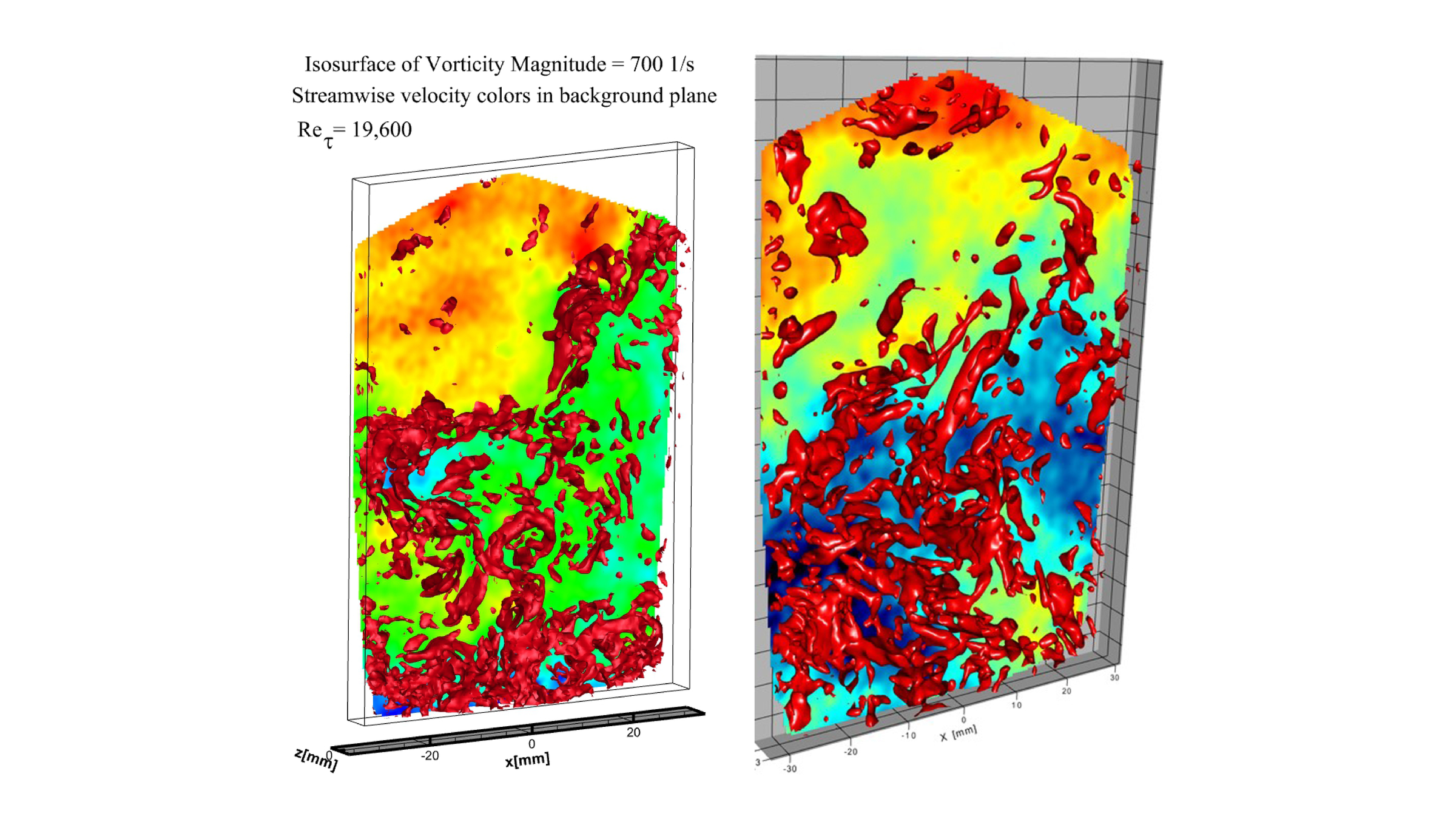
We report on Tomographic PIV measurements in the CICLoPE turbulent pipe facility, that is managed by the University of Bologna in Italy. Using frame-straddling and 4200 image-pairs/s, we obtain time-resolved measurements of the velocity field in a range of narrow volumes, at different distances from the wall, over the Reynolds number range Reτ from 4,500 to 45,000. Each measurement volume is about 6 mm thick in the azimuthal direction, while the streamwise-radial extent varies, between 37 × 27 mm to 84 × 125 mm. We use smoke-particle seeding to obtain Tomo-PIV measurements, with a vector pitch of ∼ 430 µm. Our focus is on the statistics and structure of the vorticity fields, which is validated against published multi-probe hot-wire results acquired in the same facility. The root-meansquare of the fluctuating components of vorticity show good agreement. For these large values of Reτ , the pdfs of the azimuthal vorticity show a stretched exponential form. These measurements also allow us to extract the alignment of the vorticity vector with the principal directions of the rate-of-strain tensor. In addition we perform stereo-PIV measurements on two radially adjacent areas, extending in the radial direction from 0.02 to 0.65 pipe radii. This allows the study of prevalence of Uniform Momentum Zones (UMZ) and the internal intermittency.