Turbulent Kinetic Energy Analysis Of Coherent Structures In The Near Field Of Constant/Variable Density Jet Flows
F. Patiño, L. Voivenel, L. Danaila, E. Varea
Normandie Univ., UNIROUEN, INSA Rouen, CNRS, CORIA, 76000 Rouen, France
DOI:
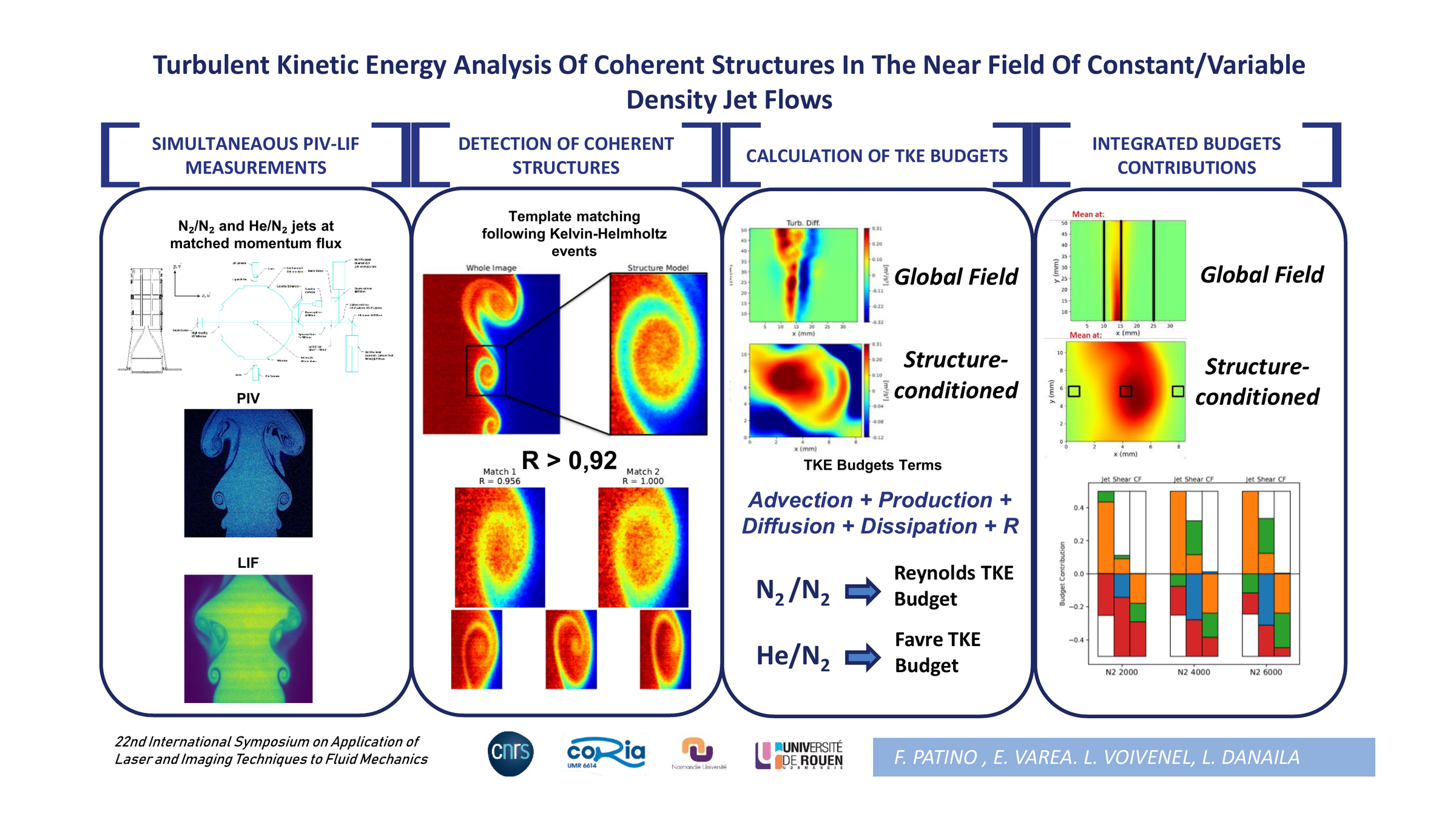
Turbulent round jets exhibit strong intermittency in their shear layers, where localized events govern mixing and energy transfer. Conventional global (whole field) averaging provides robust mean trends, but it can obscure the dynamics of individual events because coherent motions vary in position, orientation and intensity across realizations. In this study we analyse turbulence in the frame of coherent structures: repeatable features that organize local transport over finite spatial regions. Coherent structures are detected by template matching on instantaneous PLIF scalar fields using a correlation criterion, and synchronized PIV fields are extracted at the same locations. Each detection is converted into a fixed size window aligned with the structure, enabling ensemble statistics in a local reference frame that can be compared directly with global averages. Two configurations are considered: a constant density round jet (N2/N2) and a variable density round jet (He/N2) issuing into the same nitrogen coflow. Energetics are quantified using an axisymmetric turbulent kinetic energy (TKE) budget in cylindrical coordinates under statistically stationary, low-Mach-number conditions. Reynolds averages are used for the N2/N2 jet, while Favre averages are used for the He/N2 jet to account for density fluctuations. The evaluated terms are mean flow advection, shear production including anisotropy contributions, radial and axial turbulent transport in divergence form, and dissipation estimated with a two-dimensional locally axisymmetric surrogate. Pressure diffusion, unresolved azimuthal transport and remaining measurement/processing imbalance are grouped into a residual. The results show that structure conditioning sharpens dissipation and production into thin sheets and compact hot spots that are smeared in global averages. Advection and turbulent diffusion, which appear as broad patterns in the laboratory frame, become localized neighboring positive/negative lobes inside the structure frame, revealing event-wise redistribution across and along the turbulent/non-turbulent interface. Increasing Reynolds number intensifies all budget terms, while variable density amplifies asymmetry and enhances the relative importance of transport terms in the helium jet. Normalized local budget bars confirm that the negative side is dominated mainly by dissipation, whereas the positive activity is carried by advection and, depending on position and configuration, by turbulent diffusion or the pressure-diffusion/residual contribution. The structure-conditioned framework therefore separates dynamic structures from background turbulence and provides a compact view of how coherent shear layer events redistribute turbulent kinetic energy in constant and variable density jets.