Experimental investigation of turbulent flow over bluff-body geometries using high-speed PIV
G. Guggilla, M. Stelter, F. Beyrau
Laboratory of Technical Thermodynamics, Otto-von-Guericke-Universität Magdeburg, 39106, Germany
DOI:
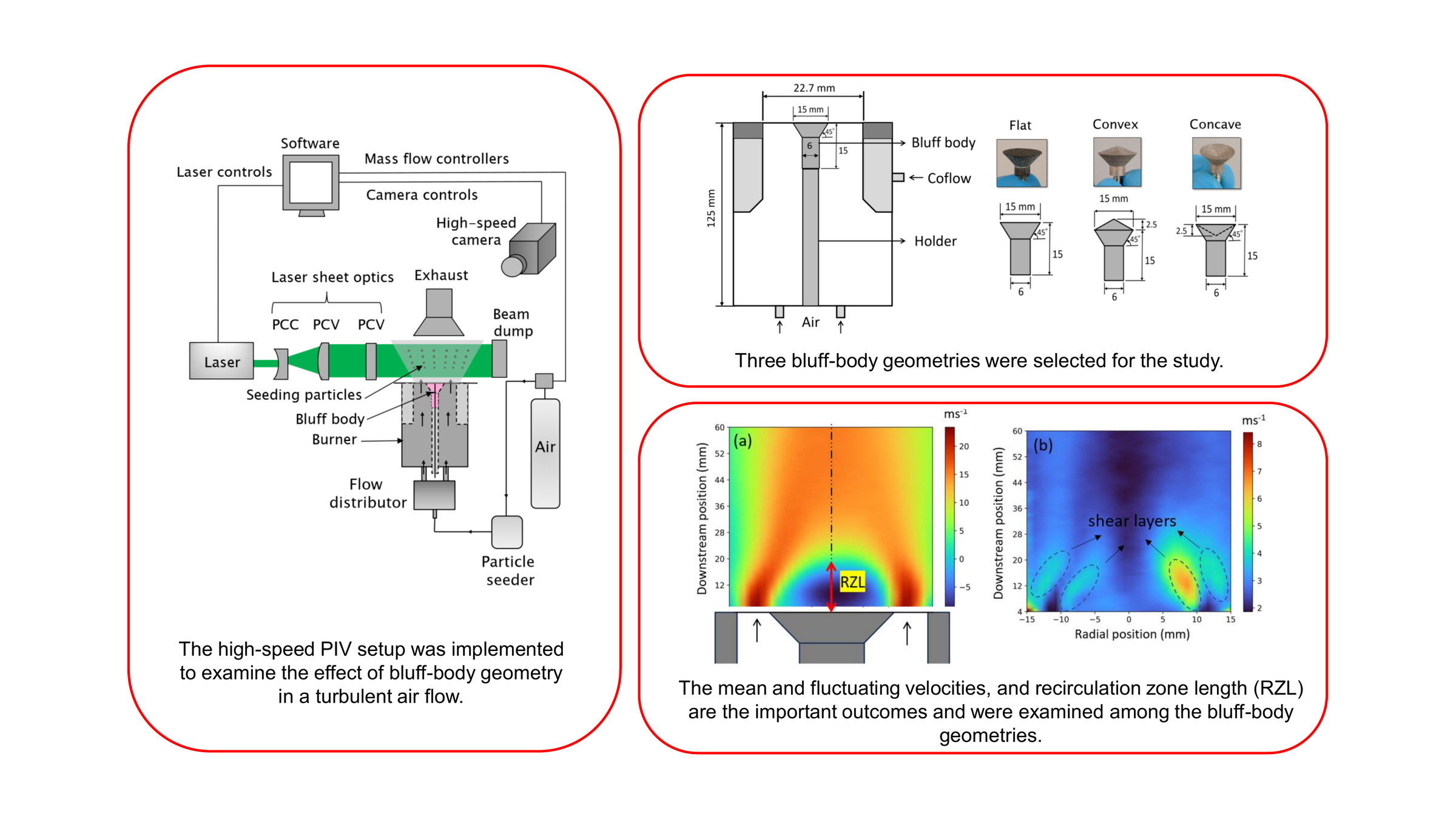
Bluff-body-induced turbulent flows are widely used in engineering, most notably for stabilizing flames in combustion systems. This study focuses on the aerodynamic behavior of such flows under non-reactive conditions, forming a critical baseline for future investigations involving ammonia–hydrogen combustion. Three bluff body geometries, namely flat, convex, and concave geometries were investigated using high-speed Particle Image Velocimetry (PIV) under identical operating conditions with a mean annular velocity of 18.28 ms−1 and a corresponding Reynolds number of approximately 18240. From the PIV-derived axial velocity fields, three key parameters were extracted: recirculation zone length (RZL), peak annular axial velocity, and peak axial velocity fluctuations. In general, the investigated geometries exhibited similar flow characteristics. However, the concave bluff body produced the longest and most coherent recirculation zone, whereas the convex configuration resulted in the shortest. These cold-flow measurements provide a detailed aerodynamic baseline for interpreting flame stabilization, mixing behavior, and wake characteristics in future reactive flow studies with ammonia–hydrogen blends.