Construction and Instrumentation of a Closed Loop Facility for PIV Measurements Inside Rib-roughened Pipes
I.L. Mercado, S. Ruck
Thermal and Fluid Dynamics System Design, Karlsruhe Institute of Technology, Germany
DOI:
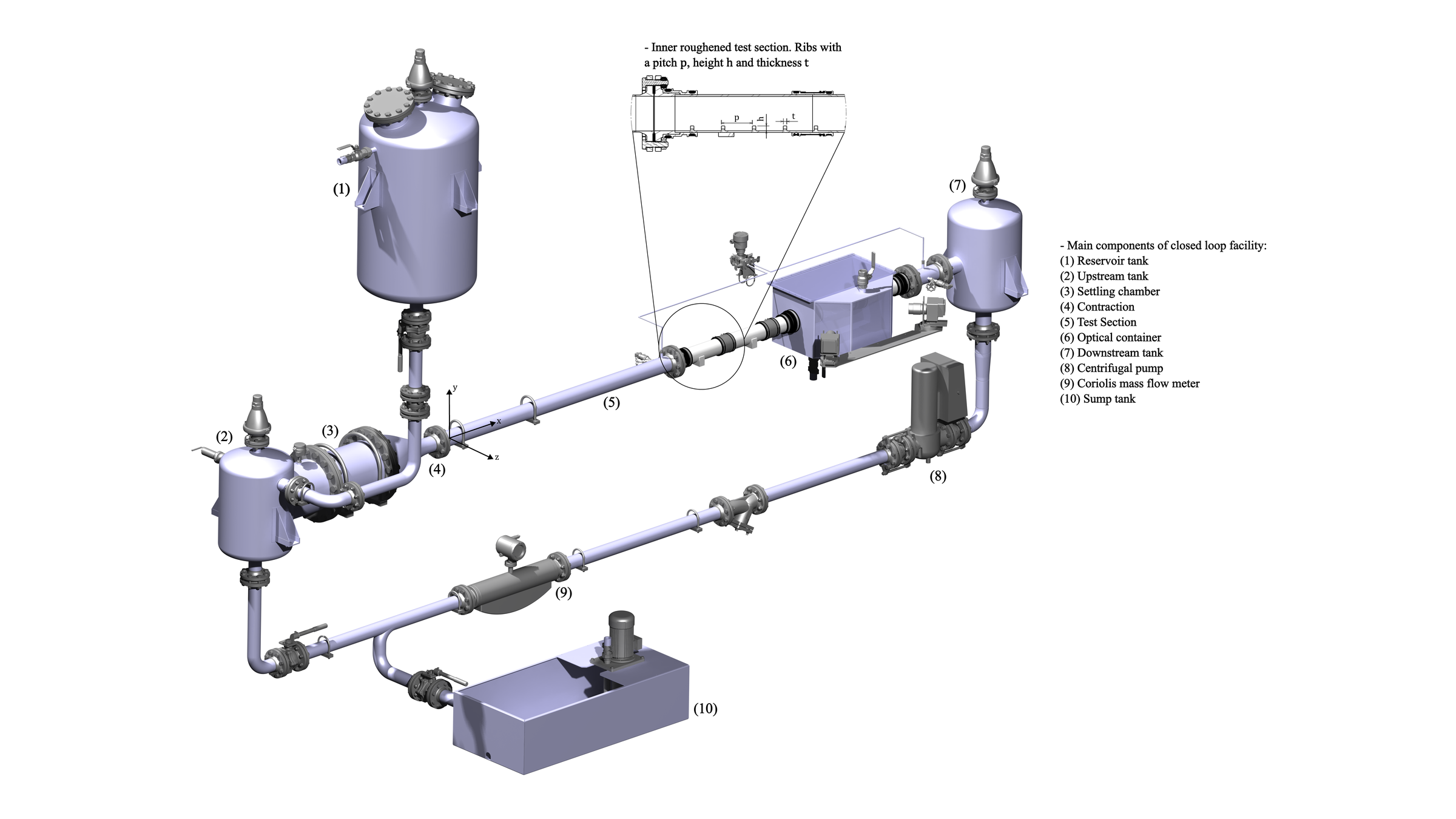
Efficient thermal control is critical for maintaining the reliability, performance and operational longevity of high-temperature engineering systems. Rib turbulators acting as turbulence promoters disturbing the thermal and hydrodynamic boundary layers have played a significant role in heat engineering and highly thermally loaded applications. Heat transfer enhancement and flow field turbulence produced by attached or detached ribs applied as surface-structures in array or single configurations inside rectangular ducts have been extensively studied. Less research however has been conducted for rib-roughened circular cross-sectional channels, where CFD simulations lack experimental work. Therefore, a new facility is being constructed at the Institute of Neutron Physics and Reactor Technology (INR), Karlsruhe Institute of Technology (KIT). The facility is a closed loop with the purpose of studying the turbulent flow field in a rib-roughened circular test section capable of operating in a Reynolds number (based on the test section’s inner diameter and the bulk velocity) range of 5000 < Re < 50000, and for understanding the effects of varying rib geometrical parameters on the turbulent mixing, secondary flow field and velocity gradients. The test section is a 4.23 m long pipe with a section made out of polypropylene and transparent borosilicate glass to allow for Particle Image Velocimetry (PIV) velocity measurements, where the method of Refractive Index Matching has been applied to overcome the optical aberration caused by the curvature of the test section’s glass wall.