Time-resolved PIV and IPCT measurements of fluid-structure interaction of the flap seal of a two-element high-lift wing
J. Lemarechal(1), R. Geisler(1), F. Philipp(1), P. Godbersen(1), C. Jente(2), J. Wagner(1), T. Kirmse(1), A. Schröder(1,3)
1: German Aerospace Center (DLR), Institute of Aerodynamics and Flow Technology, Göttingen, Germany
2: German Aerospace Center (DLR), Institute of Aerodynamics and Flow Technology, Braunschweig, Germany
3: Institute of Transport Technology, Brandenburg University of Technology, Cottbus, Germany
DOI:
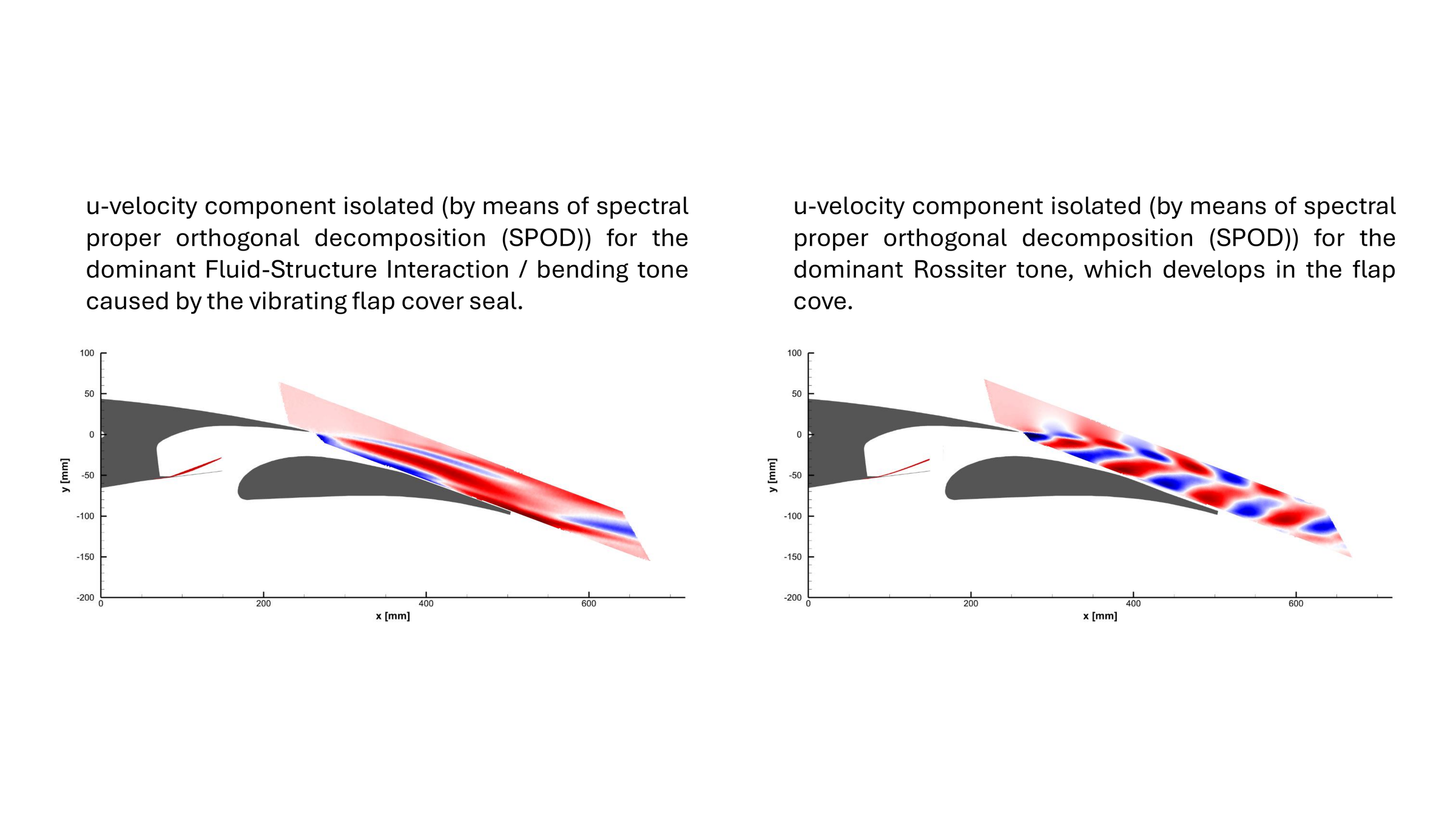
The fluid-structure acoustic interaction of a flap cover seal on a two-element 2D wing is investigated. Time-resolved velocity measurements were conducted at the inflow into the flap cove just downstream of the flap cover seal and on the suction side of the flap starting just upstream of the trailing edge of the main wing and including the outlet of the flap cove by means of Particle Image Velocimetry (PIV). Furthermore, simultaneously time-resolved deformation measurements of the seal were performed by means of Image Pattern Correlation Technique (IPCT). The Fluid-Structure Acoustic Interaction of the seal is investigated for two conditions of the seal: bent seal and excited seal. This variation was achieved by changing the thickness of the seal and adapting the flow speed. The periodic motion of the seal was self-excited by the FSI. The spectral analysis of the seal deformation successfully identified several characteristic frequencies in the range of 60 Hz to 400 Hz for the excited seal, which result in tones due to the fluid-structure interaction of the seal. These frequencies are also found in the spectral analysis of the flow field. For the seal that is only bent by the aerodynamic forces only a single weak FSI mode is detected in the deformation and velocity results. These deformation and velocity data for the FSI tones enhance the findings of the acoustic measurements conducted during the same test campaign. For the bent seal characteristic frequencies are found in the spectral analysis with large amplitudes at 576 Hz and its first harmonic. These modes are caused by the Rossiter effect show significantly different dispersion compared to the FSI tones.