Model-scale PIV measurements of the far-wake of a frigate
M. Birvalski(1), R. Hallmann(2), J. Bosschers(2)
1: Performance at Sea dept., MARIN, The Netherlands
2: Defence dept., MARIN, The Netherlands
DOI:
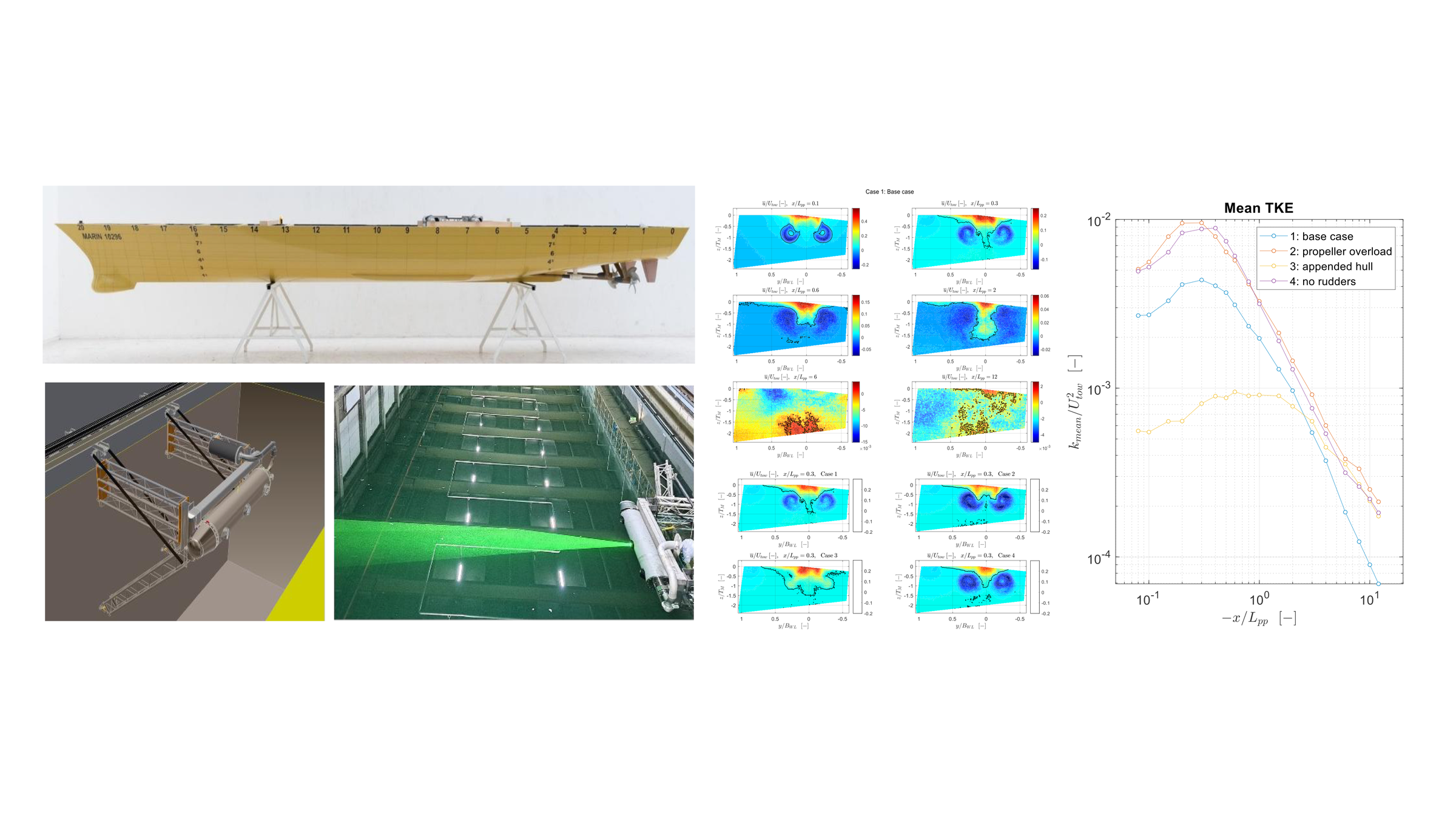
This study presents model-scale stereo Particle Image Velocimetry (PIV) measurements of the wake evolution behind a twin-screw frigate hull, with particular emphasis on the far-wake region. While previous studies have predominantly focused on near-wake flow structures, far-wake measurements remain scarce despite their importance for understanding wake persistence, signature characteristics, and propulsor–wake interaction. To address this gap, a basin-fixed stereo-PIV system was deployed in MARIN’s deepwater towing tank to acquire velocity fields up to 12 ship lengths downstream of the model. A generic frigate model was tested under four configurations. The PIV system measured three velocity components in a large transverse plane, enabling detailed characterization of the flow. Measurements were performed at a towing speed of 1.9 m/s, with multiple runs and varying PIV inter-frame times to resolve both high-velocity gradients near the propellers as well as lower velocities in the far wake. The results demonstrate a clear evolution of the wake structure from a highly organized propeller-dominated flow near the stern to a more diffuse and dissipated flow in the far wake. Powered cases exhibit strong recirculating and rotational features that decay with distance, while the unpowered configuration shows a symmetric, forward-directed flow without pronounced vortex structures. Differences between configurations highlight the influence of propeller loading and rudder presence on wake topology and turbulence levels. Although measurement uncertainties are influenced by calibration limitations, seeding quality, and a finite number of runs, the mean velocity fields are considered sufficiently reliable for comparison with CFD. The dataset provides valuable insight into the far-wake behavior of naval vessels and serves as a benchmark for future validation studies and hydrodynamic design optimization.