Physics-Informed Interpolation of Velocity and Pressure Gradient from Particle Tracking Velocimetry Data
Y. Zhang(1), M. Moaven(1), D. Carter(1), L. Cattafesta(1), P. Schmid(2)
1: Department of Mechanical, Materials, and Aerospace Engineering, Illinois Institute of Technology, US
2: Physical Science and Engineering Division, King Abdullah University of Science and Technology, Saudi Arabia
DOI:
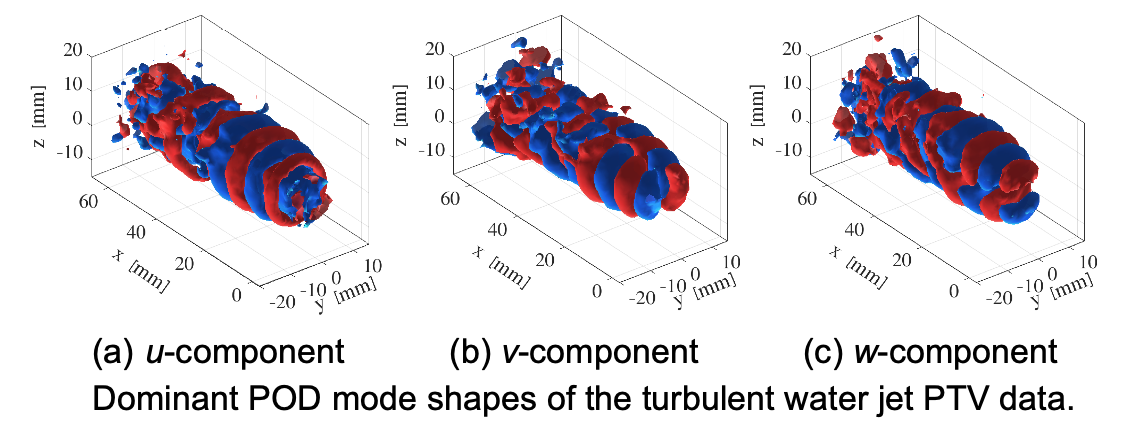
We introduce a physics-informed local interpolation framework for reconstructing velocity, velocity gradients, velocity Hessians, and pressure gradients on structured grids from particle-based measurements, including particle positions, velocities, and material accelerations. The method embeds the incompressible Navier-Stokes momentum equation as linear constraints within a weighted least-squares formulation, ensuring physically consistent estimates from irregularly distributed Particle Tracking Velocimetry (PTV) data. A divergence-free continuity constraint is enforced exactly via a KKT system, and robust estimation using the Huber loss with iteratively reweighted least squares provides resilience to spurious particle tracks. Validation using direct numerical simulation data from the Johns Hopkins University turbulence database demonstrates accurate reconstruction of velocity fields, vorticity, and pressure gradients, including coherent structures and near-wall features, under both noise-free and noise-corrupted conditions. Experimental results from time-resolved PTV of a turbulent water jet further demonstrate the method's robustness, enabling high-fidelity 3D flow-field reconstruction and subsequent modal analysis via Proper Orthogonal Decomposition, with strong agreement against VIC# at substantially lower per-snapshot computational cost. The approach provides a unified and computationally efficient tool for mapping Lagrangian particle measurements to Eulerian grid representations suitable for gradient-based diagnostics and pressure reconstruction.