LPT and DA challenges anytime: an open web portal for continuous development and benchmarking of algorithms
B. Leclaire(1), P. Cornic(2), F. Champagnat(2), P. Godbersen(3), S. Grauer(4), A.G. Guerra(5), D. Schanz(3), A. Schröder(3,6), A. Sciacchitano(5)
1: DAAA, ONERA, Institut Polytechnique de Paris, 92190, Meudon, France
2: DTIS, ONERA, Université Paris-Saclay, 91120, Palaiseau, France
3. Inst. of Aerodynamics and Flow Technology, German Aerospace Center (DLR), Germany
4: Dept. of Mechanical Engineering, Pennsylvania State University, United States
5. Faculty of Aerospace Engineering, Delft University of Technology, Delft, The Netherlands
6. Chair of Image Based Measurement Techniques, Brandenburg University of Technology (BTU), Cottbus, Germany
DOI:
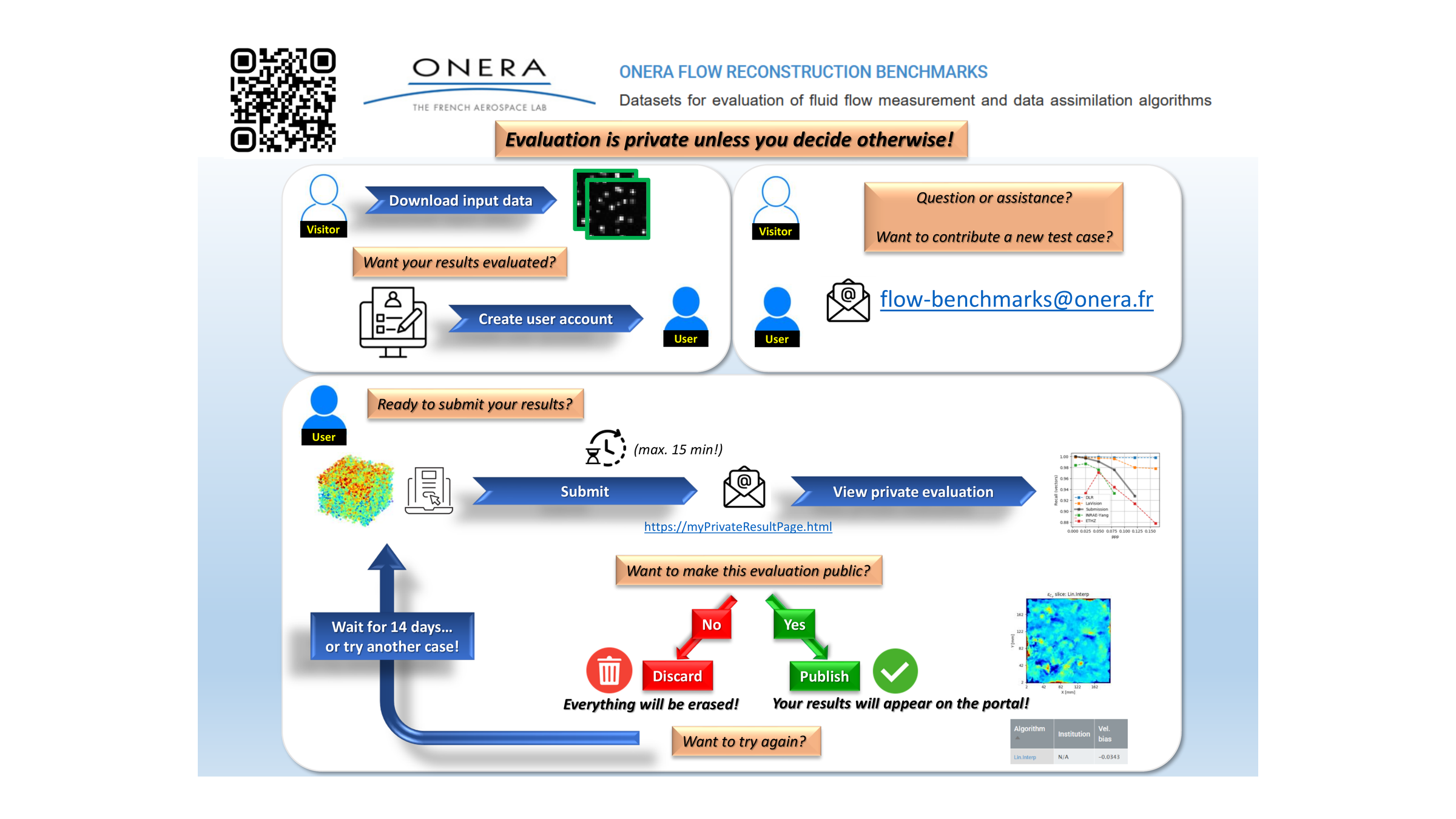
We introduce a web portal (https://www.onera.fr/flow-benchmarks) dedicated to automatic evaluation and benchmarking of Lagrangian Particle Tracking (LPT) and related Data Assimilation (DA) algorithms. Following a first prototype launched in 2022, with a single dataset of two-pulse LPT (i.e. Particle Tracking Velocimetry - PTV), the portal has been substantially completed, and now hosts all test cases of the First and Second LPT and DA Challenges. This constitutes a total of twelve different datasets, including an experimental one, addressing a large range of physical situations and parameters of influence. While datasets are free to download to everyone, the portal offers the possibility to a registered user to upload their result and automatically receive its evaluation in a fully private way. The user can then freely choose between publishing the evaluated result, or discarding it. The portal is thus intended as a development tool for the community, to help algorithmic development, as well as a way of providing easier access to established benchmarks, which otherwise are only accessible when challenges are organized. It can also be used to organize challenges themselves, as has been the case for the second LPT and DA challenges, whose results are presented in companion communications (Sciacchitano et al. 2026, Schröder et al. 2026). The objective of the present communication is to provide all necessary information to researchers interested by the portal, by presenting the datasets and describing in a practical way how to get an evaluation and possibly publish it. A second objective is to encourage the community to propose new datasets to be integrated to the portal, in order to keep it up-to-date with research progress.