Validation of methods for estimating velocity gradients from highly resolved particle tracking data
D. Certini(1), M. Schiødt(1,2), H. Abitan(1), P. Suchde(3,4), T. Buchwald(5), A. Schröder(5,6), C.M. Velte(1)
1: Dept. of Civil and Mechanical Engineering, Technical University of Denmark, Denmark
2: DHI, Hørsholm, Denmark
3: Department of Engineering, University of Luxembourg, Luxembourg
4: Fraunhofer Institute for Industrial Mathematics (ITWM), Germany
5: Image-Based Measurement Technology, Brandenburg University of Technology Cottbus-Senftenberg, Germany
6: Deutsches Zentrum für Luft- und Raumfahrt - DLR, Germany
DOI:
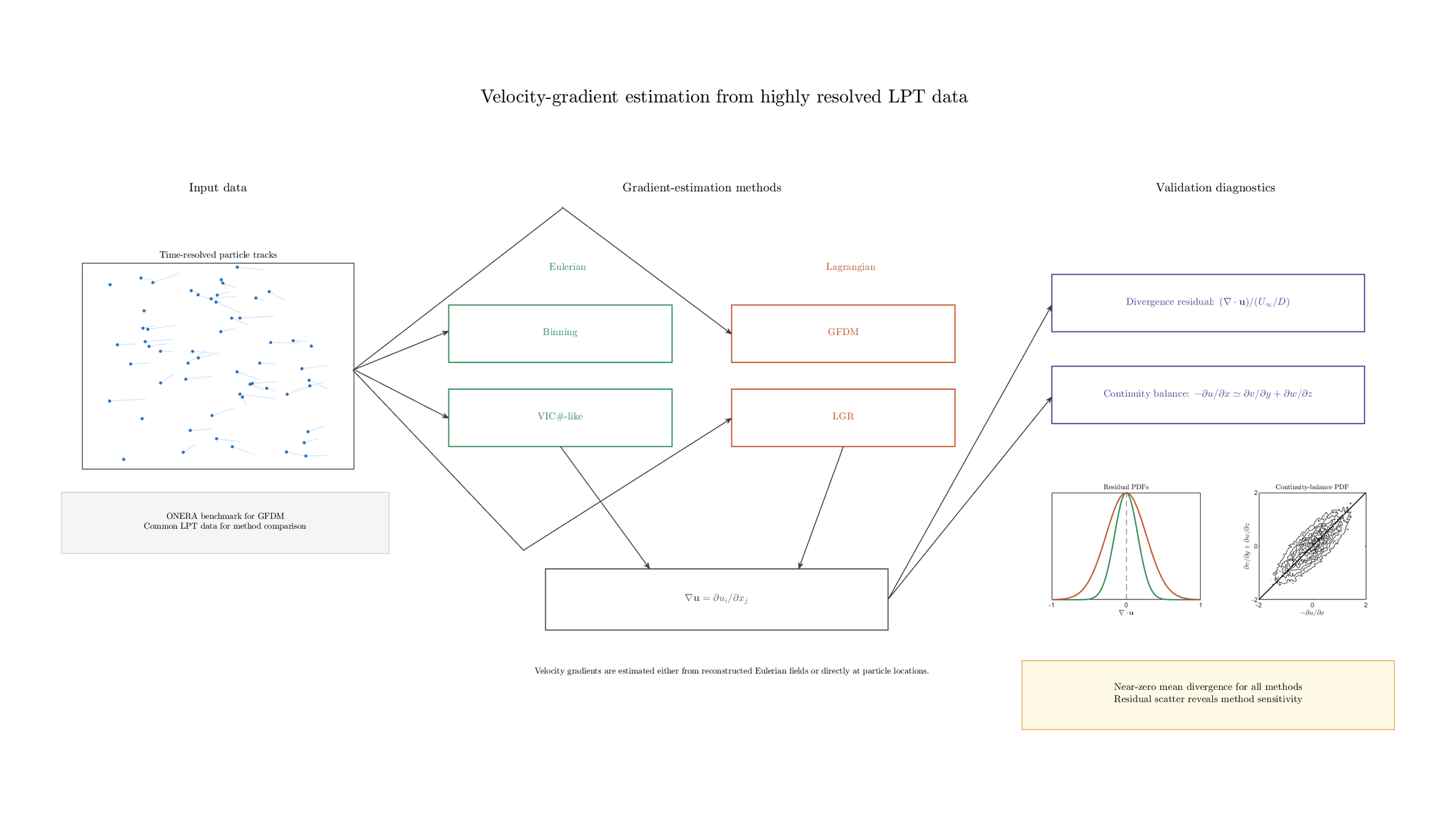
Velocity gradient estimation is of significant interest for turbulence theory and model development, in particular for characterising the fine scale structure of turbulence. However, correlation based methods have not generally demonstrated sufficient accuracy for measuring small scale gradients. Estimating gradients directly from particle velocity tracks can potentially provide the full velocity gradient tensor with the fidelity required for theoretical developments, since the maximum attainable information from the particle position measurements is retained. In this setting, at least for highly resolved data, measurement noise may instead become the limiting factor, as spatial differentiation amplifies noise increasingly with derivative order, even when the underlying tracks have relatively low noise levels. Herein, we compare different methods for estimating spatial velocity gradients from particle tracking data and evaluate their usability using a dataset with well defined ground truth and negligible noise levels. We compare two Eulerian reconstruction methods, Binning and VIC#-like, with two Lagrangian methods, Lagrangian Gradient Regression and the Generalized Finite Difference Method. Importantly, Binning performs local Eulerian averaging regression without enforcing continuity, whereas the VIC#-like reconstruction includes a divergence free constraint through its physics based data assimilation formulation. Therefore, the divergence residual is interpreted as an a posteriori consistency diagnostic for Binning and the Lagrangian methods, but as a constrained quantity for VIC#-like. The results show that all methods recover physically consistent gradient fields with near zero mean divergence, but differ markedly in residual scatter, sensitivity to processing parameters, and computational scalability. • GFDM was independently assessed using the ONERA time-resolved benchmark, while the four method com parison was performed using divergence and continuity balance diagnostics; • Binning, VIC#-like reconstruction, GFDM, and LGR all produced divergence residual distributions centred near zero, indicating statistically consistent incompressible gradient fields; • The main differences between methods were found in the scatter of the divergence residuals and in the com pactness of the continuity balance joint PDFs; • GFDM is a promising Lagrangian gradient estimator for highly resolved particle-tracking data. Its accuracy depends strongly on support size, particle density, stencil conditioning, and boundary treatment; • Despite the absence of systematic parameter optimisation, the ONERA GFDM benchmark showed improved velocity and vorticity error trends with increasing particle density, supporting further optimisation in the planned future work.