The VICCTOR algorithm for 3D Particle Tracking Velocimetry
J. Le Bris(1), M. Hebey, B. Leclaire, P. Cornic, F. Champagnat(3), A. Cheminet(1)
1: SPEC, CEA, CNRS, Université ParisSaclay, CEA Saclay, GifSurYvette, France;
2: ONERA, Department of Aerodynamics, Aeroelasticity and Acoustics, Meudon, France;
3: ONERA, Department of Information Processing and Modelization, Palaiseau, France
DOI:
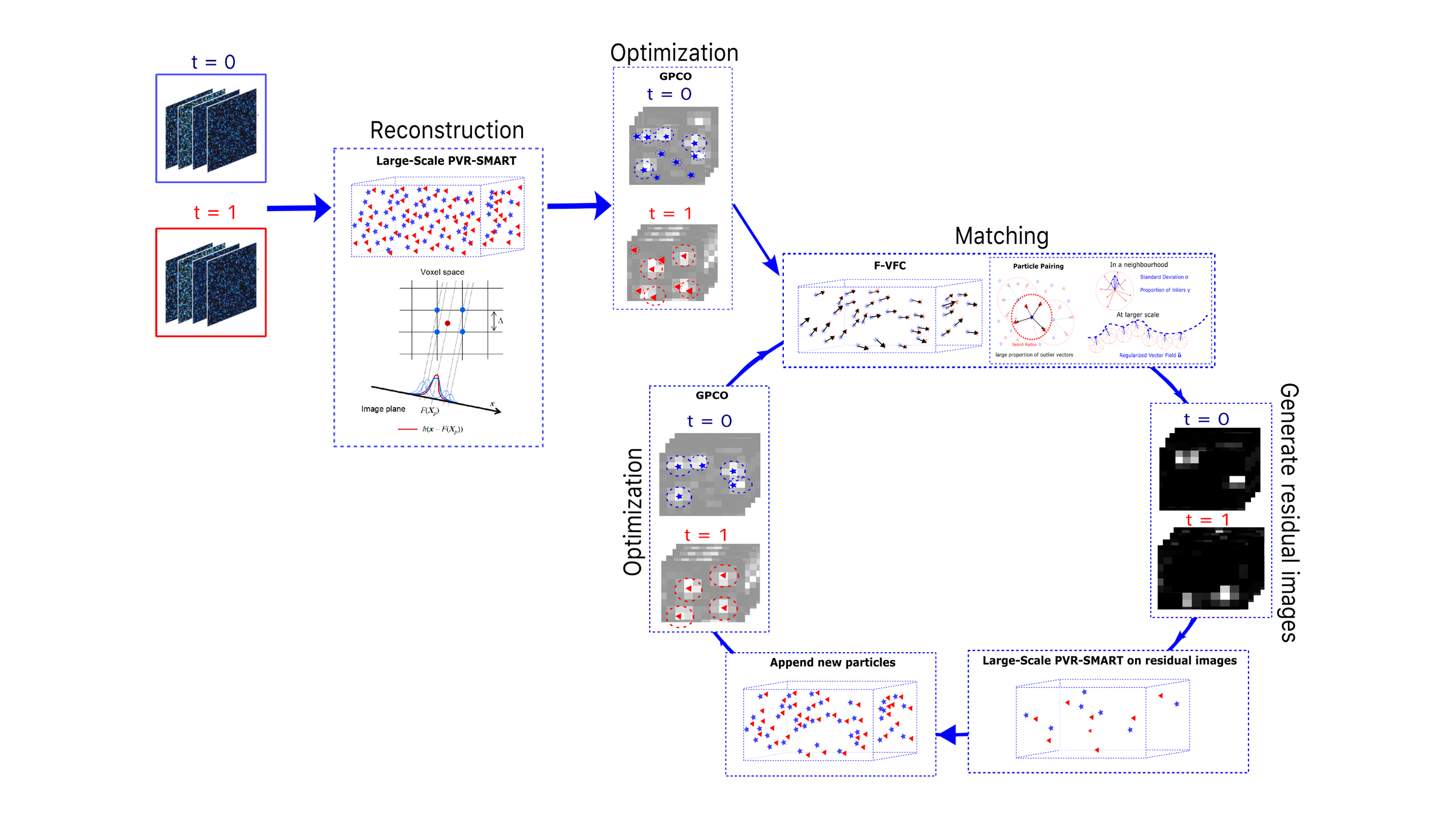
We present a new two-pulse particle tracking velocimetry (PTV) algorithm that builds on recent advances in 3D particle reconstruction, matching, and position optimization. Unlike most current state-of-the-art approaches, such as Godbersen et al. (2024), which progressively recover the true particles while retaining a small proportion of outliers, we take a symmetric approach, operating at a high rate of detected real particles, and focusing most of our algorithmic choices on the gradual elimination of outliers. Initial estimates of particle positions at both time points are obtained by introducing a modified, large-scale version of the particle volume reconstruction (PVR) from Champagnat et al. (2014), which discretizes the image formation process onto a fine voxel grid. The positions and intensities are then globally optimized using an L-BFGS optimizer. Once the particles with low reconstructed intensity are discarded, the resulting clouds cover a large portion of the actual particles, although they contain a significant amount of noise (i.e., ghost particles). The F-VFC algorithm presented in Le Bris et al. (2025) is then used to match the particles from the two time steps while removing a large number of ghost particles from the particle clouds. This entire process is repeated on the residual images until convergence.