Main Results of the Second LPT Challenge
A. Sciacchitano(1), P. Godbersen(2), S. Grauer(3), A.G. Guerra(1), B. Leclaire(4), D. Schanz(2), A. Schröder(2,5)
1: Faculty of Aerospace Engineering, Delft University of Technology, Delft, The Netherlands
2: Inst. of Aerodynamics and Flow Technology, German Aerospace Center (DLR), Germany
3: Dept. of Mechanical Engineering, Pennsylvania State University, United States
4: DAAA, ONERA, Institut Polytechnique de Paris, 92190, Meudon, France
5: Chair of Image Based Measurement Techniques, Brandenburg University of Technology (BTU), Cottbus, Germany
DOI:
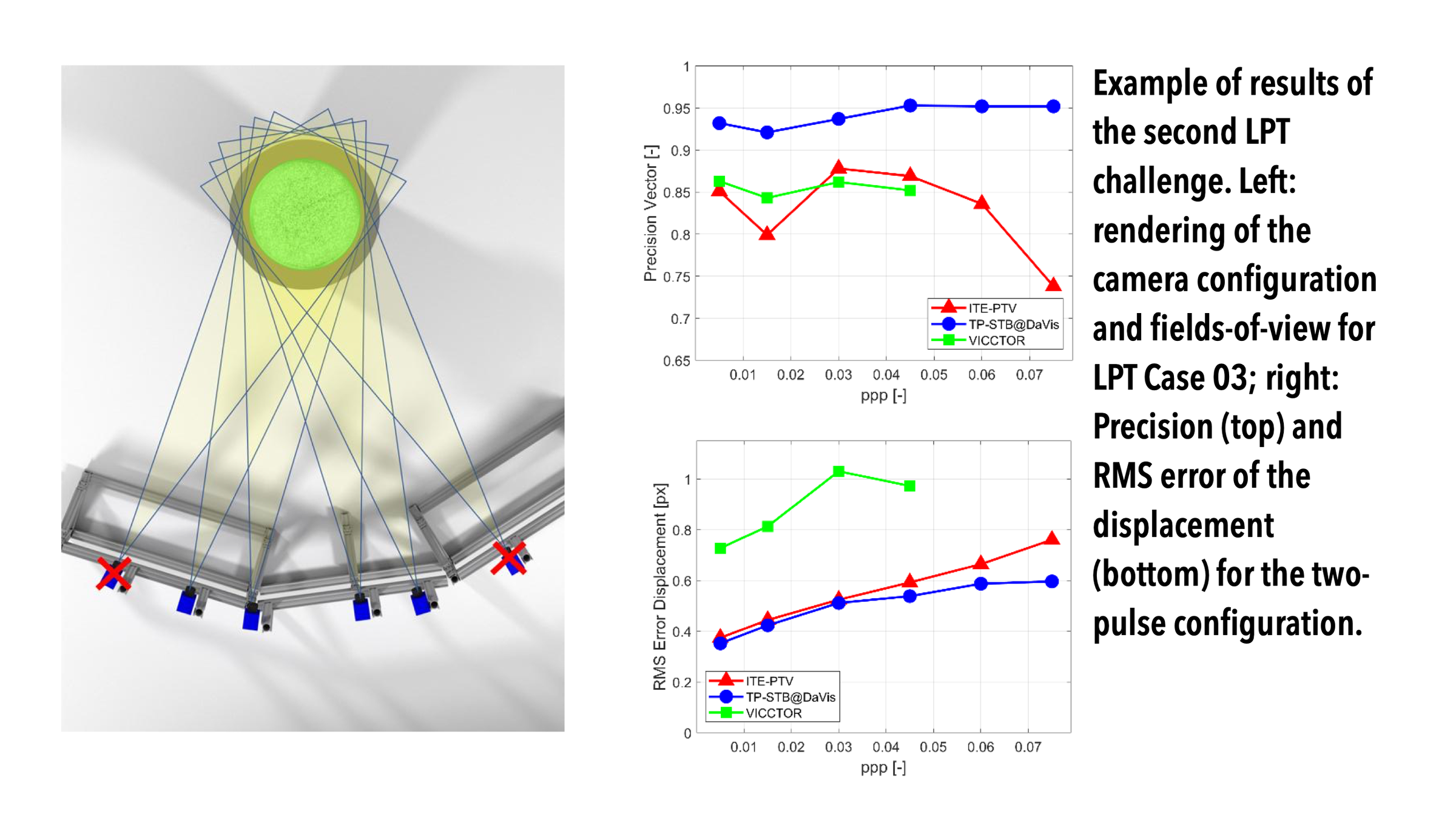
This work presents the main results of the second Lagrangian Particle Tracking (LPT) challenge, jointly organized by TU Delft, DLR, ONERA, and Penn State. We consider three test cases, namely two synthetic (a turbulent channel flow and the near-wall flow in the wake of cylindrical obstacles) and one experimental (Rayleigh-Bénard convection). Both timeresolved (for all test cases) and two-pulse (for the latter two test cases) image acquisitions are addressed. The effects of relevant parameters of the experimental setup are analysed, including the particle image density (ppp), the time separation between image recordings, the presence or absence of Mie scattering and the fraction of the total measurement volume imaged by all the cameras. The results are presented in terms of precision and recall of the particle reconstruction, as well as errors of the reconstructed particle positions, velocities and accelerations. The input data is freely available for download in the online portal (https://onera-flow-benchmarks.fr/en/Second_LPT_DA_Challenge), where the automatic evaluation of the submitted results is conducted.