Skin Friction topology on generic objects by 3D particle tracking
L.A. Hendriksen, A. Sciacchitano, F. Scarano
Dept. of Aerospace Engineering, Delft University of Technology, The Netherlands
DOI:
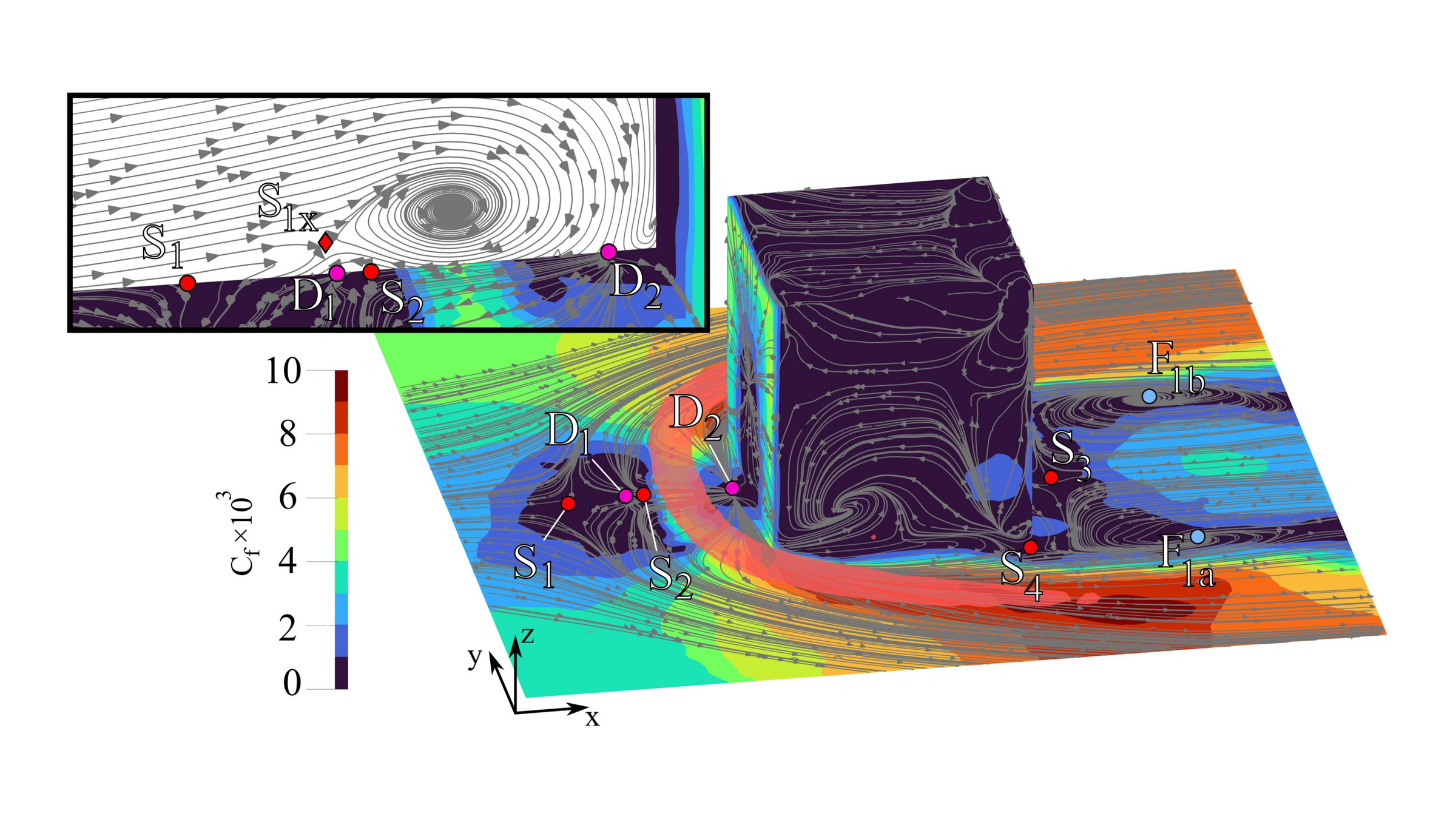
A framework is presented to determine time-averaged skin friction and surface-flow topology around three-dimensional objects using Lagrangian particle-tracking. The approach introduces a surface-compliant discretization and binning, whereby velocity samples are collected following the local orientation of the object surface. A nonlinear fit is introduced that models the near-wall velocity distribution using the arctangent function. The latter is shown to accommodate for the nonlinearity of near-wall velocity profile, while remaining robust to the near-surface data gap caused by a void of tracers. Comparison with flat surface-adapted binning (coins) indicates that the arctangent model most frequently yields physically consistent wall-shear estimates than linear or quadratic fits, owing to its ability to represent the steep velocity profile and complying with an external asymptote. Time-averaged data from 3D particle-tracking of the flow around a wall-mounted cube at is examined. The resulting skin-friction distribution reproduces the canonical features of the cube flow, including the horseshoe vortex, sharp separation at the leading-edges, arch vortex and the associated critical points. The proposed framework provides a generalized methodology for skin friction analysis around objects of arbitrary shape based on large-scale 3D particle tracking experiments.