On-Site Full-Scale Race Car Aerodynamics Analysis Using The Ring-Of-Fire
P.I.A. Garcia, A.G. Guerra, A. Sciacchitano
Delft University of Technology, Delft, The Netherlands
DOI:
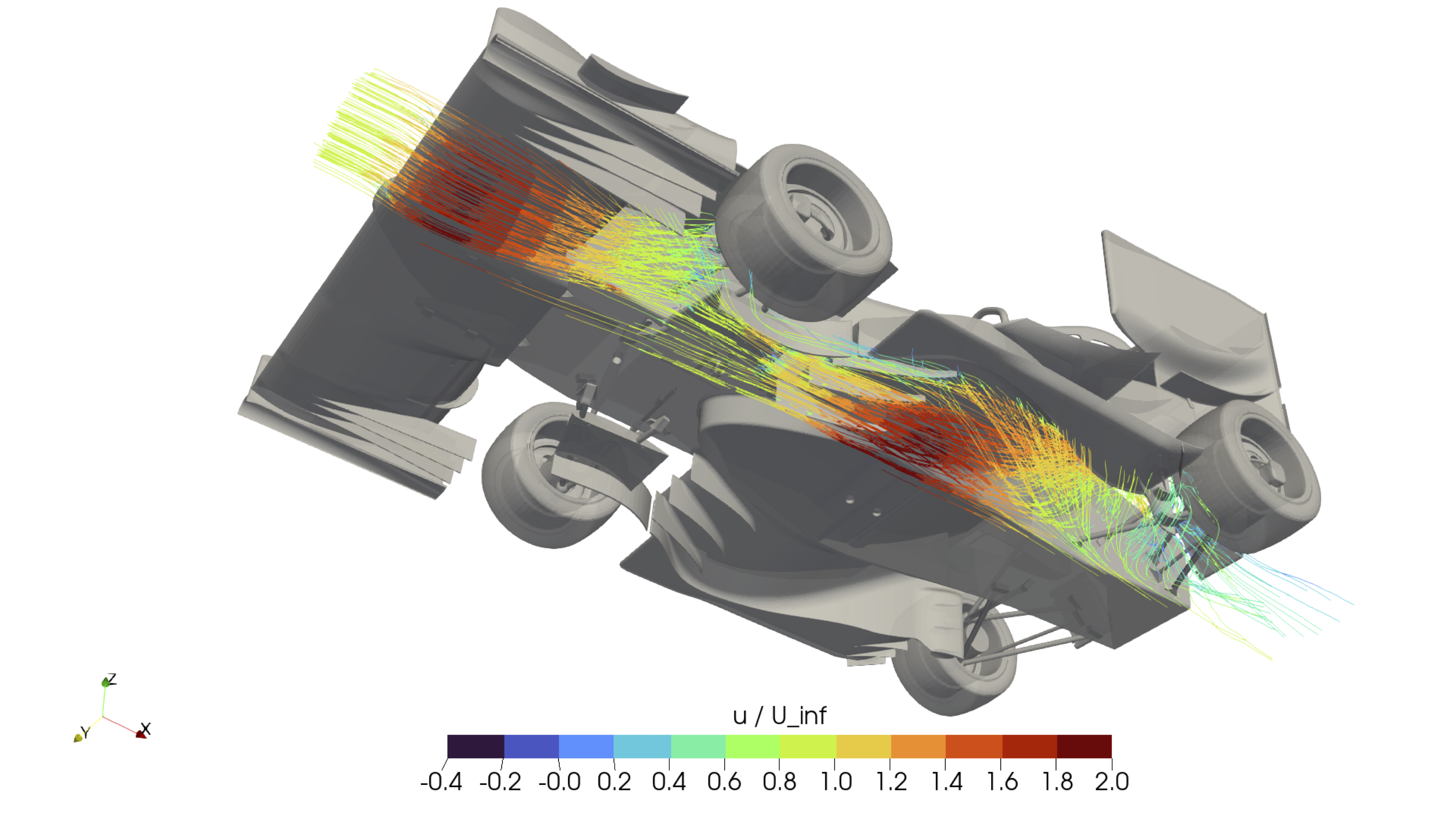
This study explores the use of the Ring of Fire methodology for investigating the aerodynamics of a Formula Student race car using Lagrangian Particle Tracking (LPT) via the Shake-the-Box (STB) algorithm. Applied to the DUT24 developed by Formula Student Team Delft, the approach enables high-resolution reconstruction of the three-dimensional velocity and pressure fields around a fully aerodynamically equipped vehicle. The investigation focuses on two critical regions: the underbody diffuser and the wakes shed by the rotating tyres. Experiments were conducted on a 60 m test track at approximately 12 m/s using Helium-Filled Soap Bubbles as neutrally buoyant tracers. For the diffuser study, three cameras and four LEDs were installed in a ditch beneath the car, defining a measurement volume of 300 × 400 × 350 mm, while tyre-wake measurements employed a lateral camera and LED arrangement, yielding a 400 × 800 × 450 mm volume. Results reveal strong acceleration beneath the front wing and diffuser, with peak velocities exceeding twice the free-stream (\sfrac{u}{U_\infty}> 2.2). Diffuser strakes generate coherent streamwise vortices promoting flow attachment and downforce, while tyre wakes are highly three-dimensional and unsteady, with larger wakes from the front tyres, strongly influenced by the front-wing. Pressure reconstruction using omnidirectional integration reproduced physically consistent distributions, capturing diffuser recovery and tyre-wake stagnation zones. Comparison with CFD demonstrates good agreement in overall flow topology and acceleration, while differences were observed in vortex strength and tyre rotation effects. Overall, the full-scale application of the Ring of Fire methodology successfully captures the complex aerodynamics, including high-velocity underbody flows, coherent diffuser vortices, and unsteady tyre wakes, establishing its effectiveness as a robust tool for on-site vehicle aerodynamic investigation.