Vortical Wake Flow of Wetting Disk-Like Drops in Flat Channels
S. Luckey, F. Hermann, S. Burgmann, U. Janoske
Chair of Fluid Mechanics, The University Wuppertal, Germany
DOI:
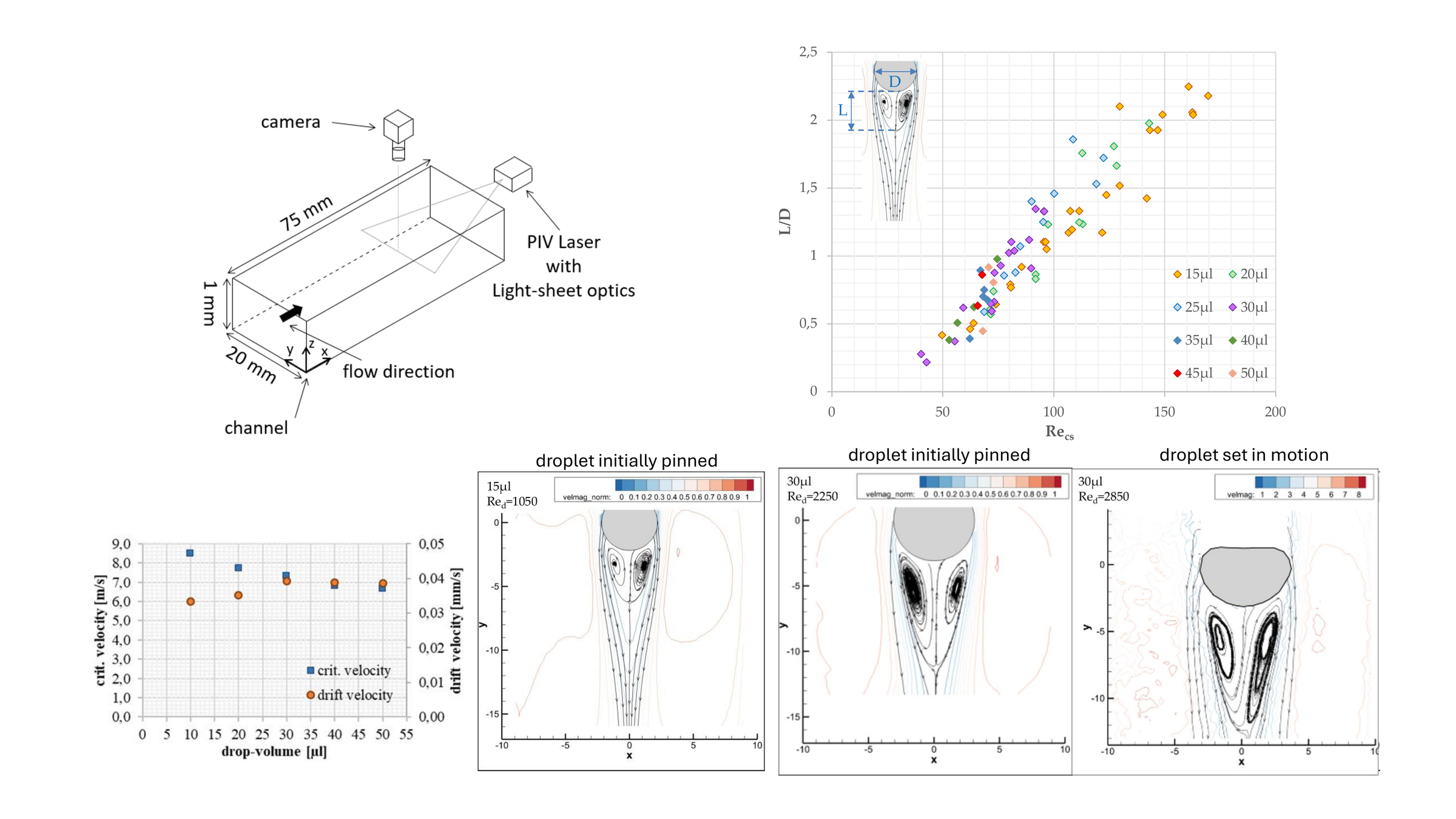
The control of droplet movement, especially its initiation, plays a major role in many areas of chemical and pharmaceutical technology. In many applications, droplets wet both confining walls, resulting in the motion of a wetting liquid through a parallel-wall gap channel. Of particular interest here are the necessary conditions that lead to the onset of movement of the droplet under the influence of external forces (here flow). However, there is almost no information in the literature on the conditions for a droplet in flow, wetting on both sides, which go beyond the configuration of a Hele-Shaw cell in terms of dimensions, viscosity ratios and flow velocities, i.e. for the combination of Reynolds number Re and gap width ratio ≥ 1. Droplets of different sizes (10 - 50 μl) are applied to a test rig in a slit channel with a cross-section of 1 x 20 mm², wetting both the upper and lower (glass) walls, i.e. initially forming a round liquid disk. The gas flow in the channel is successively increased and the drop deformation, the detachment of the drop and the further drop movement are analyzed using shadowgraphy. In addition, measurements are carried out using particle image velocimetry (PIV) to obtain information about the flow field of the adhering and moving droplet. The initially round, disc-shaped droplet is deformed with increasing gas velocity in such a way that it is flattened on the upstream side. The downstream, almost semi-circular contact line does not move. If the flow velocity is increased further, the deformed droplet finally detaches, whereby it initially takes on a kidney-shaped form for larger droplets. The subsequent droplet movement downstream also occurs if the flow velocity does not increase any further. The critical gas velocity (for droplet detachment) decreases with the droplet volume, like sessile droplets in a flow channel. The almost constant drift velocity of the droplet is four orders of magnitude lower than the gas velocity. For larger droplets, a bursting of the droplet is observed during further movement. In the droplet wake, a recirculation zone with two counter-rotating vortices develops in both the adhesion and movement phases. The length of the recirculation zone increases with increasing Reynolds number. The results also show that the vortex pair can exhibit fluctuations in the wake in such a way that one of the two vortices temporarily dominates and displaces the other, resembling a vortex oscillation pattern.