3D Measurements of Transient Microscopic Phenomena using a Double-Helix Point Spread Function and a Convolutional Neural Network
B. Yang(1), Y. Zhang(1,4,5), C. Bilsing(1), M. Helbig(3), H. Köhler(3), J. Czarske(1,2), L. Büttner(1,2)
1: Laboratory for Measurement and Sensor Systems Techniques (MST), TUD Dresden University of Technology, 01062 Dresden, Germany
2: BIOLAS, Laboratory of Measurement and Sensor System Techniques, 01069 Dresden, Germany
3: Chair of Processing Machines/Processing Technology, Faculty of Mechanical Science and Engineering, TUD Dresden University of Technology, 01062 Dresden, Germany
4: Institute of Optics and Electronics, Chinese Academy of Sciences, Chengdu, Sichuan 610209, China
5: University of Chinese Academy of Sciences, Beijing 100049, China
DOI:
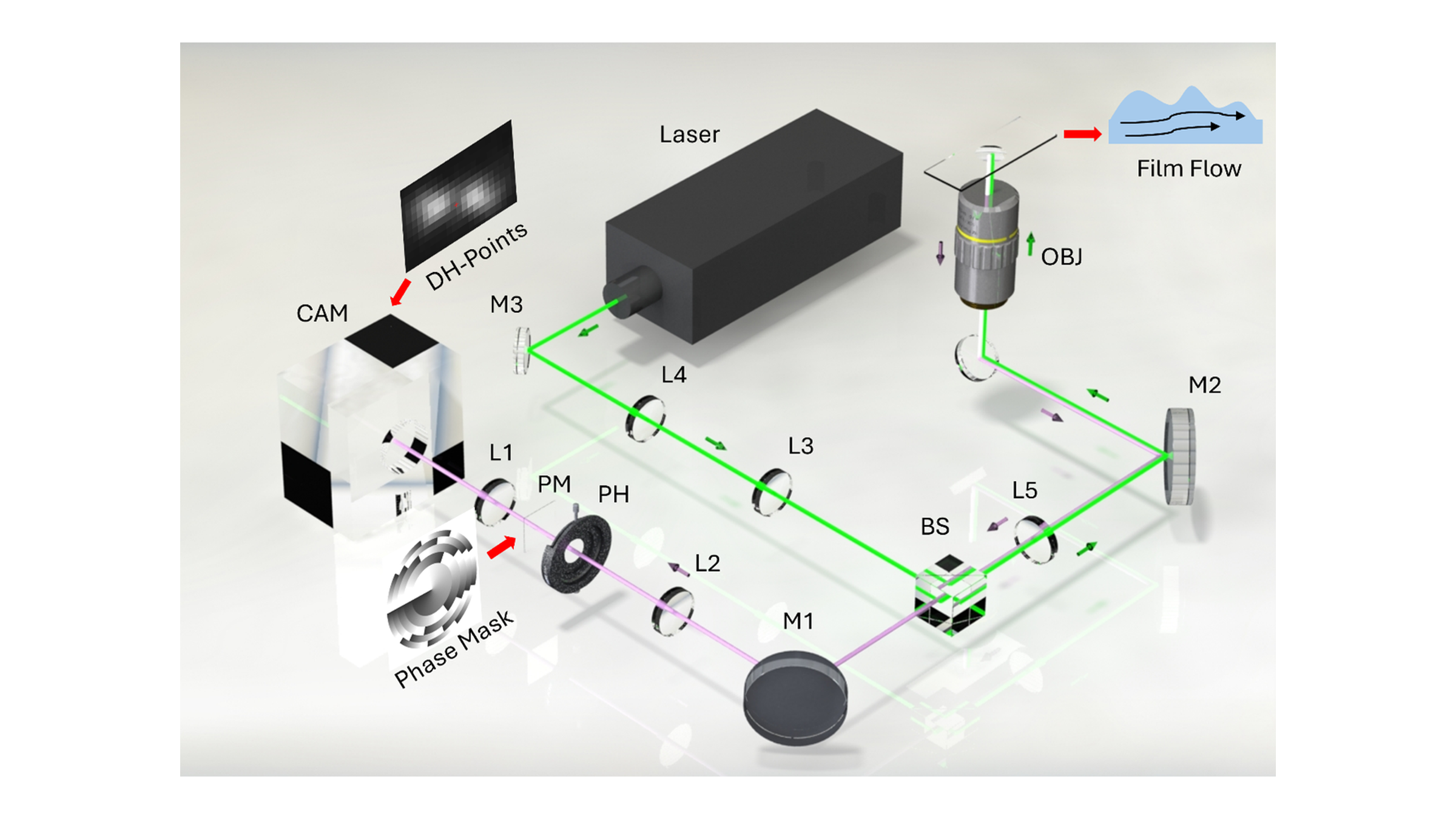
Microscopic multiphase flows play an important role in a wide variety of applications such as process engineering (e. g. separation, transport or cleaning processes) and biomedicine (e. g. mixing in droplet microreactors). We investigate film flows occurring at spray cleaning as well as the spray-induced cleaning of soil from surfaces by applying High-Speed 3D Fluorescence Localization Microscopy based on the Double-Helix Point Spread Function with frame rates up to 1 kHz. This single-camera technique offers a high axial measurement range of approximately 1000 μm at a comparatively low localization uncertainty. We present measured near-wall film flow profiles with a resolution of up to 7.3 μm that were measured with a single access and subsequently determine the wall-shear stress. In order to investigate the transient process of spray-induced soil removal from a surface, we apply convolutional neural networks to locate particles at high particle densities and low signal-to-noise ratios. The results pave the way for 3D measurements of transient microscopic processes with a high temporal and spatial resolution.