Influence Of Electrodes Inclination On Bubble Dynamics In Saline Water Electrolysis
Jeferson Diehl De Oliveira (1), Elaine Maria Cardoso (2), José Eduardo Socha Pereira (3), Reinaldo Rodrigues De Souza (3), Ana Sofia Moita (3)
1. UNESP, Sao Joao Da Boa Vista, Brazil
2. UNESP, São João Da Boa Vista, Brazil
3. Universidade de Lisboa, Lisboa, Portugal
DOI:
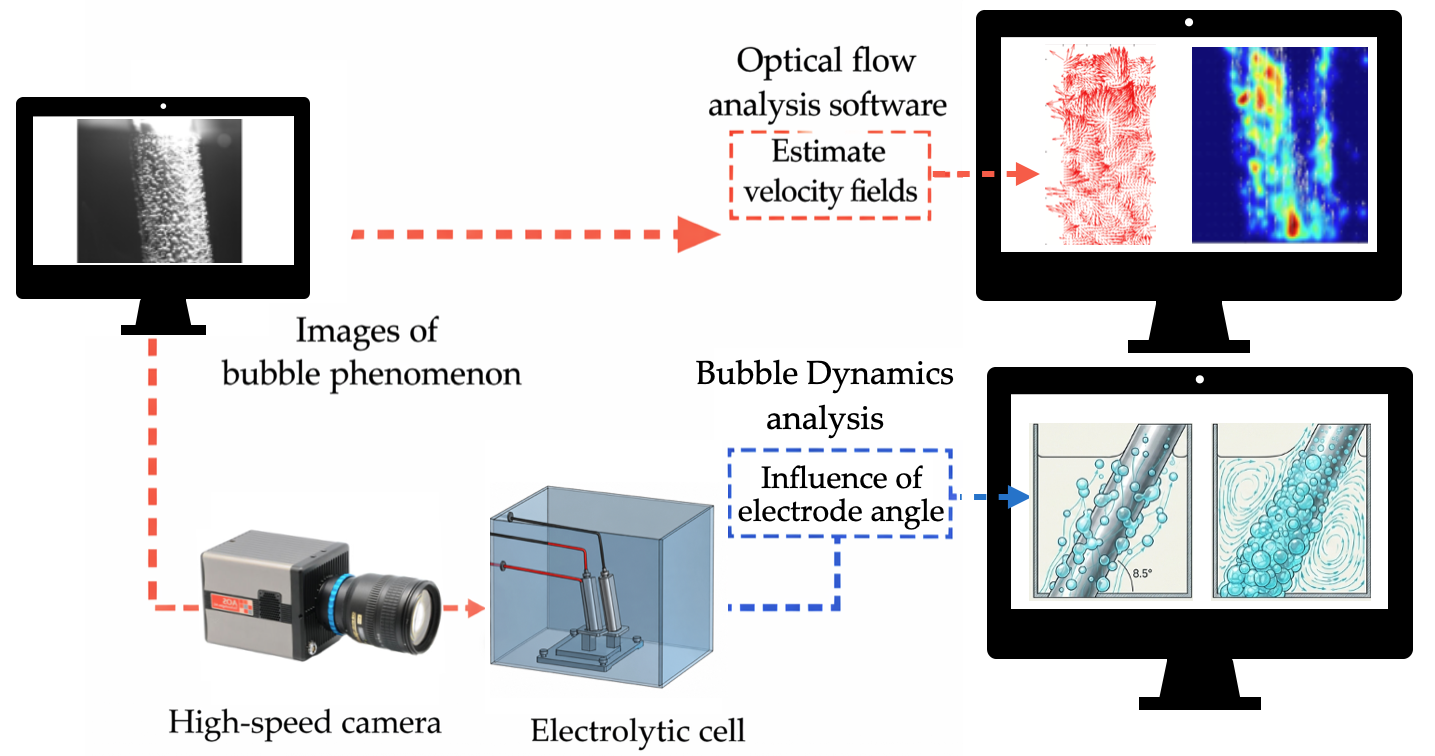
This experimental study investigates hydrogen bubble dynamics during saline water electrolysis under inclined-electrode conditions, with emphasis on bubble-induced flow fields at different current densities. Stainless-steel cylindrical electrodes inclined at 8.5° relative to the vertical were employed, with a length of 75.6 mm and internal and external diameters of 13.7 mm and 15.9 mm, respectively. These dimensions are representative of configurations commonly found in industrial electrolysis systems. Experiments were conducted over a current density range from 1.82 to 45.56 A/m², covering typical operating conditions for low-current-density electrolysis. High-speed imaging was used to capture the formation, growth, detachment, and transport of hydrogen bubbles along the cathode surface. Image acquisition was performed at a spatial resolution of 55 μm per pixel and a frame rate of 500 frames per second, enabling detailed visualization of buoyancy-driven bubble motion and the associated flow structures. Velocity and vorticity fields were obtained using optical flow techniques applied to the recorded image sequences. The results reveal pronounced modifications in the local hydrodynamics due to bubble-induced convection, with significant variations in velocity and vorticity fields as the current density increased. Enhanced turbulence levels were observed, particularly in regions near the cathode, where hydrogen generation rates were highest. The inclined configuration promoted asymmetric bubble trajectories and altered near-wall flow structures, while the vertical component of velocity exhibited limited variation along the electrode depth. Furthermore, hydrogen production, bubble-driven convection, and convective mass transfer increased nonlinearly with current density. These findings highlight the complex coupling between electrochemical reactions, electrode orientation, bubble dynamics, and hydrodynamic transport. The results provide new insights into hydrogen bubble transport mechanisms in inclined-electrode electrolyzers, contributing to the optimization of electrolysis systems for improved efficiency and sustainable hydrogen production.