Sphere Entry and Trajectory in a Pool: Influence of Wettability
P.K. Billa(1), C. Tropea(2), P.S. Mahapatra(1)
1: Multiscale Multiphysics Group (MMG), Department of Mechanical Engineering, Indian Institute of Technology Madras, 600036, India
2: Institute for Fluid Mechanics and Aerodynamics, Technical University of Darmstadt, 64287, Germany
DOI:
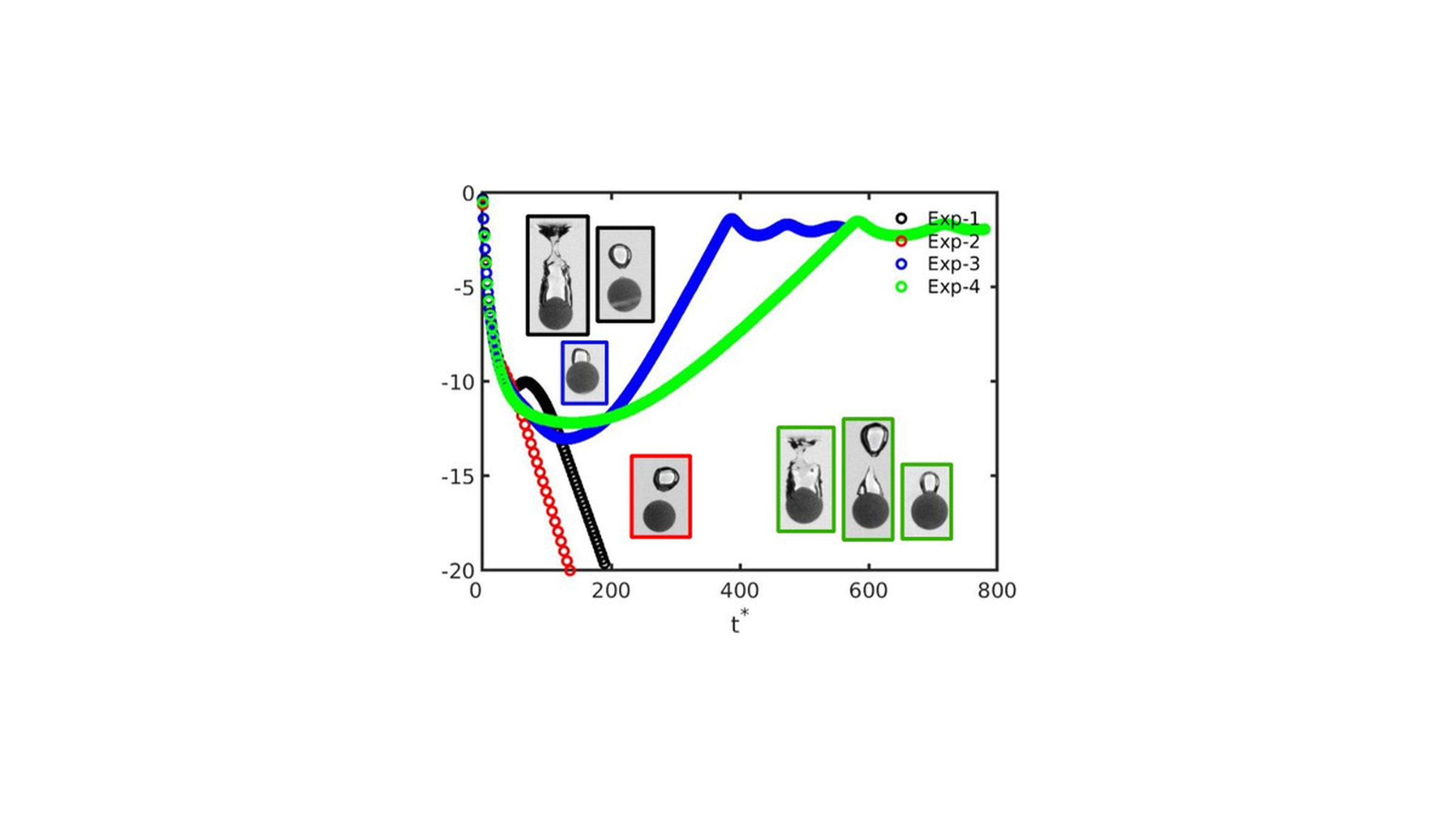
In this study, we investigate the influence of hydrophilic, hydrophobic and superhydrophobic (SH) surfaces on spheres entering a deep pool, in particular cavity formation and secondary pinch-offs. Experiments were conducted using spheres of various densities and diameters, released from controlled heights to systematically vary the impact Froude number. High-speed imaging and image-based volume reconstruction were employed to quantify the instantaneous displaced volume, as well as the sphere trajectory, velocity and acceleration. Results show that hydrophilic spheres do not entrain air cavities, but exhibit high fluctuating lift forces, leading to trajectories deviating largely from pure downward vertical motion. As the sphere becomes increasing hydrophobic, a stable air layer that sustains encapsulated cavities or thin air bubbles forms upon entry, leading to either terminally descending or ascending trajectories depending on the displaced volume. The scaling of the displaced volume is based on the first cavity collapse, whereas a regime map, constructed from the final cavity collapse, captures the transition between terminally descending and ascending trajectories.