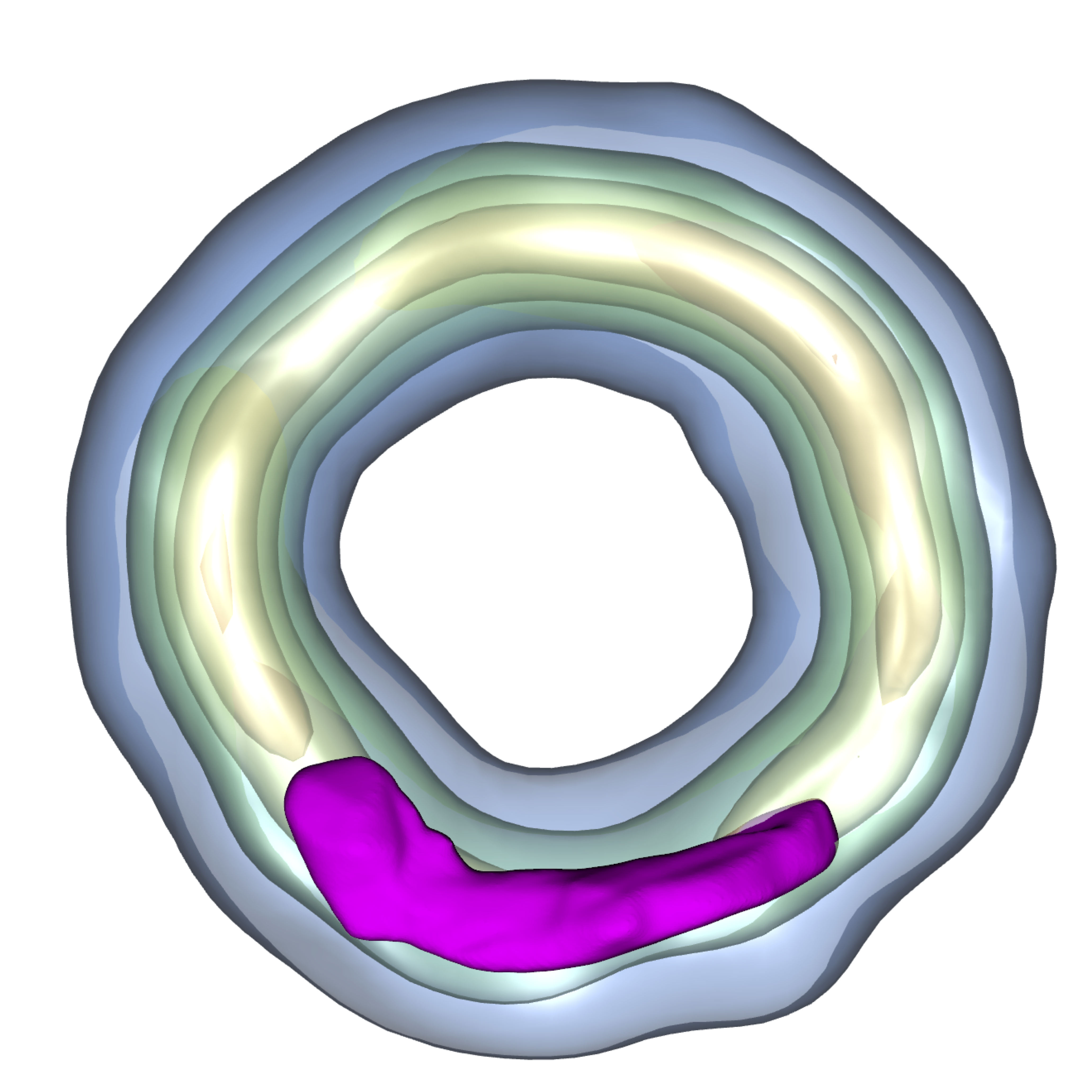
3D experiments on the interaction of a vortex ring with a rising bubble
C. Estepa-Cantero(1,2), M. Lorite-Díez(1,2), J. Ruiz-Rus(2,3), S. Cazin(4), R. Bolaños-Jiménez(2,3), P. Ern(4), C. Martínez-Bazán(1,2)
1: Dpto. de Mecánica de Estructuras e Ingeniería Hidráulica, Universidad de Granada, Granada, Spain.
2: Instituto interuniversitario de Investigación del Sistema Tierra en Andalucía (IISTA), Universidades de Granada, Jaén and Córdoba, Spain.
3: Dpto. de Ingeniería Mecánica y Minera, Universidad de Jaén, Jaén, Spain.
4: Institut de Mécanique des Fluides de Toulouse (IMFT), CNRS, Toulouse INP and Université de Toulouse, Toulouse, France.
DOI:
The interaction between turbulent flows and bubbles is a complex phenomenon ubiquitous in both natural and industrial settings. In this work, we experimentally investigate, from a fundamental perspective, the interaction between a rising bubble and a vortex ring in counterflow. Using time-resolved three-dimensional Lagrangian Particle Tracking (4D-LPT) coupled with tomographic shadowgraphy, we obtain simultaneous measurements of the bubble motion and the surrounding liquid flow. This approach enables detailed observation of the bubble dynamics, deformation, and eventual breakup, as well as the associated fluid motion. We examine several flow configurations by varying the vortex circulation and the Weber number while maintaining a comparable vortex-to-bubble size ratio. Based on these measurements, we classify the interaction events into three categories according to their impact on bubble dynamics and vortex stability over time. Our experiments provide the first investigation of the three-dimensional effects of these interactions, which were overlooked in previous studies. The analysed experiments are divided into three cases: Case I corresponds to a weak interaction in which neither the bubble nor the vortex is significantly affected; Case II describes a regime in which the bubble is captured and advected by the vortex, leading to strong vortex distortion due to the presence of the bubble within its core; and Case III involves a stronger vortex capable of capturing the bubble and breaking it into two fragments without significant loss of energy in the vortex core. The analysis of these results provides insight into the bubble breakup process and the mechanisms responsible for the destabilization of the vortex ring.