On the aspect ratio of ellipsoidal bubbles at different viscosities
P. Kováts, K. Zähringer
Laboratory of Fluid Dynamics and Technical Flows, Otto-von-Guericke-Universität Magdeburg, Germany
DOI:
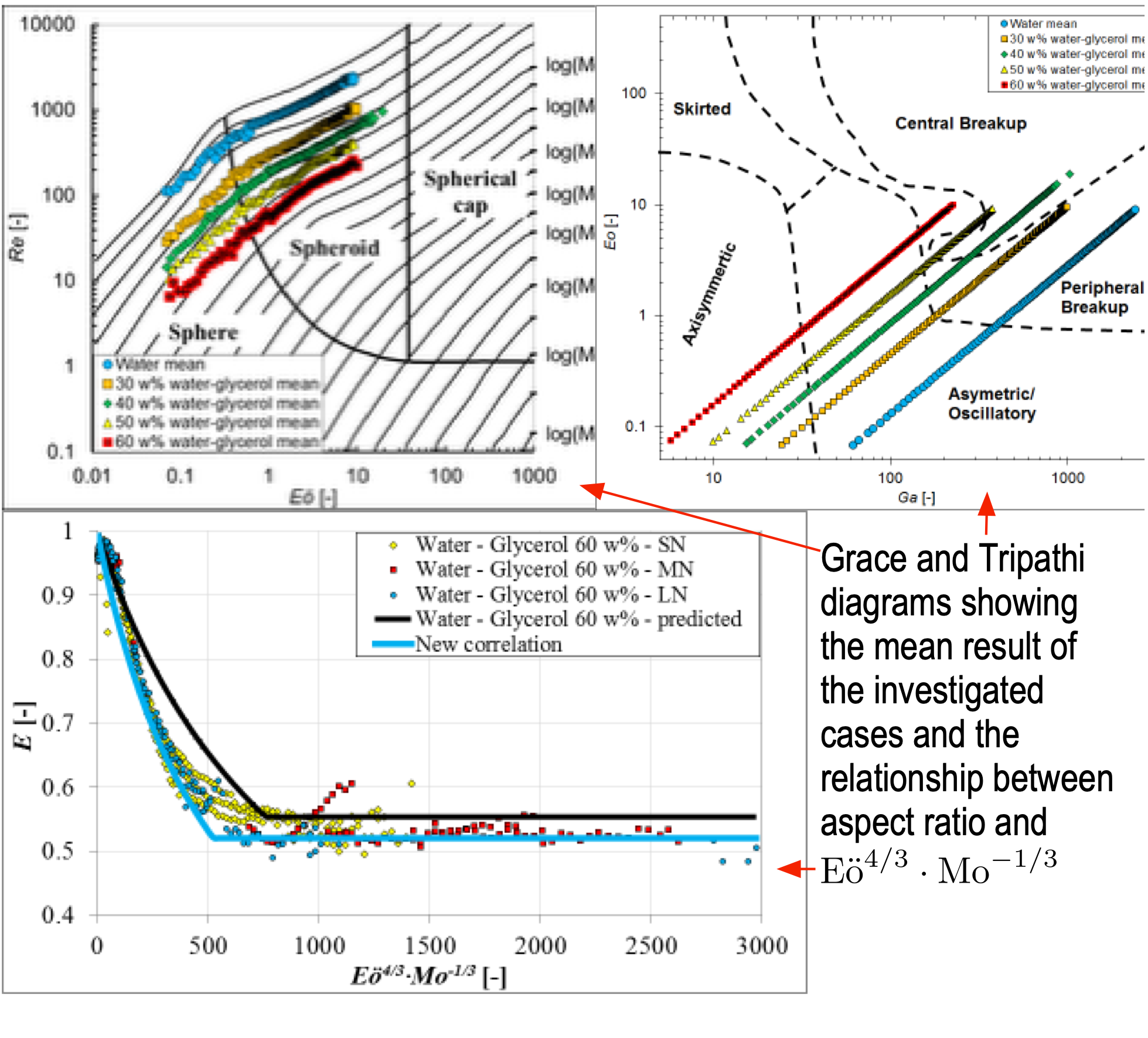
Bubble shape is one of the key parameters governing hydrodynamics, mass transfer, and residence time in bubble column reactors. Accurate prediction of bubble aspect ratio is therefore essential for reactor design, scale-up, and computational fluid dynamics (CFD) simulations. Most available correlations for bubble shape have been developed from single-bubble experiments and may not be directly applicable to bubble swarms encountered in industrial processes. However, experimental data on bubble swarms in liquids of higher viscosity are still limited. In the present study, the aspect ratio of spherical and ellipsoidal bubbles rising in water–glycerol mixtures was investigated experimentally using high-speed shadowgraphy in a laboratory-scale bubble column. Measurements were performed in pure water and in 30, 40, 50, and 60 wt.% glycerol solutions, covering a Morton number range from . Air bubbles were generated using nozzles with different diameters and gas flow rates, resulting in equivalent sphere diameters (ESD) between approximately 0.65 and 8.5 mm. Bubble size, shape, and velocity were extracted from image sequences and statistically processed to obtain mean aspect ratios as a function of bubble diameter with a resolution of 50 µm. The results show a strong dependency of bubble shape on the liquid viscosity. Small bubbles remained nearly spherical, exhibiting aspect ratios close to unity, whereas increasing bubble size led to a rapid transition towards ellipsoidal shapes. Increasing glycerol concentration shifted this transition to larger bubble diameters, indicating a stabilizing effect of viscosity on bubble deformation. For sufficiently large bubbles, the aspect ratio approached a nearly constant value of approximately 0.50–0.55, independent of the investigated liquid. Analysis using Grace and Tripathi regime diagrams confirmed that the measured bubbles were located predominantly within the spherical and spheroidal deformation regimes and that increasing viscosity reduced Reynolds and Galileo numbers while suppressing oscillation and breakup tendencies. The newly acquired data were used to evaluate and refine a previously proposed empirical correlation relating bubble aspect ratio to Eötvös and Morton numbers. The revised correlation provides improved prediction of both, the transition region and the asymptotic aspect-ratio limit. The results contribute to closing an important data gap for bubble swarms in higher-viscosity liquids and provide a basis for improved bubble-shape modelling in multiphase reactor simulations.