Optical Diagnostics for Splash Behavior of Fuel Liquid Film on a Wall with Induction by Airflow
R. Kobayashi, R. Kushida, Y. Zama
Division of Mechanical Science and Technology, Gunma University, Japan
DOI:
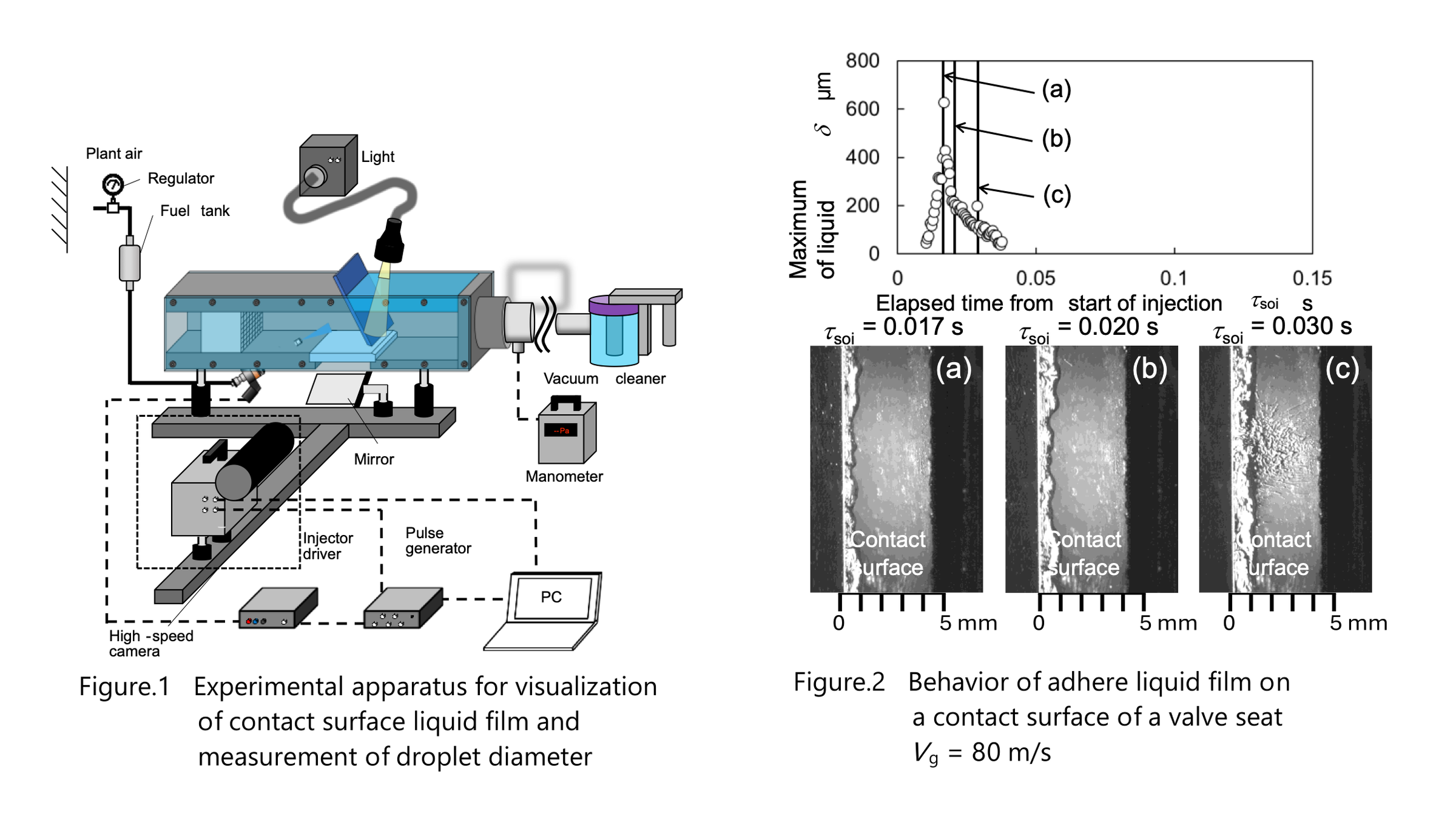
Reducing particulate number (PN) and unburned hydrocarbon (HC) emissions in port fuel injection (PFI) engines is an urgent priority. In these engines, fuel spray impacts the intake valve and forms a liquid film. During the intake stroke, fuel droplets shed from the fuel film is generated and goes into the combustion chamber. There is a possibility that the entry of shed droplets into the combustion chamber leads to the formation of locally fuel-rich zone, thereby affecting exhaust emission. Therefore, it is necessary to understand the droplet shedding mechanism of the liquid film on the intake valve in order to consider the strategy for the reducing exhaust emissions. Test channel simulating an intake port of PFI engine was utilized in this study, and a quartz glass plate simulated intake valve was installed in the channel to provide optical access. The test fuel ejected from a PFI injector impinged on the glass plate, and the behavior of the liquid film formed on the plate was observed. The various optical diagnostics techniques, including shadow imaging, laser-induced fluorescence (LIF) and particle image velocimetry (PIV), were applied to capture the droplet shedding process from the liquid film on the glass plate. Consequently, the effect of intake airflow velocity in the valve gap on the shedding process was investigated in this study, and the airflow velocities in the valve gap (Vg) were set to 40, 60, and 80 m/s. As the results obtained in this study, airflow separation occurred at the boundary between the valve face and the contact surface on the simulating intake valve, and the liquid film stagnated within separation zone formed on the contact surface. The maximum thickness of the fuel film formed on the contact surface of valve seat increased with increasing the airflow velocity in the valve gap. Moreover, it was found that the generation of the coarse droplets more than 100 µm, and the maximum diameter of droplets shed from the liquid film decreased with increasing the airflow velocity. However, the observed droplet diameter was more than twice as large as the spray droplet diameter generated by PFI injector, suggesting that the droplet shed from the liquid film on the intake valve could have a detrimental effect on exhaust emissions.