Differential Infrared Thermography System and Optical Calibration for Transcritical Spray Analysis
M. Son, L. Zigan, T. Sander
Institute of Thermodynamics, Universität der Bundeswehr München, D-85577 Neubiberg, Germany
DOI:
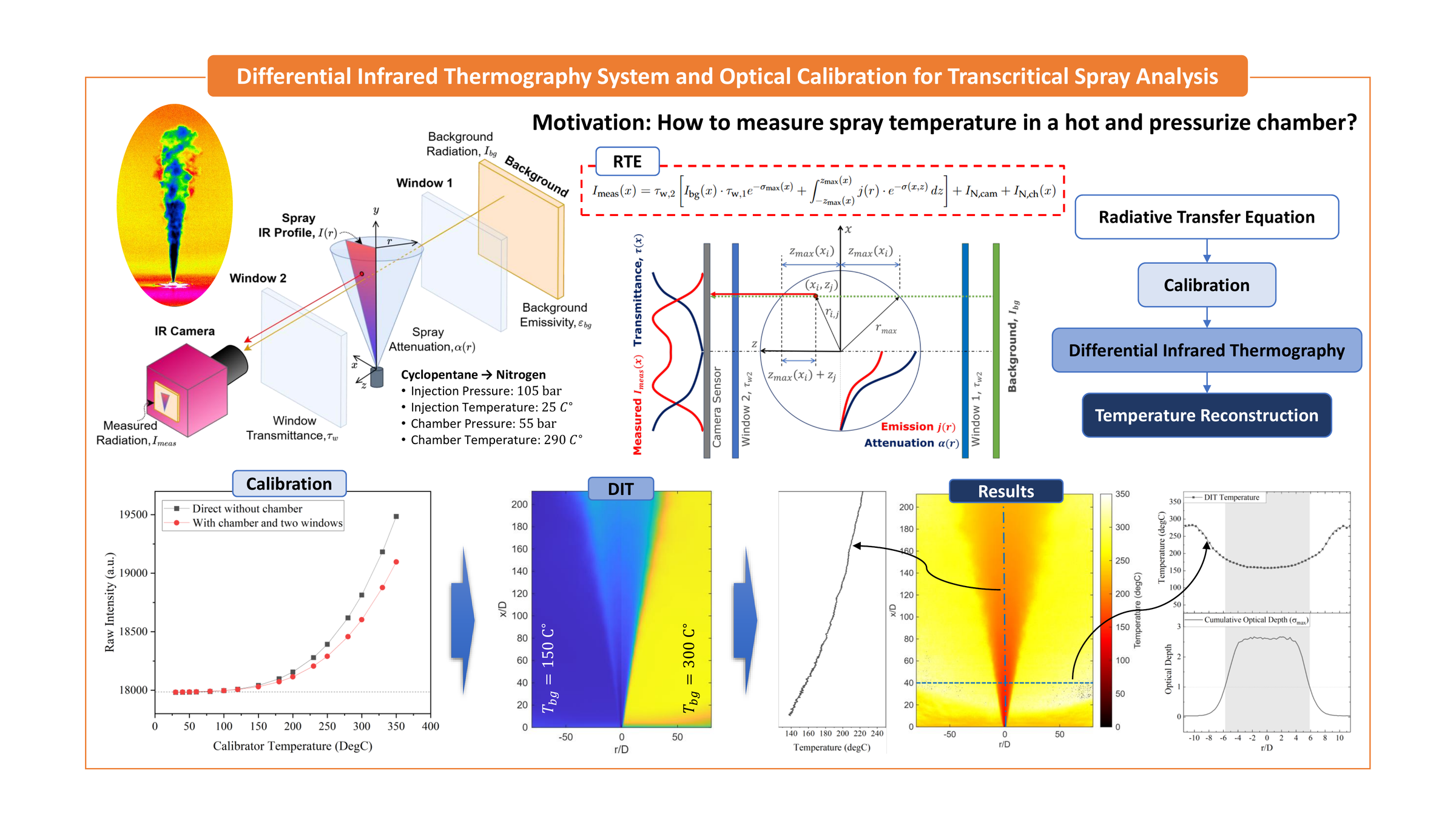
A Differential Infrared Thermography (DIT) system and an optical calibration methodology were established for quantitative analysis of transcritical fuel sprays in high-pressure nitrogen environments. A calibration procedure was developed for high-pressure, high-temperature conditions in a chamber using cyclopentane as a surrogate fuel and preheated nitrogen to precisely control chamber conditions. The infrared camera signal was calibrated with a graybody source to relate measured intensity to black-body temperature, and the combined noise from the camera and the optically accessible chamber (with two opposing sapphire windows) was systematically characterized. The effects of chamber pressure and temperature on recorded infrared intensities were evaluated to ensure robust calibration across transcritical conditions. Spray temperature fields were obtained under transcritical operation using the DIT technique with a slab-spray assumption and two independently controlled background temperatures, enabling spatially resolved, quantitative evaluation of spray temperature. However, the system yielded overestimated temperatures in the dense core region due to high optical depth and associated radiative transfer effects. Overall, the proposed DIT system and calibration framework offer a viable tool for investigating transcritical phase change and heat transfer, but the results highlight that improving accuracy in optically thick regions will require deconvolution-based analysis to better account for path-integrated emission and attenuation.