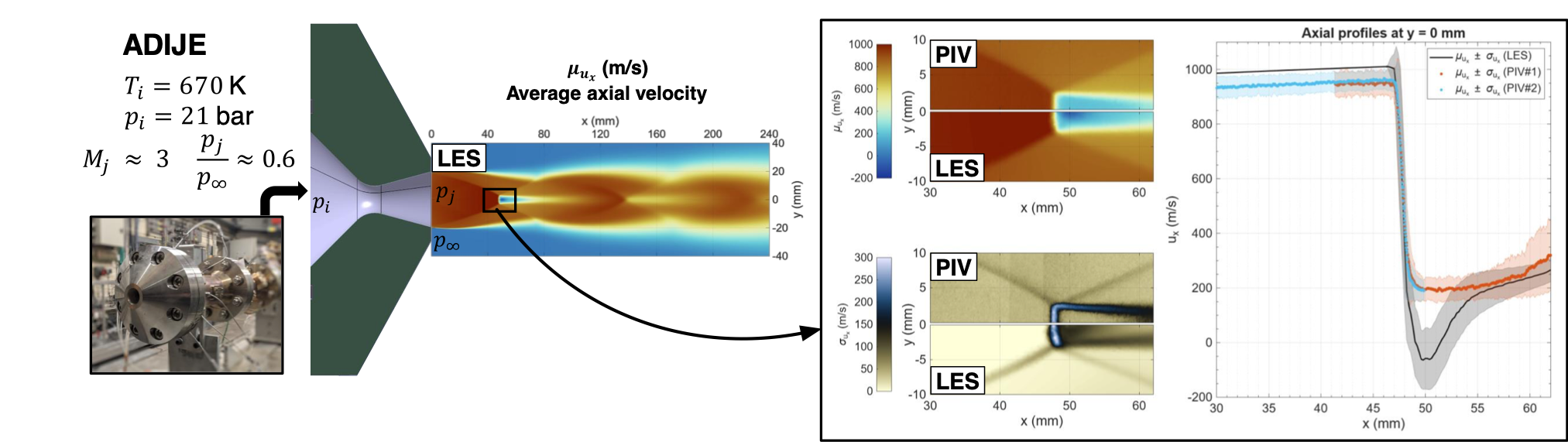
High-resolution velocity field in the first Mach disk region of an overexpanded supersonic jet
R. Jalain, S. Petit, B. Blaisot, N. Lupoglazoff, A. Langenais
ONERA/DMPE, Université Paris Saclay, F-91123, Palaiseau, France
DOI:
Overexpanded supersonic jets, occurring when the nozzle exit pressure falls below ambient, are characterised by a complex shock-cell structure including oblique shocks, reflected shocks and, under certain conditions, Mach disks followed by subsonic pockets. This work presents high-resolution planar Particle Image Velocimetry (PIV) measurements performed in the first shock cell of a large Reynolds number overexpanded free heated air jet at approximately Mach 3, produced by the large-scale ADIJE facility at ONERA, operating at generating pressure of 21 bar and temperature of 670 K. SiO2 seeding particles with an estimated relaxation time below 0.7 μs ensure reliable tracking of the strong velocity gradients across the shock structure, and a high magnification optical setup provides a vector spacing of 22 μm. Experimental velocity fields are compared to a Large-Eddy Simulation (LES), showing an overall excellent agreement between the two datasets. Two main findings are reported. First, a shock-tracking procedure based on instantaneous velocity probability density functions reveals that the Mach disk oscillates axially with a peak-to-peak amplitude of approximately 1.5 mm. Computing a conditional average in the shock reference frame reduces the standard deviation peak at the Mach disk location by approximately 100 m/s, representing 40% of the standard deviation value computed in the fixed (camera) reference frame. The shock displacement is therefore identified as a significant though not dominant contribution to the velocity fluctuations in that region, the remainder being attributed to turbulence and measurement noise. Second, no negative axial velocity, i.e. recirculating flow, is measured anywhere in the dataset, with the minimum average axial velocity consistently near 200 m/s, in contrast to the corresponding LES which predicts a drop down to -100m/s on the jet axis immediately downstream of the Mach disk. The consistency of the PIV data across the complete dataset, combined with the limited confidence in the LES prediction in the subsonic pocket region, establishes these measurements as a reliable reference dataset for the validation of compressible flow solvers applied to overexpanded supersonic jets