Spatio-temporal organization of stall cells above an airfoil
S. Khaleghizadeh(1), F. Scarano(1), M. Li(1,2)
1: Faculty of Aerospace Engineering, Delft University of Technology, Kluyverweg 1, Delft, 2629 HS, The Netherlands.
2: School of Aerospace, Mechanical & Mechatronic Engineering, The University of Sydney, Darlington, NSW 2008, Australia.
DOI:
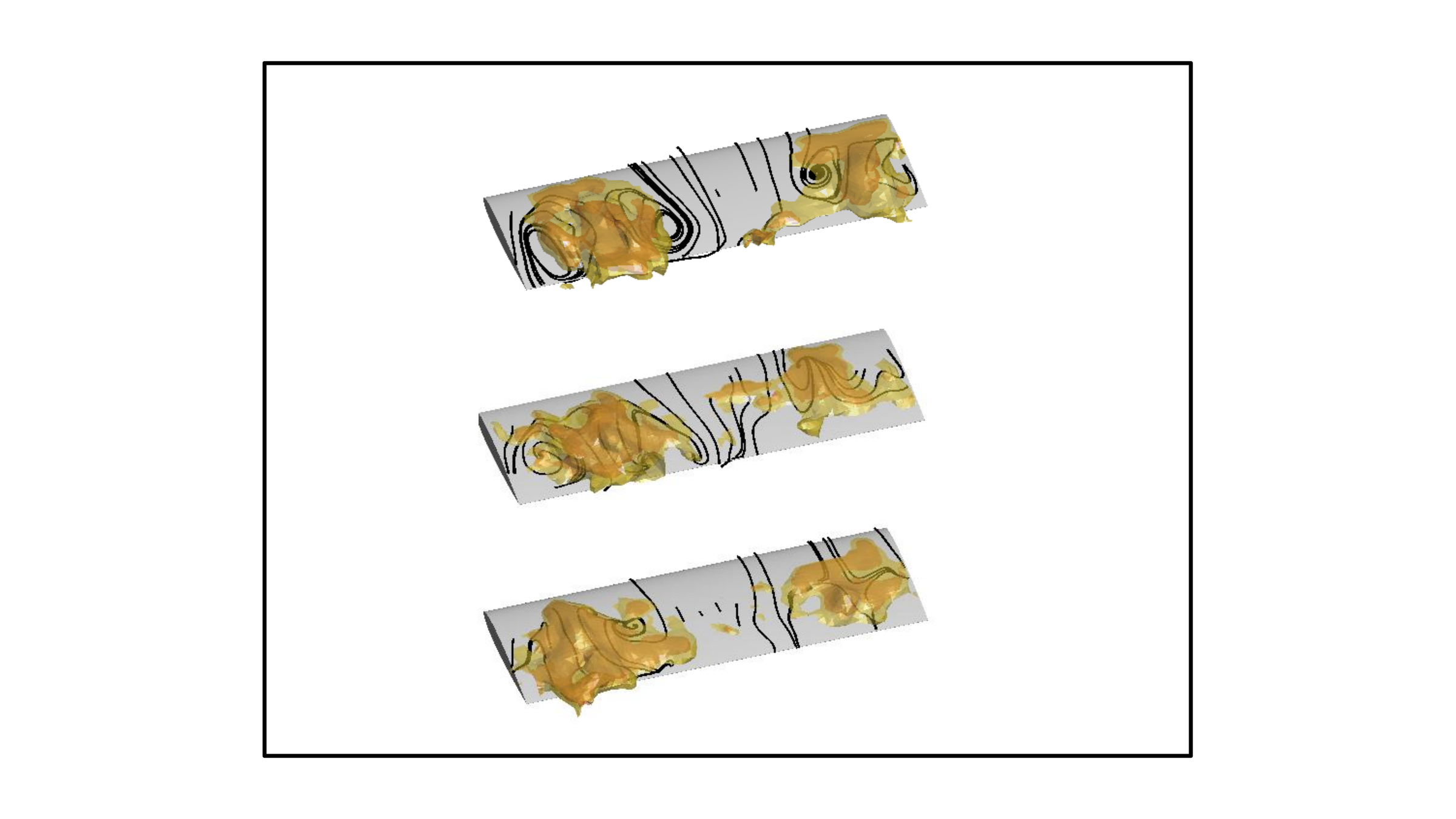
This work investigates the dynamical occurrence and spatio-temporal features of stall cells forming on a NACA0015 airfoil. Three-dimensional, time-resolved particle tracking is employed to capture the onset, evolution, and interaction of stall cells. Experiments span a chord-based Reynolds number (Re) range from 1.2 to 1.9 × 10⁵ and angles of attack α from 11° to 18°. The critical (i.e. minimum) value of Re to observe the occurrence of stall cells is revisited here, with stall-cell like behaviour found at Re values significantly smaller than reported in the literature, yet, within a narrow Re-α envelope (14° ≤ α ≤ 15.5° and 1.2 × 10⁵ ≤ Re ≤ 1.9 × 10⁵). Dynamic visualization of the near-surface flow reveals the organization of cellular separation, undergoing unsteady interactions. The data is examined along a near-wall spanwise line at mid chord, yielding two-dimensional (y - t) diagrams that reveal the main spatio-temporal behaviour of the interface between separated and attached flow. Distinct flow behaviors are identified, from stationary cellular separation (steady cells), spanwise motion (drifting cells) and low-momentum flow patches systematically departing from the core of the cell (branching cells). Occasionally, splitting or merging of cells is also observed, but at comparatively lower occurrence. The topology based on the time-averaged velocity field and the instantaneous velocity suggests that the cellular separation is a far more frequent phenomenon than reported so far. For the particular regime of drifting cells, cellular separation is active most of the time albeit the time-averaged flow analysis yields no stall cells. A general criterion is proposed, attempting to categorize the flow regimes in relation to the cellular separation. Although not fully comprehensive of all effects present in the stall cells regimes, it may be taken as a first step towards a more quantitative definition of stall cells regime, thus allowing more generalized comparison among experiments and computer simulations. The criterion highlights the limitations of conventional time-averaged flow visualization techniques and underlines the importance of time-resolved measurements that capture stall cells even when they evolve dynamically.