Multi-Pulse Dual-Frame Velocimetry
M. Moaven, D.W. Carter
Dept. of Mechanical, Materials & Aerospace Engineering, Illinois Institute of Technology, Chicago USA
DOI:
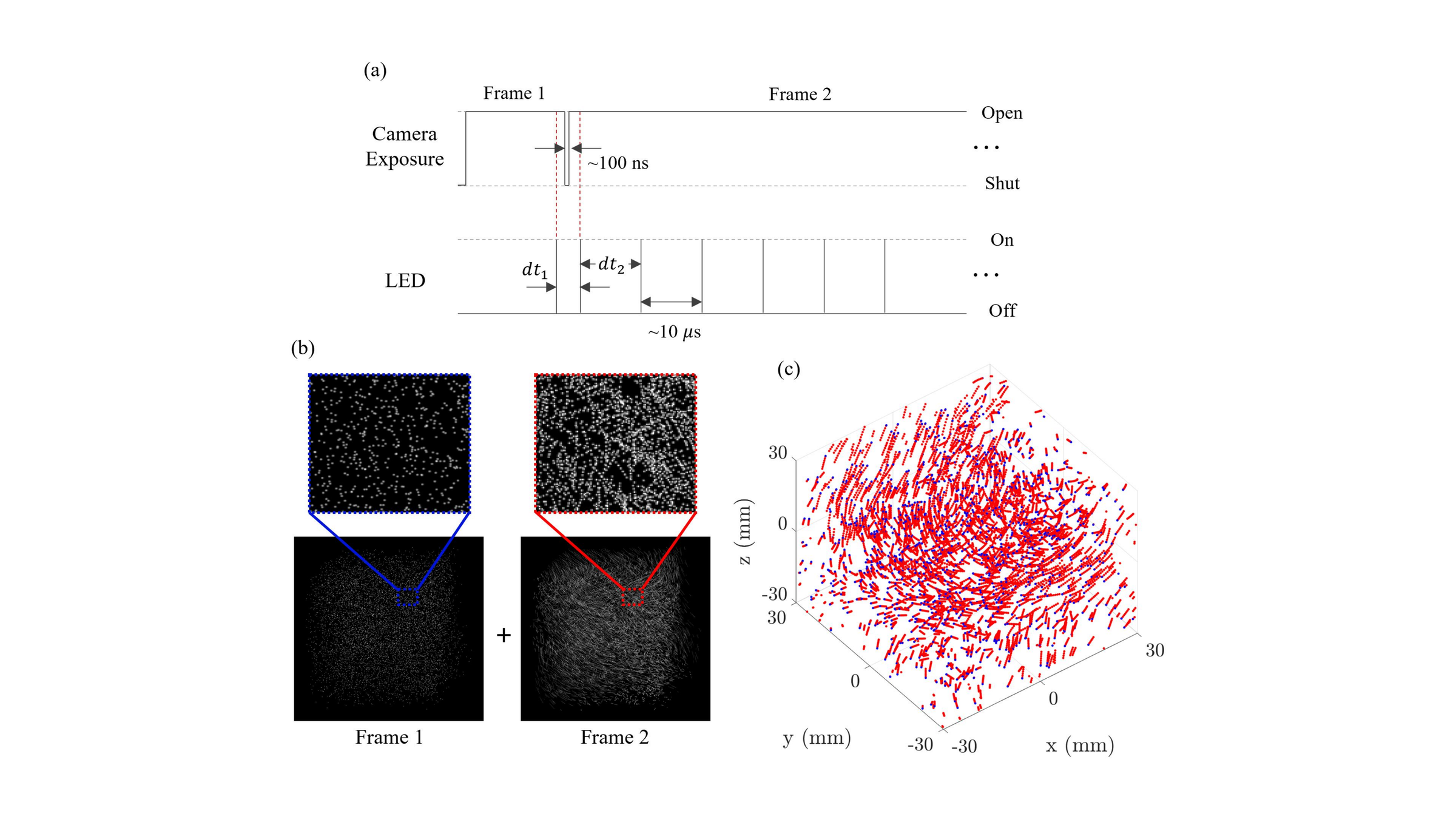
We present a novel strategy, termed Multi-Pulse Dual-Frame Velocimetry (MPDFV), to track the advection of flow tracers to obtain volumetric Lagrangian Particle Tracks (LPT) with high time-resolution using low-speed dual-frame cameras. A timing scheme is employed that pulses a volume-filling LED once in the first frame and up to seven times in the second frame. By taking advantage of the rapid pulsing of the LED and frame-straddling, the scheme resolves the problem of directional ambiguity while also effectively collecting kHz-resolved data in time. To overcome the large seeding density of particles in the second frame, the “Peak-CNN” machine learning architecture (Godbersen et al., 2024) is used to identify peak locations and the open-source “OpenLPT” code (Tan et al., 2020) is used to identify the particle tracks. Finally, Lagrangian velocities are assimilated to an Eulerian-grid using physics-informed neural networks. MPDFV enables time-resolved PTV with lower-cost higher-resolution dual-frame cameras: improving affordability and data resolution. The framework is demonstrated on two data sets: a direct numerical simulation of homogeneous turbulence (with a ground-truth reference) and a large-scale turbulence box experiment (with comparison to established time-resolved PTV).