A robust method for estimating seeding density in PIV images
M. Hebey(1), F. Champagnat(2), B. Leclaire(1)
1: DAAA, ONERA, Institut Polytechnique de Paris, 92190, Meudon, France;
2: DTIS, ONERA, Université Paris-Saclay, 91120, Palaiseau, France
DOI:
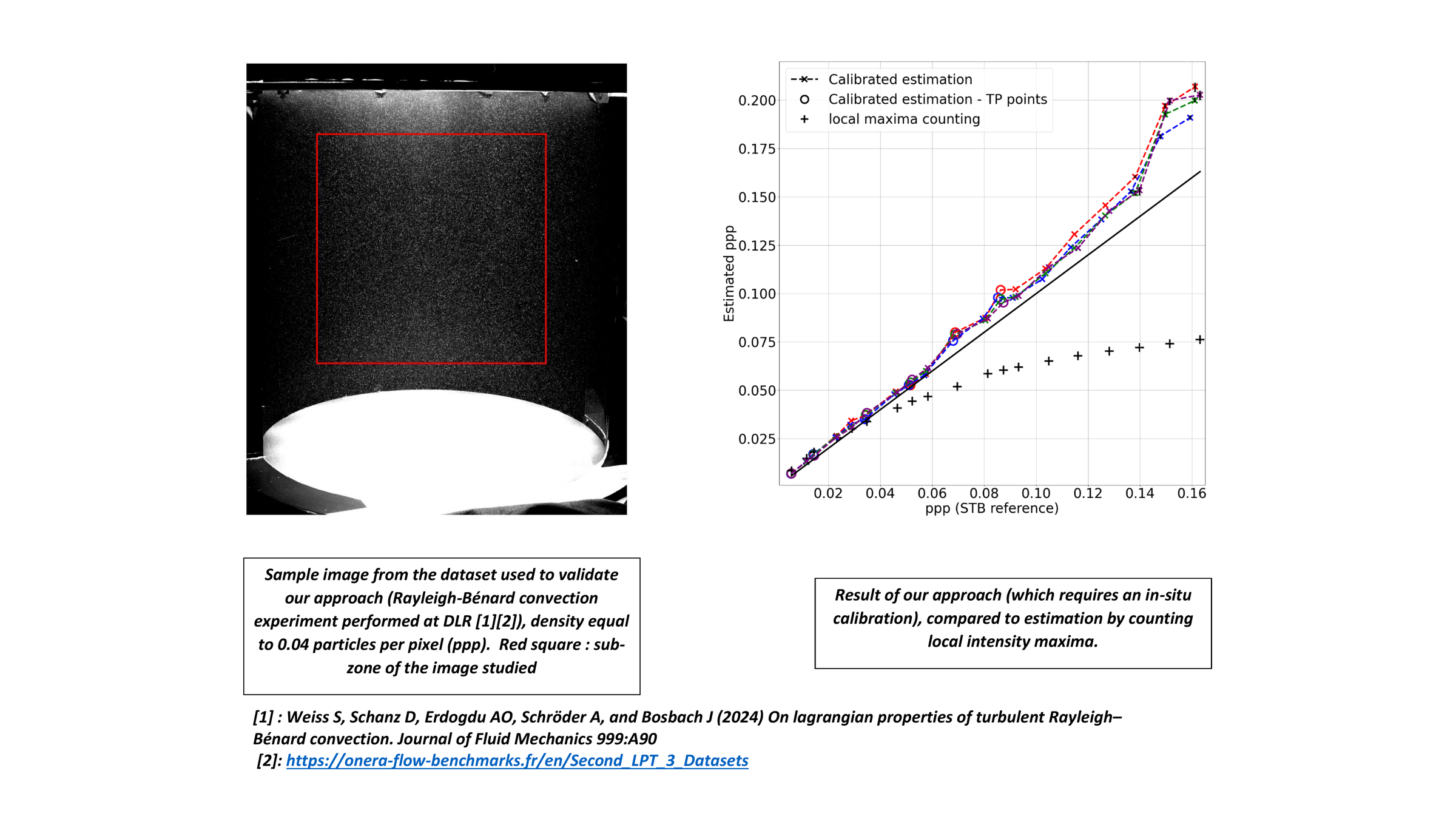
We introduce a new method for estimating the seeding density of particle images, using a statistical model of their pixel intensities based on Filtered Poisson Processes. We show that computing the ratio of two different statistical quantities from the images allows to obtain an estimator proportional to the true seeding density. This is in particular the case up to high density values, where multi-scattering effects can be present. To estimate the proportionality coefficient between estimated and true densities, which involves contributions from the particle image shapes and from their distribution of intensities, we introduce an in situ calibration process at low densities, considering estimation by counting local intensity maxima as the reference. To guarantee an optimal accuracy of this calibration step, new characterizations and guidelines for optimal and easily automated use of this reference counting have been derived. Performance assessment of the method is first presented using synthetic cases corresponding to both 2D and 3D virtual observation setups, the latter being introduced to assess the impact of spatial inhomogeneity linked to perspective viewing. They confirm the soundness of both the model and the calibration process, the excellent accuracy of the method up to very high seeding densities, as well as its robustness to both uncorrelated and correlated spatial noise (for the latter, once a historical minimum image has been subtracted). The method is then tested on experimental images from the 3D Rayleigh-Bénard convection experiment of Bosbach et al. (2021). Results confirm its very good performance across a wide range of densities, as well as its robustness to multiple scattering effects. Further analysis of the results also shows that the image cumulants, as well as our estimator, can be used as valuable diagnostic tools to monitor changes in the distribution of particle intensities.