Validity of the Particle Image Velocimetry Measurement in Dielectric Fluid Subjected to External Electric Field
M.H. Hamede, Y. Sliavin, V. Motuz, C. Egbers
Department of Aerodynamics and Fluid Mechanics, BTU Cottbus-Senftenberg, Cottbus, Germany
DOI:
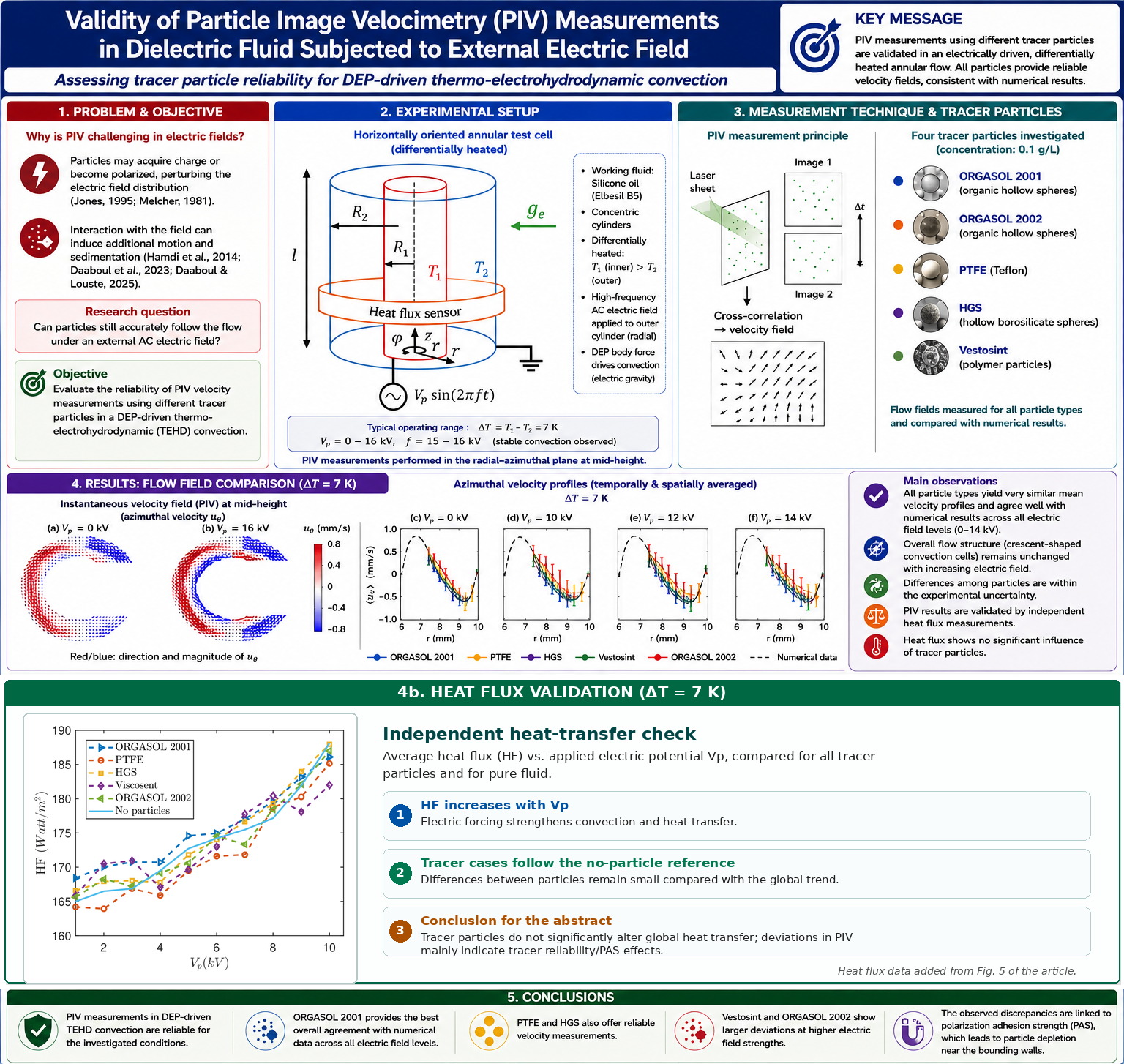
The use of particle-based flow measurement techniques, like Particle Image Velocimetry (PIV) is always controversial when a fluid is subject to an external electric field. The predominant concern in such instances pertains to particle charging, a phenomenon attributable to the electric field. In some cases, it has been observed that tracer particles accumulate electric charges on their surfaces, which may influence the electric field distribution within the fluid volume (Jones (1995)). Another issue that must be addressed is the interaction between the particles and the applied electric field, and the sedimentation velocity resulting from this interaction. The main question then arises: whether, and to what extent, these particles can still be considered tracer particles for an accurate Particle Image Velocimetry if their velocity greatly exceeds that of the flow. The present study aims to investigate the aforementioned concerns by conducting a series of experiments considering different tracer particles. To this purpose, the velocity flow field of a dielectric fluid (silicone oil Elbesil B5) confined within concentrical differentially heated, horizontal cylinders, was investigated for four different types of particles. The four used in the investigation particles are ORGASOL, hollow borosilicate spheres, PTFE (Teflon) and Vestosint. The measurement of the flow field is conducted by means of particle image velocimetry. The flow is exposed to an external high-frequency alternating current (AC) electric field. The velocity fields of the fluid flow were measured for all four particle types, then analysed and compared with numerical simulations. This process was undertaken to determine the most suitable tracer particles for use in such flow configurations.