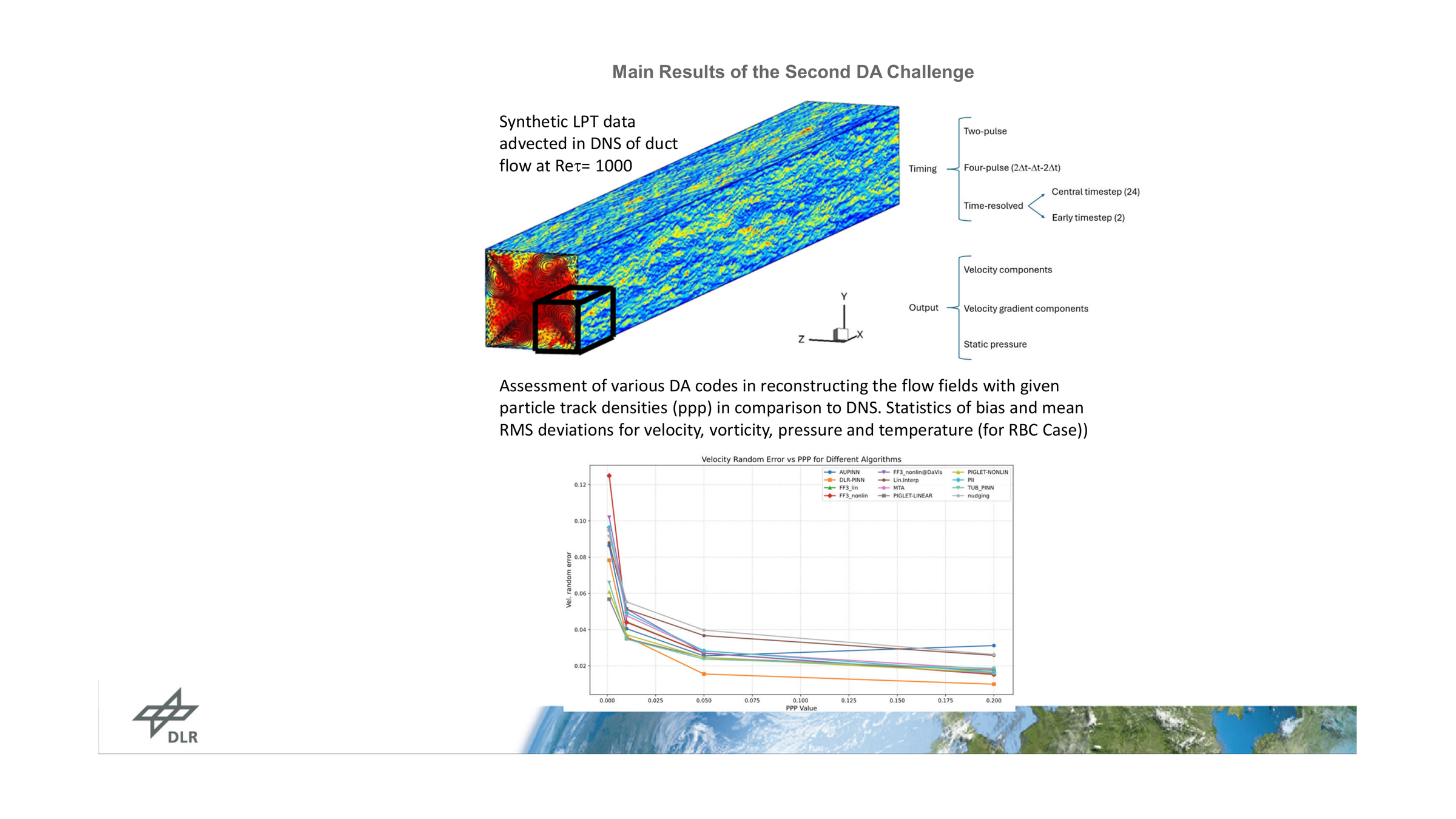
Main Results of the Second DA Challenge
A. Schröder(1,5), P. Godbersen(1), D. Schanz(1), A. Sciacchitano(2), A.G. Guerra(2), S. Grauer(3), B. Leclaire(4)
1: Inst. of Aerodynamics and Flow Technology, German Aerospace Center (DLR), Germany
2: Faculty of Aerospace Engineering, Delft University of Technology, Delft, The Netherlands
3: Dept. of Mechanical Engineering, Pennsylvania State University, United States
4: DAAA, ONERA, Institut Polytechnique de Paris, 92190, Meudon, France
5: Chair of Image Based Measurement Techniques, Brandenburg University of Technology (BTU), Cottbus, Germany ∗Corresponding author: andreas.schroeder@dlr.de
DOI:
This work presents the main results of the second Data Assimilation (DA) challenge, jointly organized by TU Delft, DLR, ONERA, and Penn State. We consider three test cases, namely three synthetic Lagrangian Particle Tracking (LPT) input cases based on advection of virtual tracers along time-series of DNS for Case 1) a turbulent rectangular duct flow at Re = 1,000, Case 2) a compressible turbulent boundary layer flow at a Mach 4.9 and Case 3) a Rayleigh-Bénard convection flow at Ra = 107 in a cubic domain. Time-resolved tracks are provided for all test cases at four (Case 1), two (Case 2) and three (Case 3) different particle tracking densities, translated to particle image densities (in particles per pixel, ppp) of a generic virtual camera set-up. Additionally, for Case 1 two- and four-pulse particle tracks are addressed and for Case 2 inertial particles beside flow tracers. The results are presented in terms of bias and mean RMS errors of the reconstructed velocity-, vorticity- and pressure fields with respect to the DNS data at a predefined 3D grid of points. For case 3 as well the temperature field inside the RBC flow is compared and assessed. The input data are freely available for download at the online portal, where the automatic evaluation of the submiĴed results is conducted and displayed as shown in the present work: hĴps://onera-flow-benchmarks.fr/en/Second_LPT_DA_Challenge. Here we consider the status of submissions until April 14th, 2026.