A meshless data-tailored approach to compute statistics from scattered data with adaptive radial basis functions
D. Rigutto(1,2), M. Ratz(1,3), M.A. Mendez(1,3,4)
1: Environmental and Applied Fluid Dynamics, von Karman Institute for Fluid Dynamics, Waterloosesteenweg 72, Sint-Genesius-Rode,1640,Belgium
2: Transferts, Interfaces Et Procédés (TIPs), Université Libre de Bruxelles, Av. Franklin Roosevelt 50, Brussels, 1050, Belgium
3: Aero-Thermo-Mechanics Laboratory, Ecole Polytechnique de Bruxelles, Université Libre de Bruxelles, Brussels, Belgium
4: Experimental Aerodynamics and Propulsion Lab, Universidad Carlos III de Madrid, Leganés, Spain
DOI:
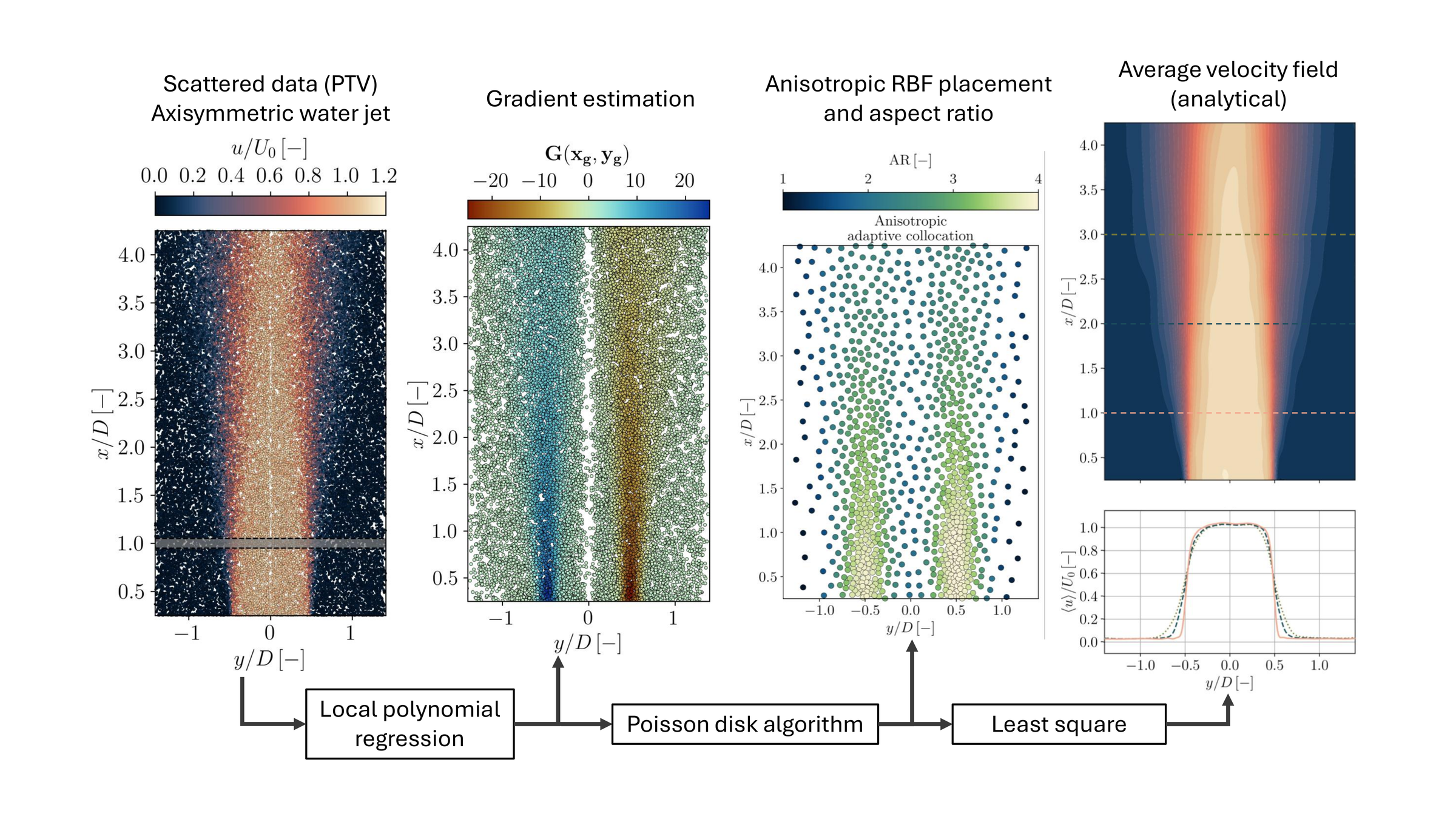
Radial basis function (RBF) regression has emerged as a powerful meshless tool for reconstructing continuous velocity fields from scattered velocimetry measurements. However, conventional isotropic formulations often exhibit oscillations in regions with strong gradients and anisotropic flow structures. This work presents an adaptive, anisotropic, and gradient-informed RBF framework for data assimilation of flow fields from scattered data. Local flow gradients, estimated from neighboring measurements, are used to guide adaptive sampling, define anisotropic kernel deformations, and introduce derivative-based regularization constraints. The methodology is tested on particle tracking velocimetry data of a turbulent round jet, characterized by highly non-uniform sampling and strong shear-layer gradients. Results demonstrate reduced oscillatory artifacts and better gradient capturing while requiring significantly fewer basis functions. The proposed framework provides an efficient and flexible meshless approach for the analysis of scattered experimental velocimetry data in complex turbulent flows. Core findings: • An anisotropic RBF regression framework is proposed to locally adapt the basis shape to the underlying flow structures. • The adaptive strategy reduces computational cost by concentrating basis functions and sampled data points only in regions where high spatial resolution is required. • For a similar number of basis functions, the proposed adaptive anisotropic formulation significantly improves the reconstruction quality compared with classical uniformly distributed isotropic RBF approaches.