Optical measurements inside a 3D model packed bed with gas flow
K. Hülz, C. Velten, K. Zähringer
Laboratory of Fluid Dynamics and Technical Flows, Otto-von-Guericke University, Germany
DOI:
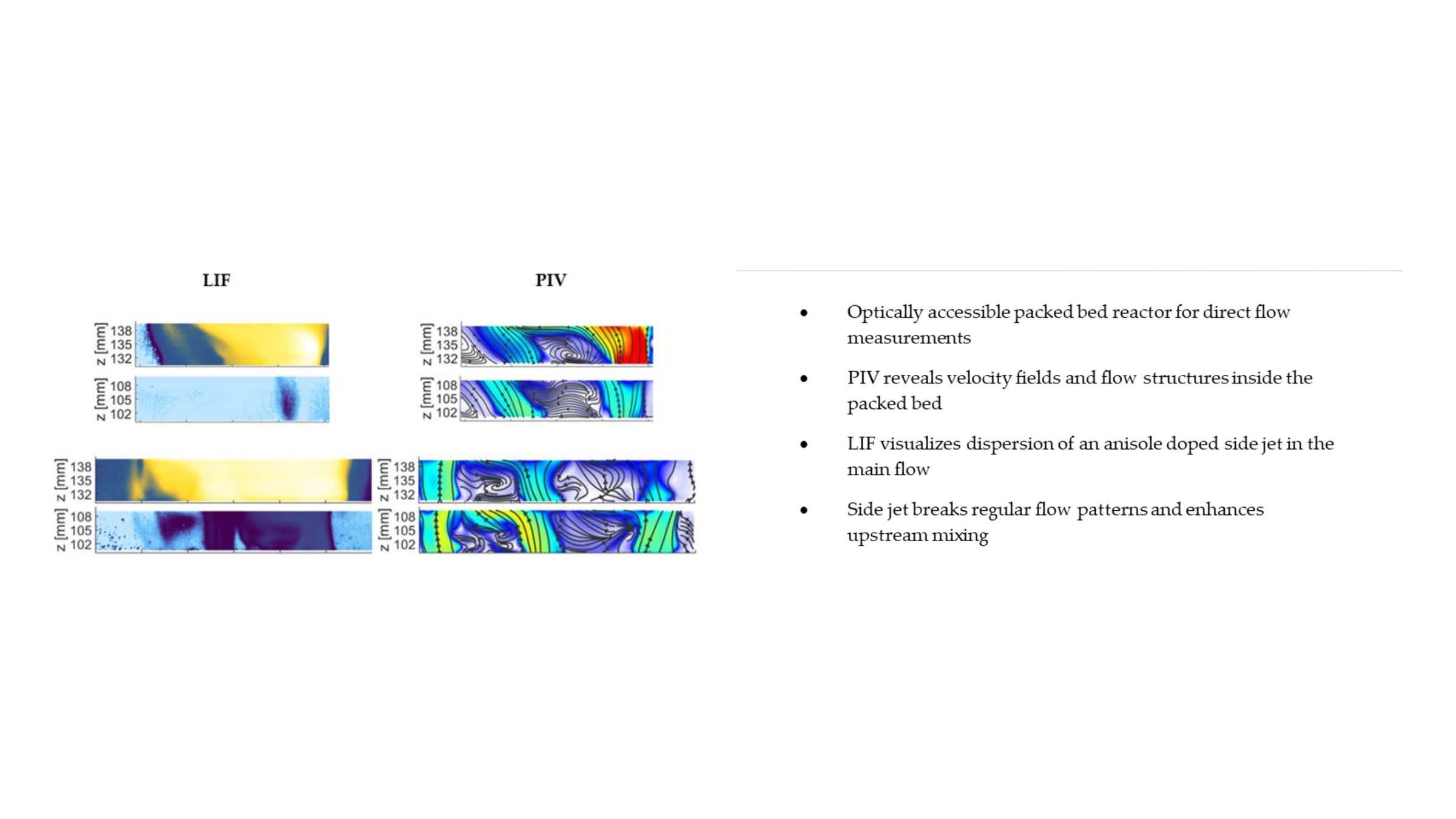
Packed bed reactors with gaseous flow are used in a wide variety of industrial applications and are associated with high energy and resource consumption. To optimize these reactors, a better understanding of the internal processes, including flow behaviour, is required. Therefore, a novel model reactor concept, designed to enable optical measurements inside the packed bed, was adapted in this study for LIF measurements. The model reactor consists of different layers of parallel bars rotated against each other, thus modelling a packed bed of polyhedral particles. In this study, laser induced fluorescence (LIF) was used to investigate the dispersion of an anisole doped side jet. The jet was introduced at two third of the reactor height into the main flow that enters the reactor from the bottom. The main volume flow l rate was 𝑄𝑃 = 9.14 min corresponding to a particle Reynolds number of 𝑅𝑒𝑃 = 99, l l while the side jet volume flow rates were 𝑄𝐽𝑒𝑡 = 2 min and 10 min. The LIF measurements are compared to particle image velocimetry (PIV) data from a previous work (Velten & Zähringer, 2026b) to correlate the dispersion behaviour with the underlying flow structures. It was found that the anisole doped side jet dispersed both, downstream and upstream of the main flow, corresponding to PIV results showing that the jet injection increased fluctuations and disrupted the regular flow structure of the main flow. Therefore, at the measurement positions (one layer below and two layers above the jet injection point) different structures of the anisole dispersion can be recognized; a homogeneous dispersion in the reactor cross-section does not exist. Increasing the side jet flow rate enhanced the fluctuations and the upstream flow, resulting in stronger mixing and a more homogeneous anisole distribution.