POD-Based Characterization of KH-Driven Surface Waves and Hierarchical Breakup Structures in a Liquid Jet in Crossflow
Y. Si, T. Wang, Y. Hardalupas
Dept. of Mechanical Engineering, Imperial College London, United Kingdom
DOI:
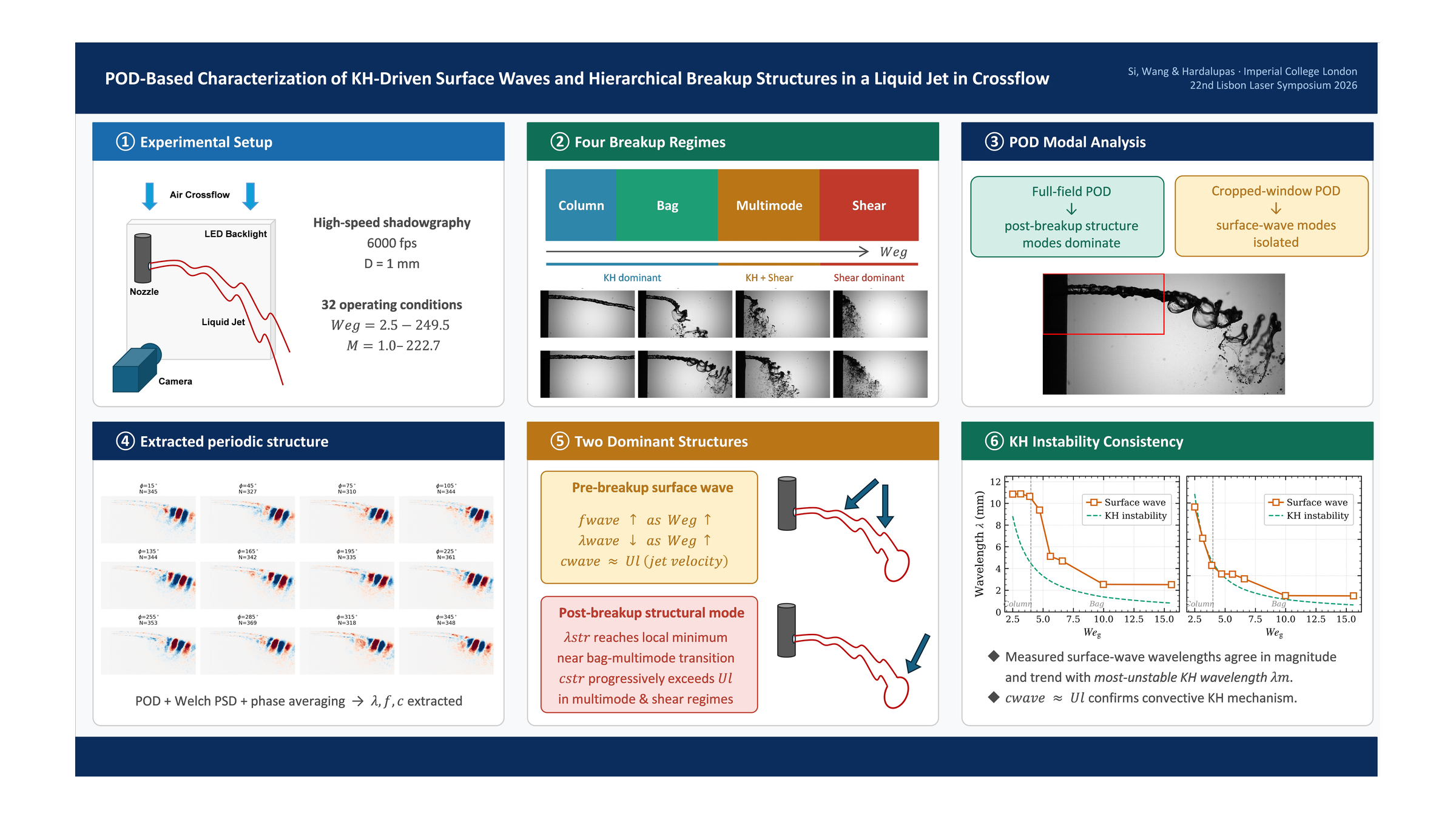
The near-field atomization of a liquid jet in crossflow (LJIC) is investigated experimentally using high-speed shadowgraphy across four breakup regimes, including the column, bag, multimode, and shear breakup regimes, with gaseous Weber numbers ranging from = 2.5 to 249.5 and liquid-to-gas momentum ratio from = 1.0 to 222.7. Proper orthogonal decomposition (POD) combined with Welch spectral analysis and phase averaging is applied to time-resolved image sequences to extract dominant spatial and temporal structures. A dedicated cropped-window analysis on the windward pre-breakup region is introduced to isolate surface-wave modes otherwise obscured by the energetically dominant post-breakup structures in full-field decompositions. Two physically distinct dominant structures are identified across operating conditions: a pre-breakup surface-wave mode exhibiting streamwise-periodic undulations on the windward liquid surface, and a post-breakup structural mode associated with the periodic formation and downstream convection of breakup products including bags, ligaments, and droplet clusters. The wavelength of surface-wave mode decreases and frequency increases monotonically with in the column and early bag-breakup regimes, consistent with increasing aerodynamic forcing at higher crossflow velocities. The wavelength on the post-breakup structural mode reaches a local minimum near the bag-to-multimode transition. Within the bag-breakup regime, cases where both modes are simultaneously extractable exhibit wavelength ratios and frequency ratios that remain approximately constant within each liquid-jet velocity group, alongside near-unity propagation speed ratios with both speeds close to the liquid-jet velocity. These results suggest that breakup structures emerge as nonlinear secondary structures periodically selected from a precursor interfacial wave train, with a clear hierarchical nesting relationship between the two. In the column and bag-breakup regime, the wavelengths of the surface-wave modes agree in magnitude with the most-unstable wavelengths predicted by the classical Kelvin–Helmholtz (KH) instability theory. Meanwhile, the theoretical propagation speeds of these waves are close to the liquid-jet velocity, which confirms a convective KH mechanism governing pre-breakup interfacial-wave selection. In general, the four breakup regimes can be interpreted as reflecting the competition between KH-driven interfacial-wave growth and direct aerodynamic shear stripping: KH waves dominate in the column and bag regimes, both mechanisms coexist in the multimode regime, and shear stripping prevails in the shear regime.