Bright-field and dark-field modes in microscopic high-speed droplet imaging
B.A. Südholt, F. Monser, N. Jüngst, S.A. Kaiser
Institute for Energy and Materials Processes – Reactive Flows, University of Duisburg-Essen, Germany
DOI:
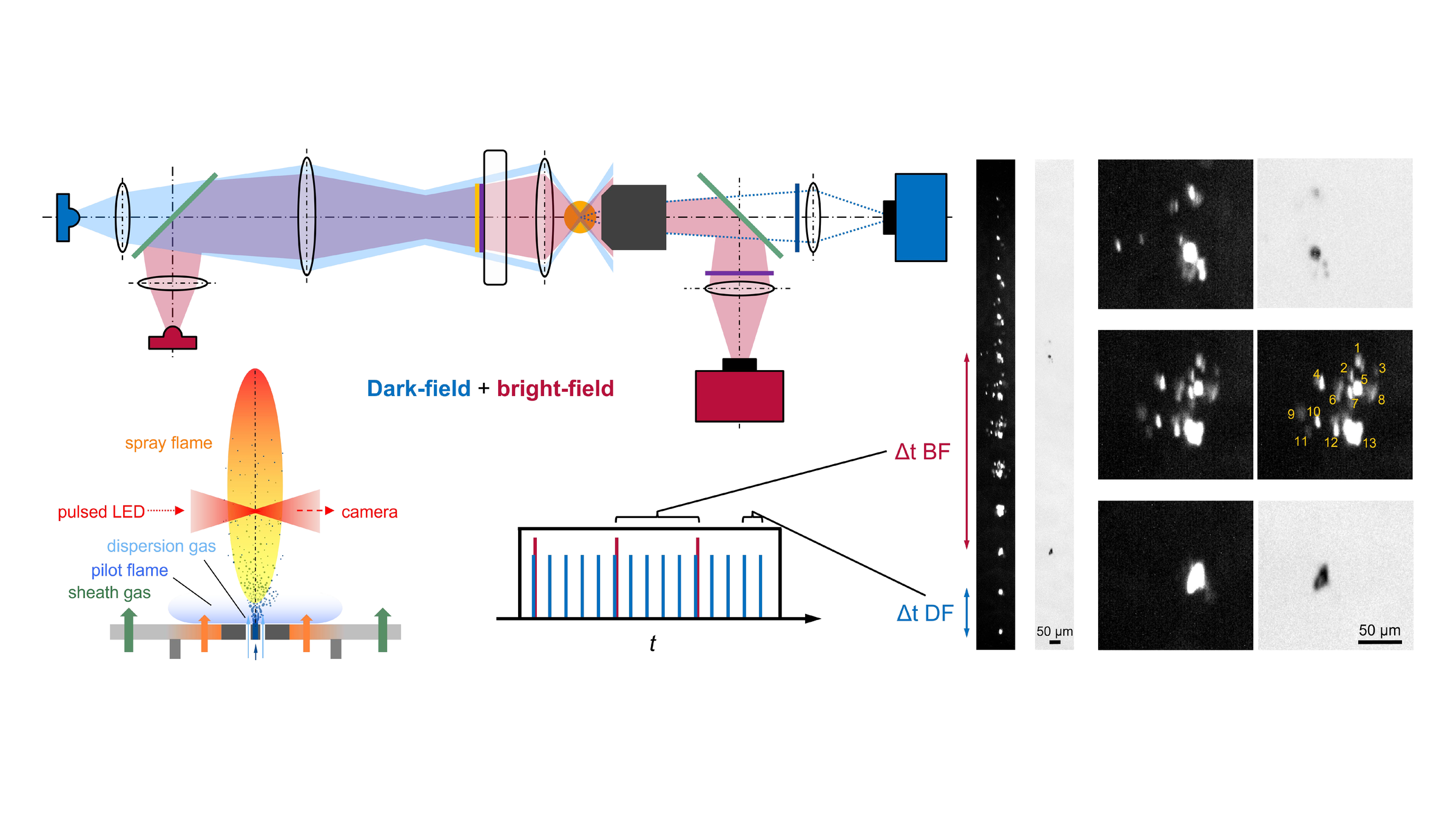
Spray-flame synthesis is a versatile process for producing metal-oxide nanoparticles from precursor-laden liquid fuels. After atomization and ignition, the burning droplets undergo thermally induced breakup, referred to as droplet disruption, which includes puffing and micro-explosions. These events influence the release of precursor material and the formation environment of the particles. However, their experimental investigation is challenging because the droplets are small, move at velocities on the order of 100 m/s, and disrupt on microsecond time scales. Previous microscopic bright-field shadowgraphy enabled direct visualization of droplet disruption, but its temporal resolution is limited by the camera frame rate and by the loss of contrast when multiple illumination pulses are stacked within one camera frame. Furthermore, weakly deflecting small fragments are difficult to detect in bright-field images.