Comparative Assessment of Laser-Induced Fluorescence and Mie Scattering for Concentration Field Measurements in Turbulent Jets
L. Engelbracht-Kloß(1), L. Boussard(2), B. Fond(2), S.A. Kaiser(1)
1: Institute for Energy and Materials Processes, University of Duisburg-Essen, Germany
2: ONERA, The French Aerospace Lab, France
DOI:
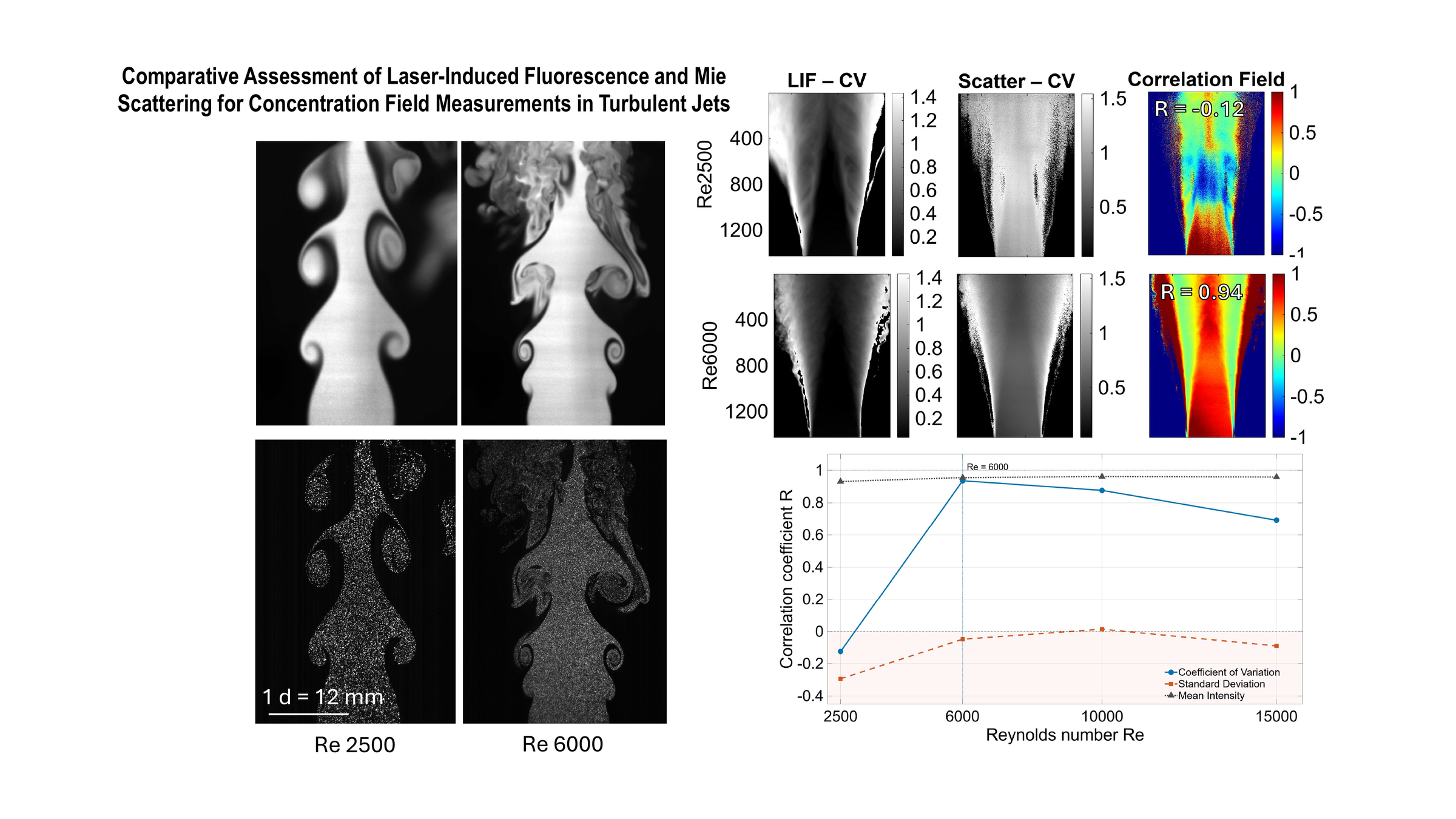
Laser-Induced Fluorescence (LIF) and Mie scattering are widely used optical techniques for concentration field measurements in turbulent flows, yet systematic quantitative comparisons between the two methods across a range of flow regimes remain limited in the literature. In this work, simultaneous LIF and Mie scattering measurements are performed in a turbulent round air jet seeded with anisole vapor and DEHS oil droplets over a range of Reynolds numbers spanning the transitional to fully turbulent regime (Re = 2500, 6000, 10000, 15000). A statistical analysis quantitatively compares the two methods based on the mean intensity, standard deviation, and coefficient of variation of the signal intensity. The standard deviation reveals a fundamental structural difference between the two methods: the LIF images exhibit elevated fluctuations in the jet shear layers, while Mie scattering shows an inverted pattern with highest values in the jet core. This inversion is attributed to the inability of inertial particles to follow diffusive scalar transport, which is an effect also visible in the instantaneous images, where vortex cores at Re = 2500 show diffusively homogenized LIF intensity but granular Mie scattering signal. The coefficient of variation (CV), defined as the ratio of standard deviation to mean intensity, substantially improves the spatial agreement between the two methods by normalizing out absolute signal level differences. The global spatial correlation coefficient between the CV fields shows a non-monotonic dependence on Reynolds number, rising from R = −0.12 in the transitional regime to a maximum of R = 0.94 at Re = 6000, before decreasing gradually to R = 0.69 at Re = 15000. This behavior is interpreted as reflecting the competing influences of molecular diffusion at low Reynolds numbers — where Mie scattering fails to capture diffusive mixing — and preferential particle concentration at high Reynolds numbers, where inertial effects cause the particle field to deviate from the scalar field. These results demonstrate that Mie scattering provides a reliable proxy for scalar concentration fluctuations in the fully turbulent regime at intermediate Reynolds numbers but should be interpreted with caution at very high Reynolds numbers.