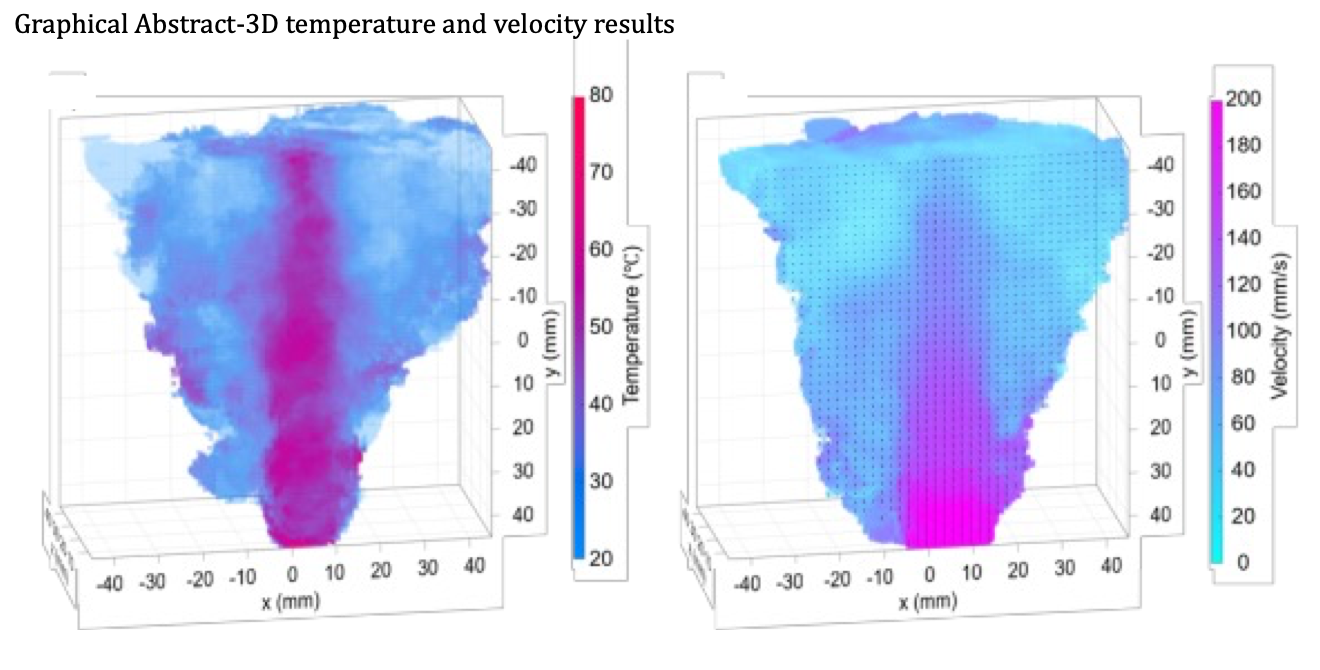
Phosphorescence-PTV: Simultaneous 3D Temperature and Velocity Measurement
D. Luan(1,2), C. Tropea(3), C. He(1,2), X. Zeng(1,2), Y. Liu(1,2), D. Peng(1,2), T. Cai(1,2)
1: School of Mechanical Engineering, Shanghai Jiao Tong University, Shanghai, China
2: Gas Turbine Research Institute, Shanghai Jiao Tong University, Shanghai, China
3: Institute for Fluid Mechanics and Aerodynamics, Technical University of Darmstadt, Darmstadt, Germany
DOI:
The simultaneous measurement of temperature and velocity fields is essential for understanding thermo-fluidic systems in which heat transfer and flow structures are strongly coupled. Conventional approaches often rely on separate tracers, intrusive probes, or planar optical measurements, which limits their capability to resolve the three-dimensional and transient interaction between thermal and momentum transport. This work presents a phosphorescence particle tracking velocimetry (Phosphorescence-PTV) methodology for simultaneous three-dimensional temperature and velocity measurement in liquids. The method integrates three technical developments: density-matched phosphorescent tracer particles, decay-based particle intensity reconstruction for lifetime thermometry, and spatial three-dimensional calibration and correction for volumetric measurements. The tracer particles are phosphorescent PDMS-based microspheres with embedded inorganic phosphor. Their apparent density is adjusted by controlling the particle matrix, phosphor loading, and low-density glass microsphere fillers, enabling improved density matching with liquid working fluids while reducing the particle diameter to 30–50 μm. For temperature retrieval, the phosphorescence lifetime method is adopted rather than a pure intensity-ratio method. A phosphorescent-decay particle tracking strategy reconstructs particle position, spot radius, and intensity from high-speed image sequences. A neural-assisted implementation further improves the extraction of two-dimensional particle position, spot size, and intensity in each camera view. To extend the method to volumetric measurements, a refractive multi-camera calibration framework is developed for transparent flat-walled vessels with known geometry. The calibration accounts for air–glass–liquid refraction using Snell’s law and joint optimization of camera, vessel, and refractive parameters. In the present flat-wall vessel demonstration, the optimized oil refractive index is n = 1.4655, with a light-corner distance RMS of 0.02 mm, a maximum reprojection error of 0.19 pixels, and a three-dimensional particle reconstruction RMS below 0.1 mm. A spatial intensity-correction procedure based on the relationship among lens focusing distance, defocus distance, particle spot radius, and recovered intensity is then used to correct particle decay sequences before lifetime fitting. Preliminary measurements of a central high-temperature injection flow in a large cavity demonstrate simultaneous volumetric temperature and velocity reconstruction over a measurement region exceeding 60×60×80 mm. The results show that the proposed Phosphorescence-PTV framework is a promising route toward quantitative three-dimensional thermo-velocimetry in liquid flows.