Reynolds-stress measurement using stereoscopic ensemble PIV
M.T. Taylor, J.M. Lawson, B. Ganapathisubramani
Aerodynamics and Flight Mechanics Research Group, University of Southampton, Southampton SO17 1BJ, United Kingdom
DOI:
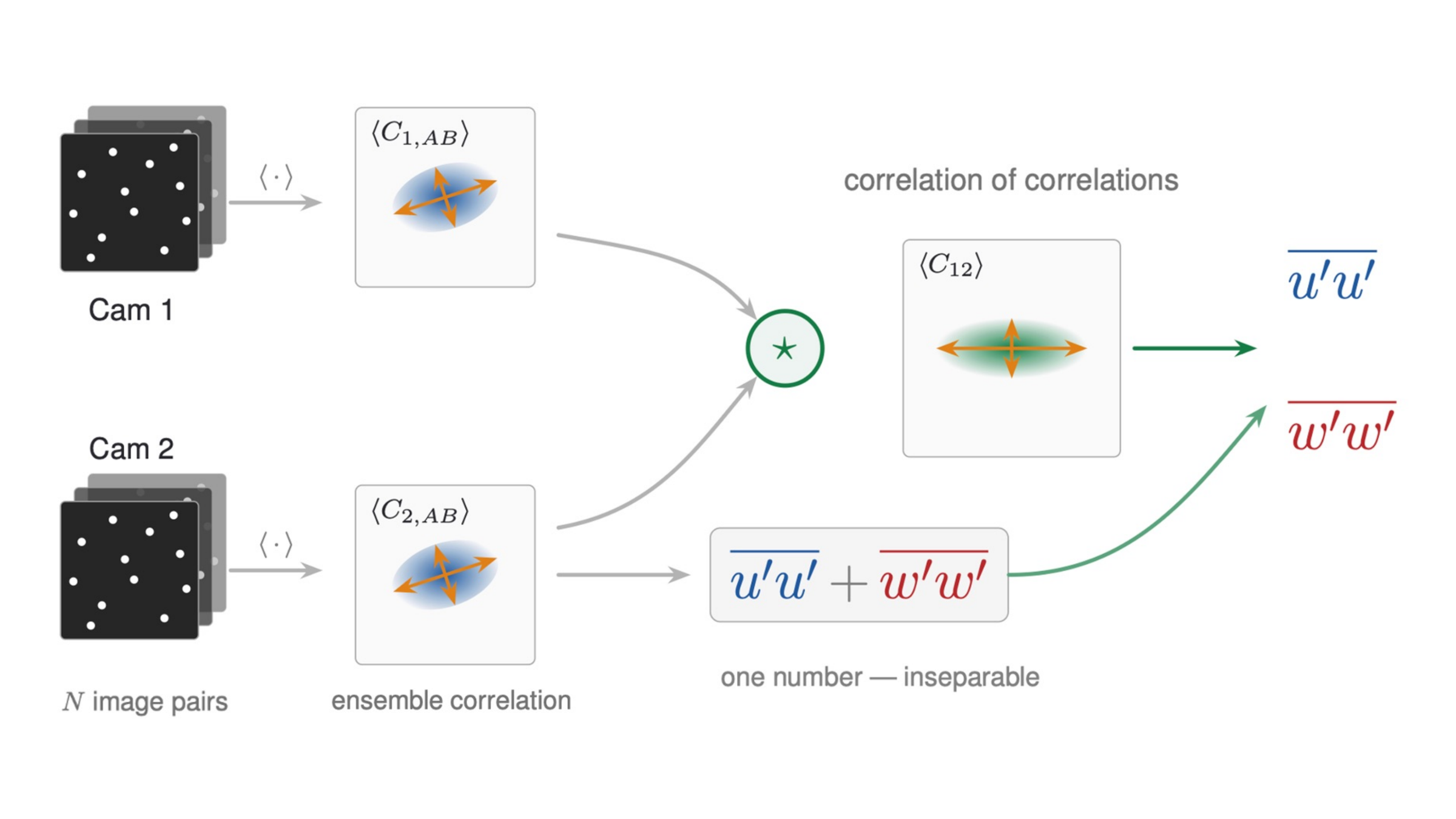
Single-pixel ensemble correlation decouples the spatial resolution of particle image velocimetry from the interrogation window size. This is a significant advantage for wall-bounded flows, where high spatial resolution is required to resolve steep gradients near boundaries. The operating principle is to measure mean flow and Reynolds stresses from measurements of the location and width of the time-averaged correlation peak. To date, this technique has been limited to 2D, two-component PIV measurements. The extension to stereoscopic PIV is not straightforward. This is because it requires a measurement of the velocity variance which can only be inferred from cross-correlations between camera pairs, and because the measurement of correlation-peak width is confounded by factors such as the laser sheet thickness, the camera point spread function and image interpolation error. We address this with two developments. Firstly, we introduce a Fourier-domain correlation-peak fitting procedure which accounts for the variation in the correlation peak width due to the imaging properties and image interpolation errors. Secondly, we introduce the “correlation-of-correlations” method to measure the velocity variance between camera pairs. This allows us to recover Reynolds stresses for low signal-tonoise ratio images in synthetic experimental data of a turbulent channel flow.