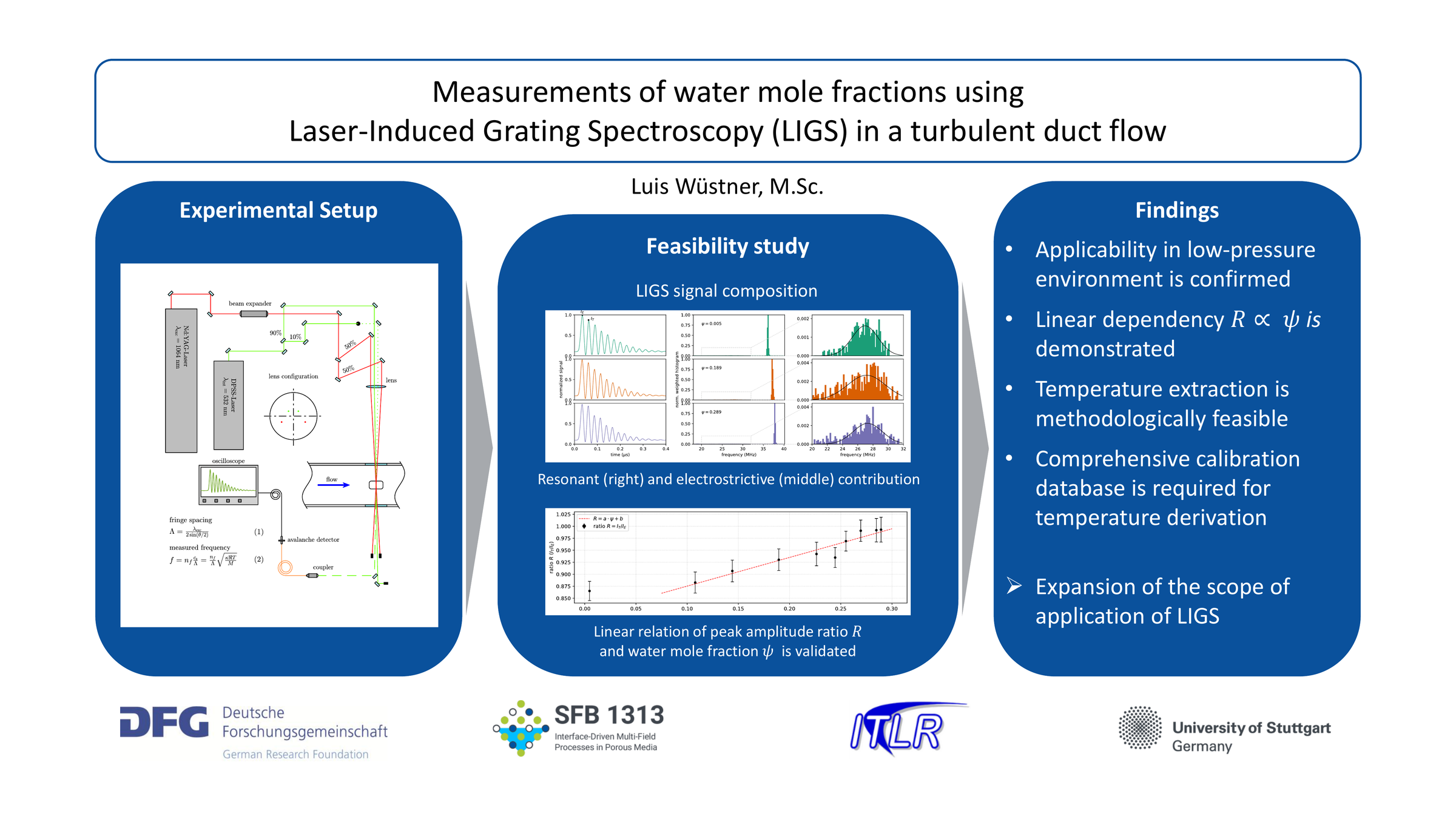
Measurements of water mole fractions using Laser-Induced Grating Spectroscopy in a turbulent duct flow
L. Wüstner, J. Härter, R. Poser, G. Lamanna
ITLR, Institute of Aerospace Thermodynamics, University of Stuttgart, Germany
DOI:
The precise, non-intrusive determination of fluid properties in highly dynamic environments remains a key challenge in experimental fluid mechanics. This study utilizes Laser-Induced Grating Spectroscopy (LIGS), an optical technique that allows for spatially resolved, pointwise measurements of speed of sound, which subsequently allows for temperature determination in gas mixtures of known composition. Here, LIGS is deployed in a turbulent two-phase flow channel, marking the first application of this diagnostic technique in such an environment. By analyzing the signal composition, a correlation between the water mole fraction 𝜓 and the amplitude ratio R, which comprises the thermal and electrostrictive signal contributions, was derived. While supplementary experimental data is missing for calibration, the current measurement framework needs to rely on supplementary sensors for temperature, pressure, and humidity. Turbulent flows inherently induce significant statistical signal fluctuations. Consequently, an in-situ calibration point in dry air was introduced to precisely determine the fringe spacing. This approach enabled the successful evaluation of the speed of sound, demonstrating good agreement with NIST reference data. However, pronounced variance in the experimental data currently precludes the reliable derivation of absolute temperatures from the speed of sound measurements. These limitations underscore the necessity for a reference calibration under controlled, stationary conditions. Establishing such well-defined boundary conditions will facilitate the derivation of a robust mapping function from R to 𝜓 and enable accurate temperature calculations, ultimately closing the system of equations required to simultaneously retrieve the water mole fraction and temperature solely from the LIGS signal at a known pressure.