Modernization of the DLR L2F-System
T. Ockenfels, M. Stein, M. Voges, C. Willert
Institute of Propulsion Technology, German Aerospace Center (DLR), Köln, Germany
DOI:
Laser-2-Focus (L2F) also known as Laser Transit Velocimetry (LTV) is a non-intrusive optical measurement technique to determine flow velocities and turbulence intensities in demanding flow conditions with restricted optical access.
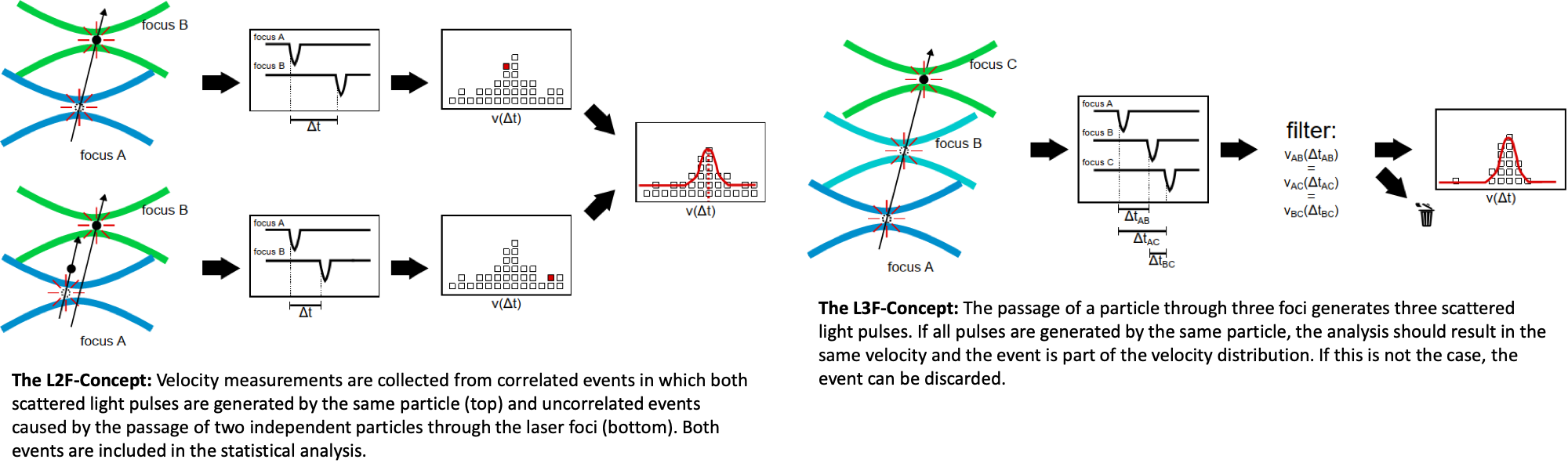
Back in the early 1970s, first steps of development were made by Schodl (1974) at the Institute of Propulsion Technology of German Aerospace Center (DLR). Since then, L2F has been constantly enhanced by DLR in cooperation with commercial partners to expand its range of application, operability, and accuracy. Over time, L2F technology has been used for various applications in the field of turbomachinery by Hergt et al. (2019) and Wittrock et al. (2020), fundamental flow research by Ueki et al. (1997) and Burow et al. (2018), as well as in-flight flow anemometry by Curry (1983) and Beversdorff et al. (1997). The goal of these experimental investigations is to provide a comprehensive image of the flow conditions as well as comparative data for complex flow simulations and design studies. In particular, L2F has established in experimental turbomachinery research due to its low requirements on optical access size. Compressor and turbine test rigs featuring high technology readiness levels (TRL) are highly instrumented which impedes optical flow visualization with most optical diagnostic techniques. Other advantages of L2F are preventing a flow disturbance at the measuring point, measuring close to rotating components like rotors and enabling flow measurements at locations that are intricate or even impossible to measure with conventional probe measurement technology. The increasing demand for reliable measurements from ever more complex environments requires miniaturized, robust and dependable measurement techniques. Therefore, the DLR’s L2F system has been recently modernized and the previous laser system, light detectors and analog electronics were upgraded. New capabilities when implementing modern diode lasers, silicon photomultipliers (SiPMs), and FPGA-based signal processing electronics are elaborated. This modernized L2F system is much more flexible, manageable, and reliable compared to the former system architecture. Among others, the new electronics allow a L2F data evaluation routine that enables real post-processing of recorded L2F data sets, e.g. post-analyzing data depending on the foci permutation of interest or phase-sorting measurement data relative to a turbomachinery rotor trigger. Furthermore, the new FPGA-based electronics enable to capture scattered particle light from more than two laser light foci at the same time which allows a fundamental new data evaluation approach called Laser-3-Focus (L3F). The novel L3F concept includes filter routines that are expected to decrease noise originating from uncorrelated particle events in future applications.