Effects of Three-Dimensional Particle Orientation on Photoelastic Response in Polarization-Based Fluid Stress Measurement
M. Naito(1), Y. Yokoyama(2,3), W.K.A. Worby(1), M. Kawaguchi(4), Y. Tagawa(1)
1: Dept. of Mech. Sys. Eng., Tokyo University of Agriculture and Technology, Japan
2: Micro/Bio/Nanofluidics Unit, Okinawa Institute of Science and Technology, Japan
3: Splash Lab, King Abdullah University of Science and Technology, Saudi Arabia
4: Institute of Engineering Academic Assembly, Shinshu University, Japan
DOI:
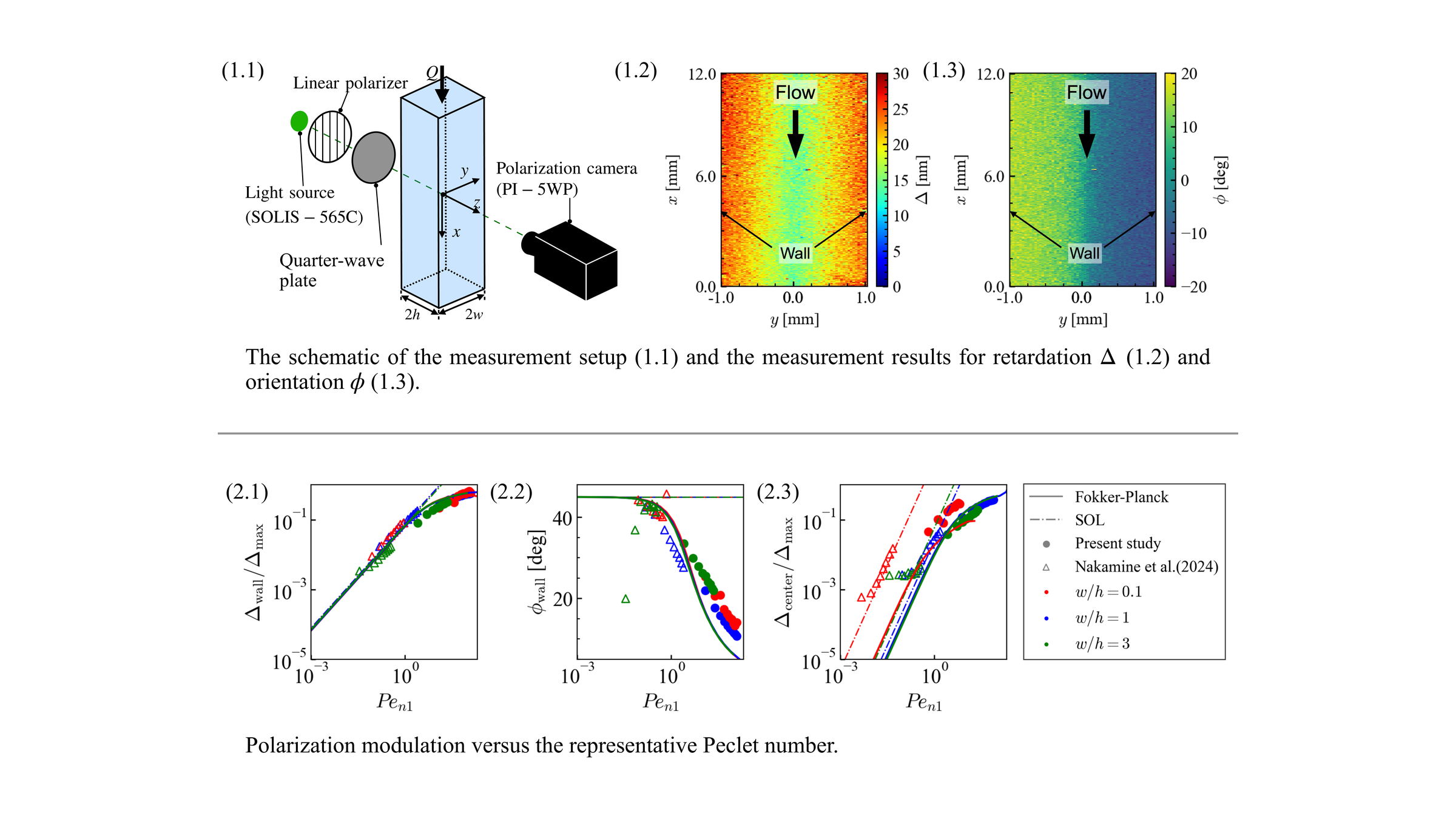
Polarization-based photoelastic measurement is a promising technique for non-intrusive measurement of stress fields in fluids. This study investigates the physical basis required for reconstructing fluid stress fields from polarization measurement images with a spatial distribution along the camera’s optical axis. To achieve this objective, polarization modulation in steady flow within a rectangular channel was experimentally measured and compared with predictions based on the conventional stress-optic law (SOL) and particle-orientation-based theory derived from the Fokker-Planck equation. A schematic diagram of the experimental setup is shown in (a), and the measurement results of the modified modulation are shown in (b) and (c). Polarization modulation is generated by the flow-induced orientation of cellulose nanocrystals (CNCs), which are rod-shaped particles dispersed in a fluid. The results suggested two important insights. The first finding is that the relationship between polarization modulation and fluid stress is governed by the Peclet number, which represents the ratio between the effect of flow-induced orientation and that of Brownian motion on particle orientation. The second finding is that the differences in polarization modulation caused by channel geometry can be characterized through the definition of the representative Peclet number along the camera's optical axis. These findings provide a physical framework for interpreting polarization measurements in three-dimensional flows and for future stress-field reconstruction.