Imaging Transient Stress Fields in Soft Materials during Droplet Impact by Photoelastic Tomography
Y. Tagawa(1), Y. Yokoyama(2), K. Matsunuma(1), H. Maruoka(3)
1: Dept. of Mech. Sys. Eng., Tokyo University of Agriculture and Technology, Japan
2: Micro/Bio/Nanofluidics Unit, Okinawa Institute of Science and Technology, Japan
3: Nonlinear and Non-equilibrium Physics Unit, Okinawa Institute of Science and Technology, Japan
DOI:
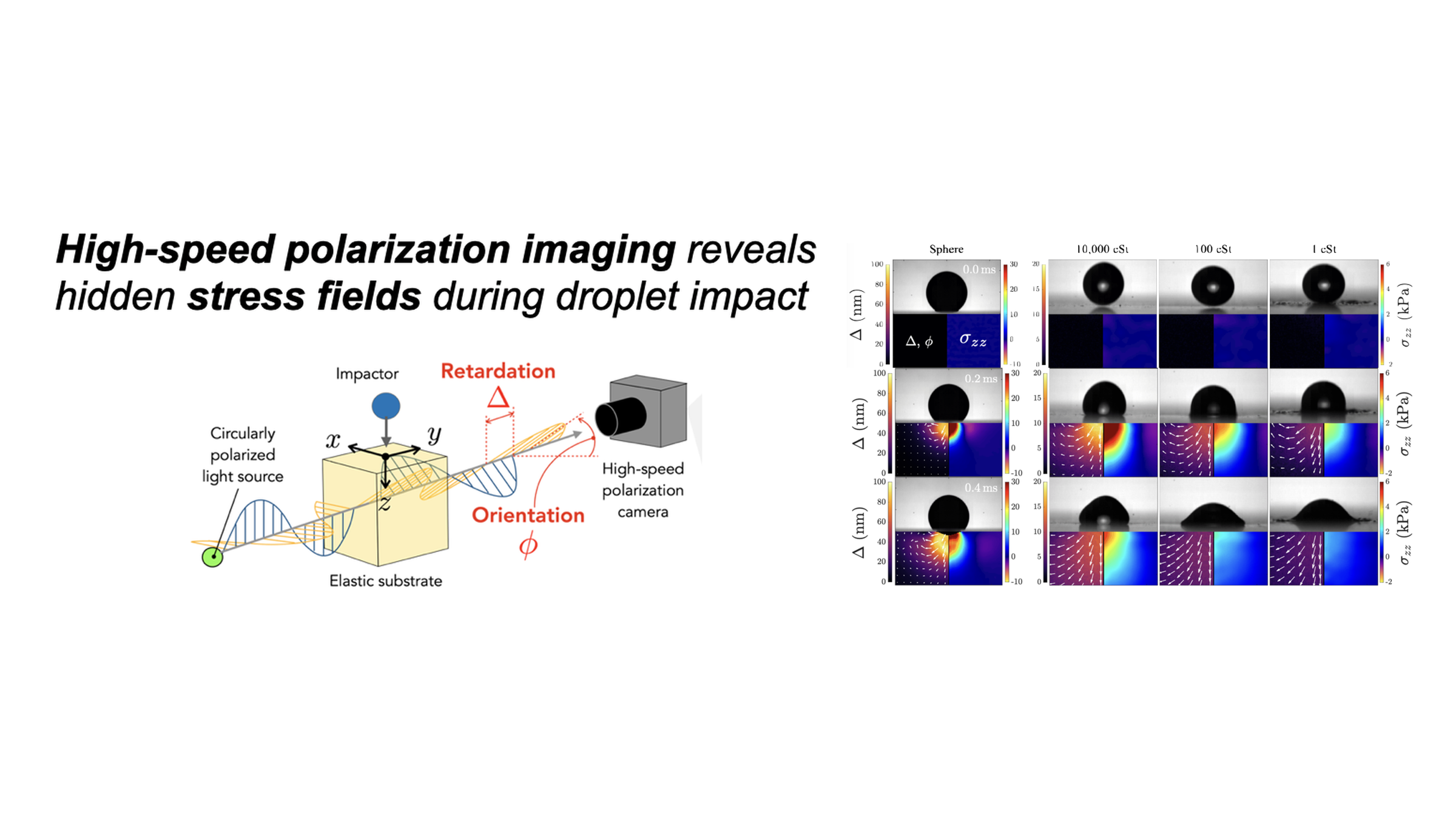
Droplet impact on soft materials is a fundamental uid–structure interaction problem relevant to erosion, coating, inkjet printing, bioprinting, and biomedical applications. Although droplet motion such as spreading, splashing, and rebound has been extensively studied, direct experimental access to the stress elds generated inside soft substrates during impact remains limited. In this work, we present a polarization-based optical method for measuring transient internal stress elds induced by droplet impact on soft substrates. The method builds on integrated photoelasticity and high-speed photoelastic tomography for soft materials. A high-speed polarization camera records the change in the polarization state of light transmitted through the stressed substrate in a single shot. These measurements are then used to reconstruct the time-resolved stress eld inside the substrate. The reconstructed stress elds reveal how compressive stresses develop, spread, and relax beneath the impact region. By integrating the reconstructed stress eld, we also evaluate the normal impact force acting on the substrate. Comparisons between sphere and droplet impacts show that solid and uid impactors generate distinct internal stress structures, even under similar impact velocities. The stress-based force measurements further reveal a transition from inertia-dominated droplet impact behaviour to Hertzian-like elastic response as the balance between droplet inertia and substrate elasticity changes. These results demonstrate that high-speed photoelastic tomography provides direct access to internal stress dynamics that cannot be obtained from surface observations alone. The approach offers a powerful laser-based diagnostic tool for studying transient stress elds in soft matter and impact-driven uid–structure interactions.