On the estimation of the skin friction topology and magnitude from surface temperature by TSP
M. Miozzi(1), A. Schröder(2,3), D. Schanz(2), M. Costantini(2)
1: Institute of Marine Engineering INM, Italian National Research Council (CNR), Rome, Italy
2: Institute of Aerodynamics and Flow Technology, German Aerospace Center (DLR), Göttingen, Germany
3: Brandenburg University of Technology Cottbus-Senftenberg (BTU), Cottbus, Germany
DOI:
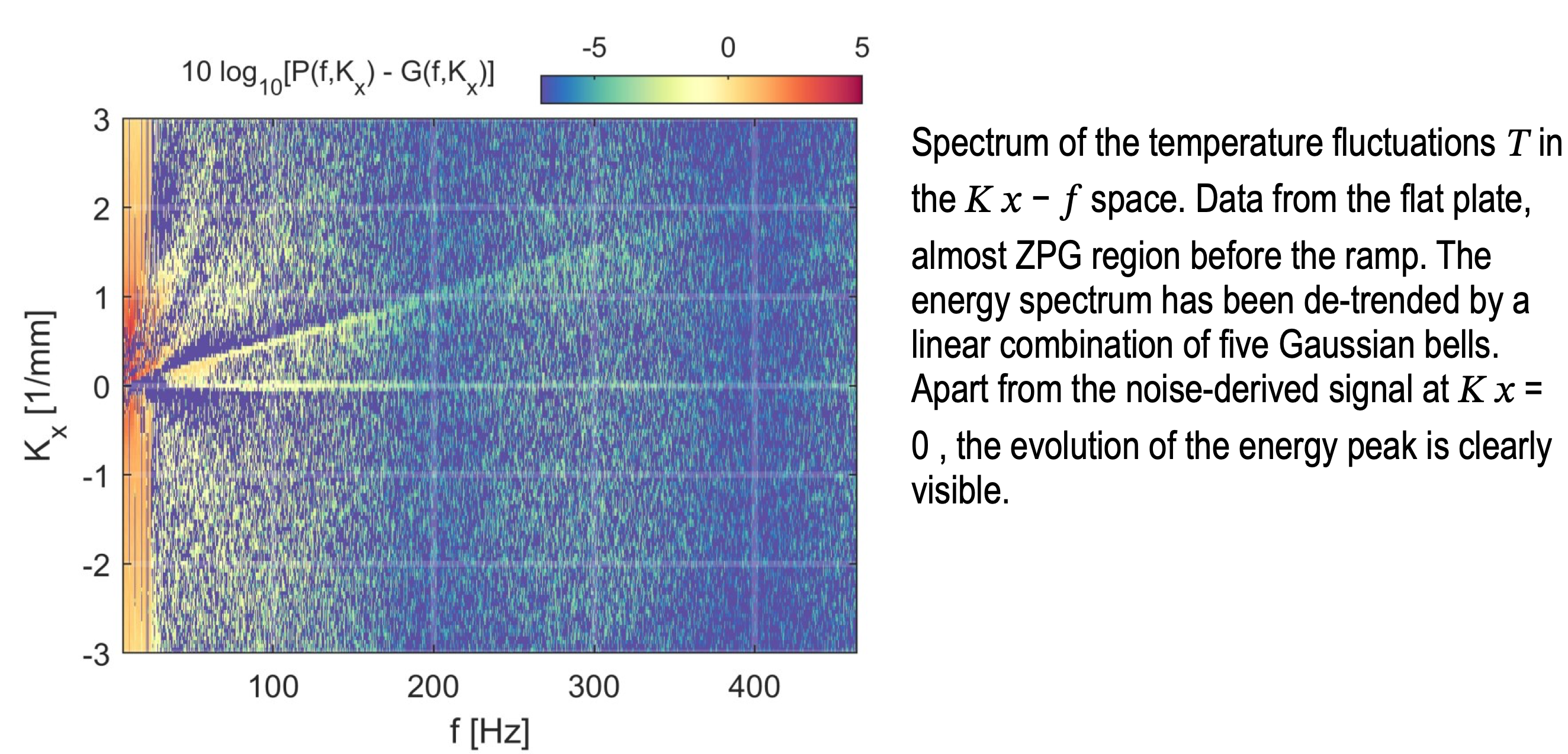
A strong interdependence exists between the thermal and momentum boundary layers. This so-called Reynolds Analogy establishes a connection between heat transfer and fluid friction in bounded flows, asserting that the same flow-induced structures govern both processes. As a direct consequence, the behavior of the flow over a slightly heated surface can be inferred from the evolution of the wall temperature field, 𝑇𝑤 (𝑥, 𝑦, 𝑧, 𝑡), where local temperature gradients are typically correlated with the distribution of wall shear stress. However, this assumption may induce misleading results in the experimental analysis of boundary layers, e.g., the detection of flow separation and reattachment, which do not necessarily occur at the minima and maxima of the time-averaged wall temperature: in fact, this kind of distribution can also originate as the consequence of other flow dynamical phenomena, such as laminar-turbulent transition. Such effects complicate the interpretation of thermal measurements and may lead to misinterpretations or spurious correlations. This misinterpretation can be avoided by considering the celerity of displacement of thermal perturbations of 𝑇 ′ (𝑥, 𝑧, 𝑡) = 𝑇𝑤 (𝑥, 𝑧, 𝑡) − 𝑇̅𝑤 (𝑥, 𝑧) (blobs) under the influence of 𝝉𝑤 . This 𝜕𝑇 representation does not rely, at least to a first-order approximation, on spatial temperature gradients . Recent 𝜕𝑥𝑖 advances in Temperature-Sensitive Paint (TSP) applications have greatly enhanced this technology, enabling nonintrusive measurements of the surface temperature distribution Tw with high-resolution in both space and time. This technique offers an innovative and visually compelling means of investigating near-wall fluid dynamical processes, allowing instantaneous observation of complex flow phenomena and their evolution. Given this scenario, the present study deepens the relevance of using TSP in advancing the understanding of flows undergoing separation and, in general, of skin friction exerted by the flow on a bounding surface, focusing on a TSP-based diagnostics of the flow before and after a Backward Facing Ramp (BFR). A qualitative, at-a-glance interpretation of the surface flow by Tw maps will be followed by the estimation of the 𝐾𝑥 − 𝑓 spectrum. The wall shear stress will be estimated using a stateof-the-art skin friction reconstruction algorithm based on the close correlation between the celerity of displacement of the temperature blobs and the friction velocity 𝑈𝑇 , as proposed in Miozzi et al. (2020, 2024) (TH method). Results will be compared with Shake-the-Box data regarding the identified reattachment location.