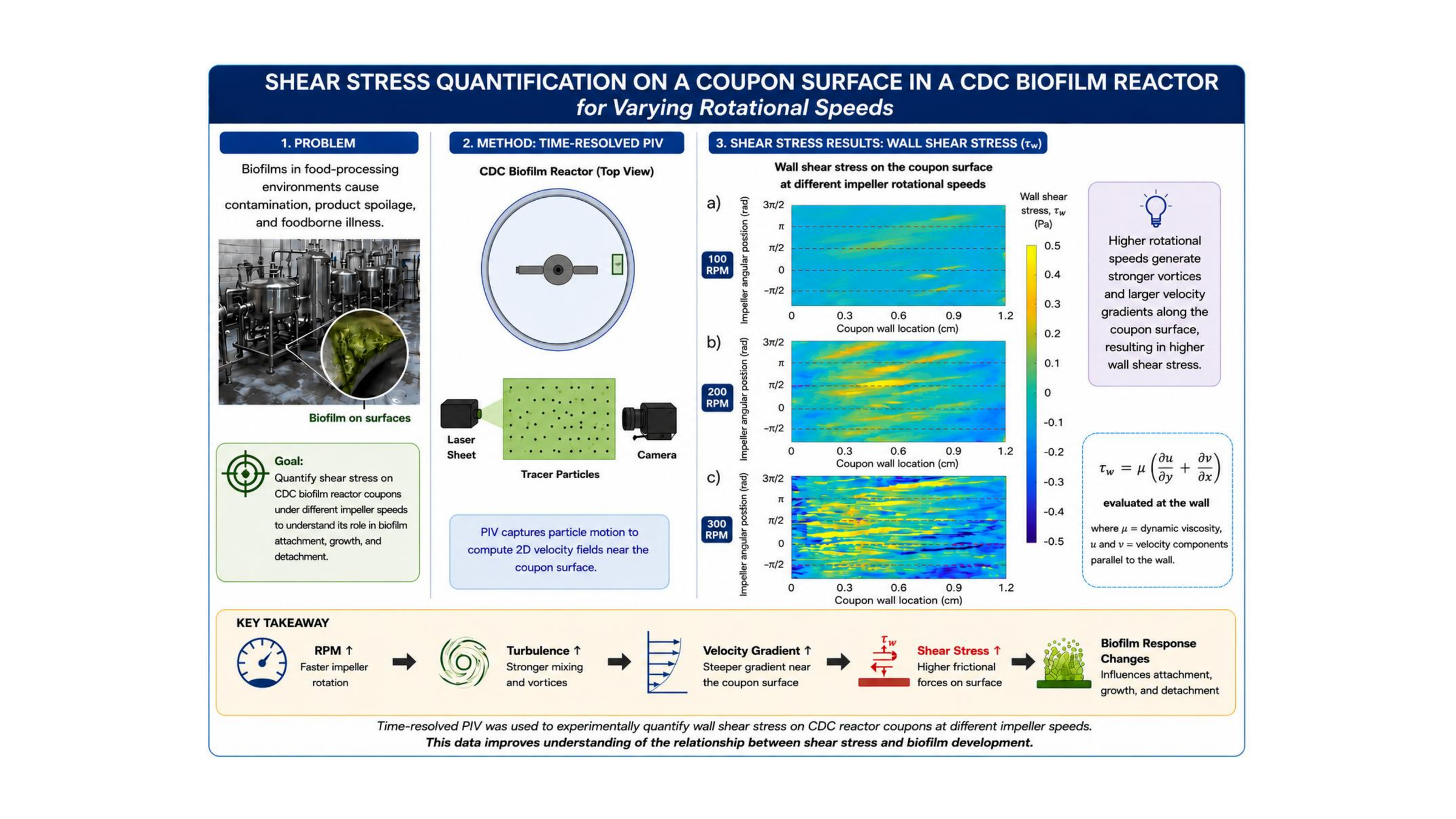
Shear stress quantification on a coupon surface in a CDC Biofilm reactor for varying rotational speeds
E.H. Kruszon(1), C.D. Eggleton(1), K. Moon(2), J. Patel(2), S. Bhattacharya(1)
1: Dept. of Mechanical Engineering, University of Maryland, Baltimore County
2: US Department of Agriculture, Agricultural Research Service, Environmental and Microbial Food Safety Laboratory, 307 Center Road, Beltsville, MD, 20705, USA
DOI:
Biofilms are dense microscopic communities or microorganisms that attach to surfaces. These communities pose challenges in food-processing environments due to their resistance to cleaning. This leads to an increase in foodborne illnesses and further contamination. Previous studies have suggested a relationship between hydrodynamic shear stress and biofilm development, but direct experimental quantifications of shear stress have no been measured. In this study, PIV was employed to characterize flow fields and quantify shear stress based on RPMs that are often seen in this environment. Velocity measurements revealed complex flow structures, vortex formation, and variation of shear stress associated with the impeller angluar position and cycle times. Peak wall shear stress locations happen prior to when the impeller is the closest to the coupon, or the cycle times 0 and π. These findings provide quantitative insight into the hydrodynamic environment experiences by the coupons in the CDC Biofilm reactor. Experimentation results displayed that 300 RPM has an average shear stress that is 26.02% larger then 100 RPM. This study established a framework for the influence of shear stress on biofilm attachment, growth, and detachment processes. Biofilms 1. PIV was applied to experimentally quantify wall shear stress on a CDC Biofilm reactors coupon surface. 2. Flow fields exhibit periodic vortex structures with localized high regions associated with the impeller tip passage across the reactors coupon. 3. Average wall shear stress increased from 0.420 Pa to 1.614 Pa as the impellers rotation increased from 100 RPM to 300 RPM. 4. Spatial and temporal wall shear stress distributions revealed non-uniform loading across the coupons surface. 5. Experimental shear stress measurements agreed with theoretical predications supporting the validity of the methodology.