Measurement of Temperature and pH Value in Microplates Using Two-Colour Laser-Induced Fluorescence Spectroscopy
P. Felbinger(1), M. Straußwald(2), P. Foehr(2), L. Zigan(1)
1: Institute of Thermodynamics, Universität der Bundeswehr München, Neubiberg, Germany
2: Inheco GmbH, Planegg, Germany
DOI:
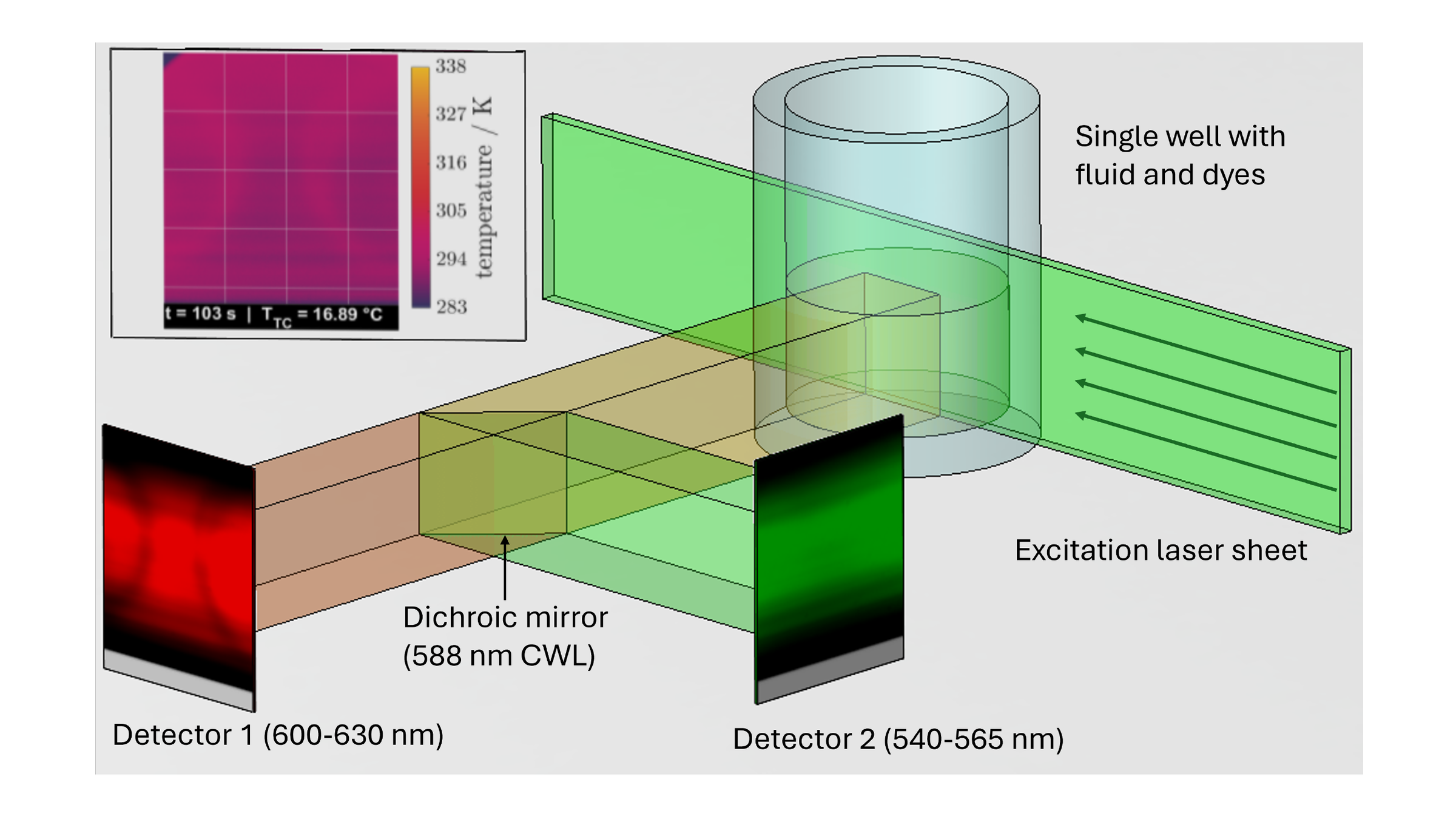
The two-colour laser-induced fluorescence (2c-LIF) technique enables the simultaneous spatial and temporal resolution of temperature and pH fields in liquid systems. In view of the continuous growth of the life sciences sector, particularly in molecular biology and diagnostics, this method offers significant potential for improving analytical and screening processes under realistic operating conditions. Within temperature-controlled microplate wells, confined liquid volumes in combination with vertical temperature gradients lead to the formation of thermally induced flow structures. These flows strongly influence scalar transport and mixing behaviour, which are critical for the performance and reproducibility of microscale assays. A detailed investigation of these coupled transport processes is therefore essential. In this study, a Fluorescein/Sulforhodamine 101 dye system in aqueous solution is used for parallel spectroscopic and imaging-based thermometry in the temperature range from 283 K to 343 K. The spectroscopic approach achieves temperature sensitivities between 2 %/K and 6 %/K, while the imaging-based method provides sensitivities from 2 %/K to 3.5 %/K. This corresponds to a statistical temperature precision of approximately 0.23 K to 0.50 K. Absorption-corrected dual-camera imaging enables quantitative full-field temperature measurements and allows the temporal evolution of thermally driven flow structures to be resolved during dynamic heating processes. These thermal movements can be quantified using the local Peclet number. In buffered solutions (pH 6–11), the fluorescence intensity ratio exhibits a linear response in the range between pH 6 and 9, enabling spatially resolved visualization of biochemical mixing. To quantify mixing dynamics, time-resolved isothermal droplet injection experiments are conducted in the absence of external forcing. A normalized mixing index based on the coefficient of variation is introduced to determine homogenization times and to assess the relative contributions of advective and diffusive transport. Overall, 2c-LIF provides a robust diagnostic framework for investigating coupled heat and mass transfer in confined microplate systems and for analysing transport-driven mixing processes in microscale liquid volumes.