Two-color laser-induced fluorescence thermometry in model fuels under transcritical conditions
A. Schaumäker, L. Zigan
Institute of Thermodynamics, Universität der Bundeswehr München, Neubiberg, Germany
DOI:
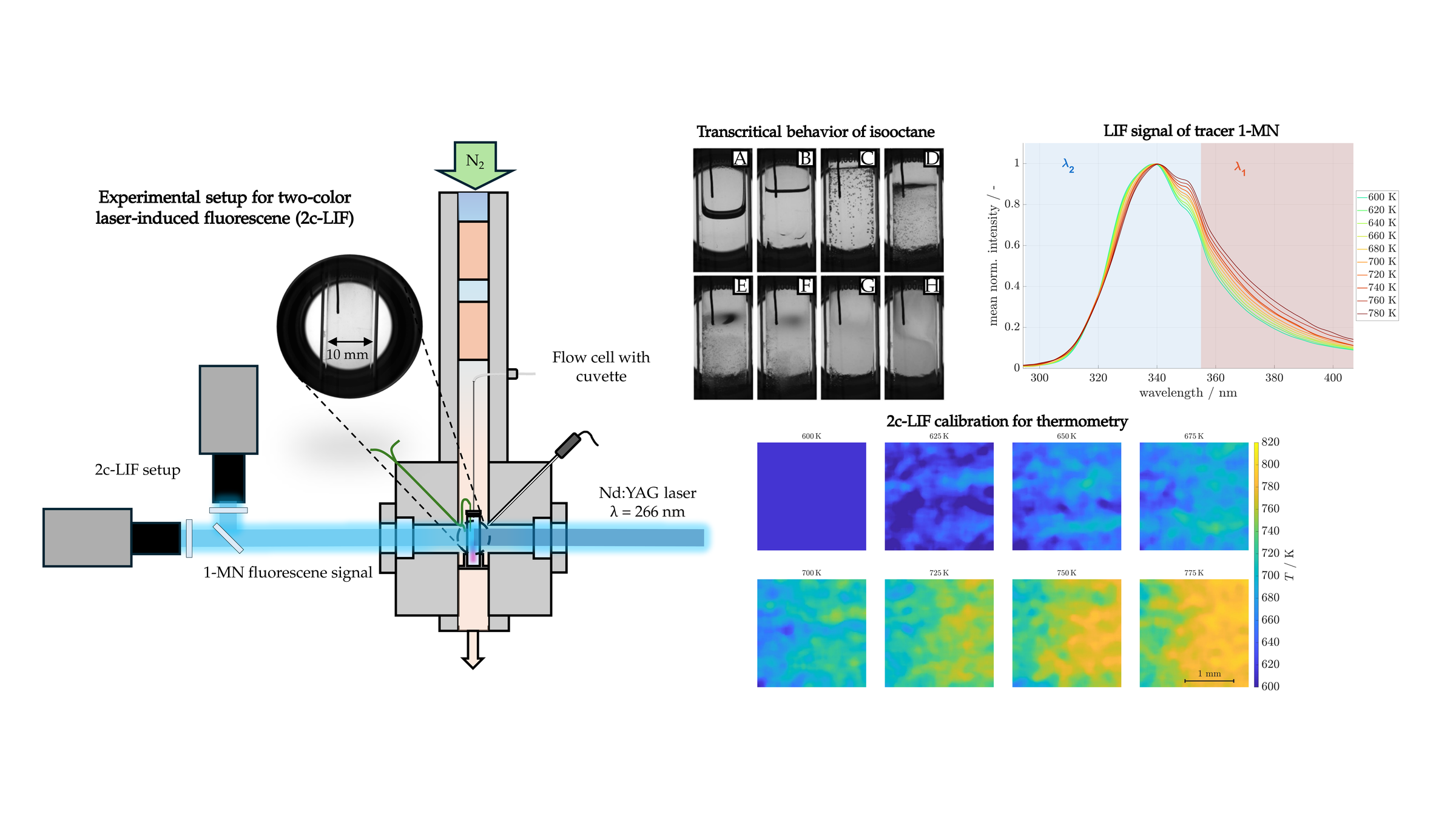
This work presents two-color laser-induced fluorescence (2c-LIF) using 1-methylnaphthalene (1-MN) as a tracer for thermometry in trans- and supercritical isooctane. The experiments are conducted in an optically accessible high-pressure flow cell at 3 MPa (), where in a nitrogen atmosphere an isooctane/1-MN mixture is heated in a quartz-glass cuvette from liquid conditions through a transition regime into the supercritical state. Fluorescence is excited at 266 nm by a pulsed Nd:YAG laser and detected simultaneously in two spectral channels using intensified sCMOS cameras equipped with different longpass filters. Additional spectrometer measurements are used to characterize the temperature-dependent spectral behavior of the 1-MN fluorescence emission. A calibration of the normalized LIF signal ratio is established for the supercritical regime between 600 K and 779 K, corresponding to reduced temperatures of to . Within this range, the calibration shows an average sensitivity of approximately 8 % per 100 K and enables the spatial evaluation of local temperature gradients. In the liquid phase and the transition region such a dependence is not found. The results demonstrate the feasibility of 1-MN-based 2c-LIF thermometry in supercritical pure fluids and provide calibration data for isooctane under transcritical operating conditions. These findings form a basis for future investigations of fuel-rich mixtures in sprays, other model fuels, and combined diagnostic approaches for distinguishing liquid, transitional, and supercritical regions. Further investigations will focus on measurements in droplets and sprays, different model fuels and techniques to discriminate between the different phases.