Low-Pressure Hydrogen Jets from a Single Hole Injector Investigated With 2D Raman and Schlieren Imaging
B. Rüppel(1,2), B. Lehnert(1,2), S. Rieß(1,2), E. Berrocal(2,3), M. Wensing(1,2)
1: Friedrich-Alexander-Universität Erlangen-Nürnberg (FAU), Professorship for Fluid Systems Technology, Cauerstraße 4, 91058 Erlangen, Germany
2: FAU, Erlangen Graduate School in Advanced Optical Technologies (SAOT), Konrad-Zuse-Straße 3-5, 91052 Erlangen, Germany
3: Division of Combustion Physics, Department of Physics, Lund University, P.O. Box 118, SE-22100 Lund, Sweden
DOI:
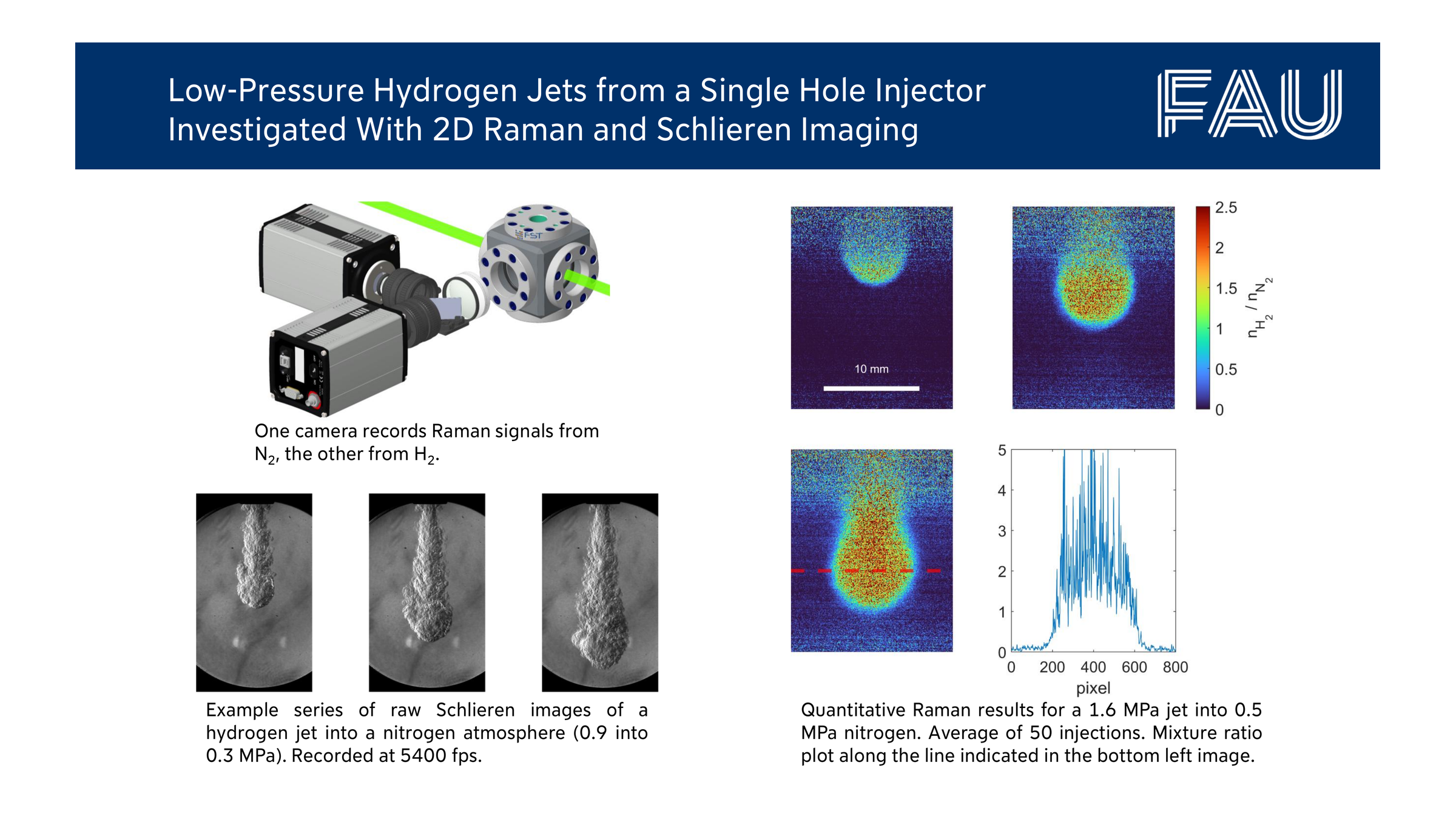
This work presents a combined Schlieren and Raman imaging methodology to quantify the spatio-temporal hydrogen–nitrogen mixture ratio of single hole injector jets in an optically accessible chamber at low pressures. The facility accommodates a constant N 2 purge flow, chamber pressures up to 0.6 MPa, and an in-house modified Synerject Strata~1 injector with a single hole cap. Schlieren imaging employs a 640 nm high-speed laser and a high-framerate camera to capture jet morphology. For quantitative species mapping, a temporally stretched double-pulse 532 nm Nd:YAG laser of combined energy of 0.8 J traverses the chamber as a light sheet beneath the injector tip. Raman signal collection happens orthogonally and spectrally split to dedicated detection paths for N2 signals at 607 nm and H2 signals at 683 nm, each recorded on a low-noise sCMOS camera with 50 µs exposure and an appropriate band pass filter. Stepping the delay between injection and laser constructs time-resolved Raman sequences, averaging 50 shots per frame to overcome single-shot signal limitations. Quantification relies on pixel-wise intensity ratios, where a calibration factor incorporates the species-dependent Raman scattering cross sections and the wavelength dependencies of the full detection chain. The calibration matrix is derived from known H2/N2 mixtures at two pressure levels that yield values close to prior point-measurement benchmarks. Rigorous image processing includes geometric transformation for pixel overlap, subtraction of laser-independent dark images acquired between laser pulses, and laserinduced background removal by subtraction of isolated background images taken in helium fills. Interpolation and median filtering mitigate near-zero divisions. Schlieren images provide clear jet outlines and facilitate penetration and cone-angle tracking but lack direct physical meaning for the apparent boundary. In contrast, Raman mapping reveals a mixture-fraction gradient at the jet edge and captures nitrogen entrainment toward the core, with uncertainty increasing where N2 counts approach zero. Non-uniform illumination limits the region of good signal-to-noise ratio, because one beam of the double-pulse is diverging and thereby restricting how close illumination can come to the injector. Example cases with comparable pressure ratios (0.9 MPa H2 into 0.3 MPa N2 for Schlieren; 1.6 MPa H2 into 0.5 MPa N2 for Raman) show good agreement in overall jet shape. Raman imaging enables quantitative, time-resolved mixture-field data at moderate pressures for model validation. Planned improvements target light-sheet uniformity and placement, comprehensive uncertainty analysis for various evaluation strategies and a systematic parametric study of jets under a variation of pressure ratios.