Burst-Mode Imaging Analysis of Flicker Oscillations in an Unsteady Hydrogen/Air Jet Flame Using Proper Orthogonal Decomposition
C. Schweizer, B. Barviau, F. Grisch
Normandie Univ., UNIROUEN, INSA Rouen, CNRS, CORIA, 76000 Rouen, France
DOI:
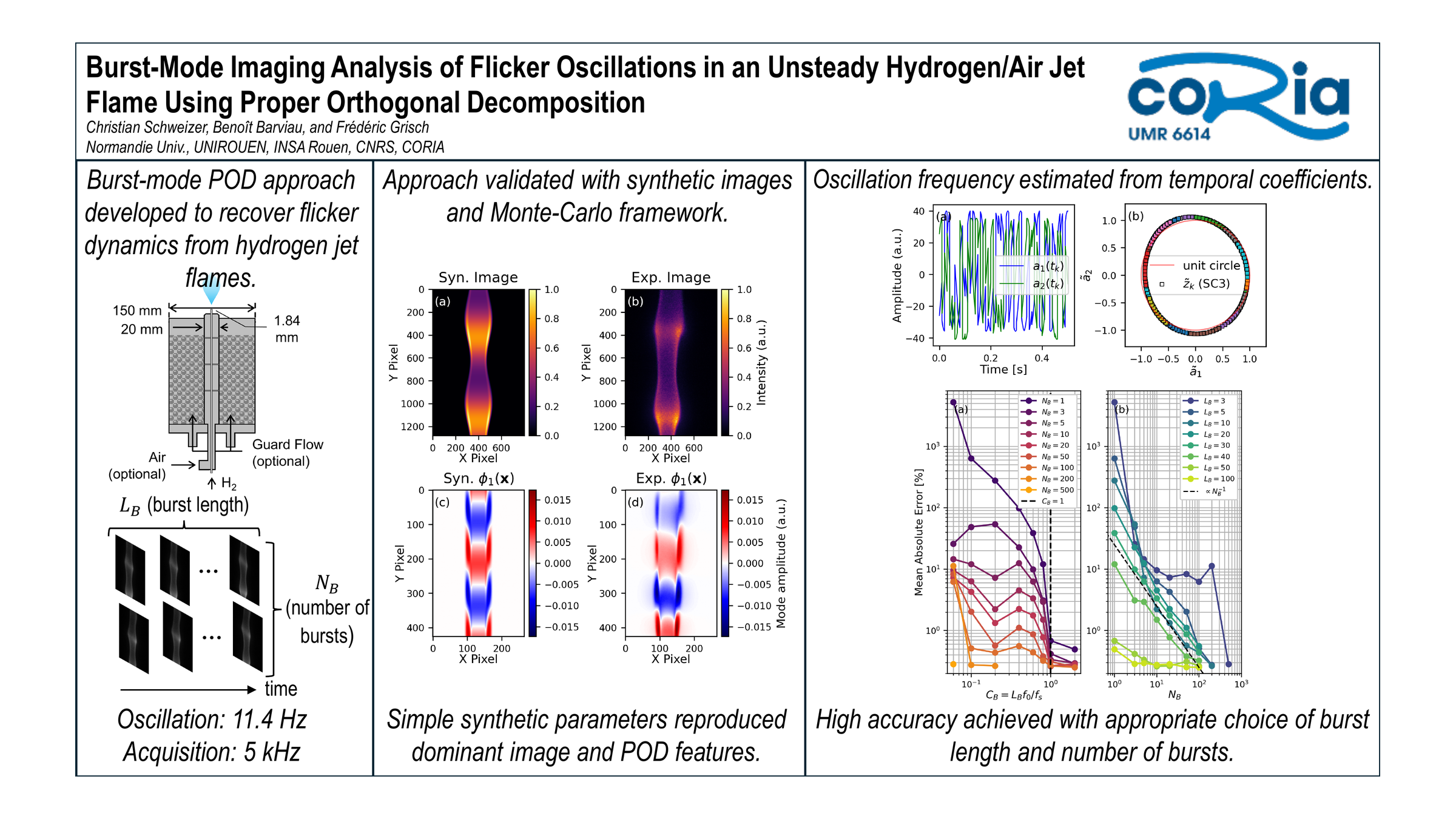
Proper orthogonal decomposition (POD) was applied to 5-kHz images of an unsteady H₂/air jet flame to demonstrate its suitability for recovering dynamical information from high-repetition-rate burst-mode measurements. To make progress toward obtaining robust descriptions of turbulent flame dynamics, an unsteady flickering flame with a well-defined low-frequency oscillation was first considered. The POD approach was validated using synthetic flame images, where the oscillation frequency at 10 Hz was successfully estimated from long, continuous recordings and ensembles of short bursts, demonstrating the efficacy of the analysis even under the acquisition constraints characteristic of burst-mode laser systems. Further analyses of synthetic oscillations at 100 Hz and 500 Hz elucidated the primary error-reduction mechanisms and showed that the estimation error can be reduced below 1% with appropriate choices of the burst length and the number of bursts. POD was then applied to experimental ensembles of image bursts with an underlying flicker frequency of 11.4 Hz. For these cases, the oscillation frequency was successfully recovered, along with the detailed spatiotemporal representation of the flame. These findings establish POD as a useful tool for burst-mode imaging analysis and provide a foundation for its application to faster dynamics and with laser-based imaging diagnostics such as OH-PLIF, NO-PLIF, and PIV.