Experimental investigation of mixing interface fluctuation in non-isothermal flows
Z. Feng, Z. Li, X. Meng, Z. Xing, Y. Jiao, Y. Huang
School of Aerospace Engineering, Xiamen University, ,China
DOI:
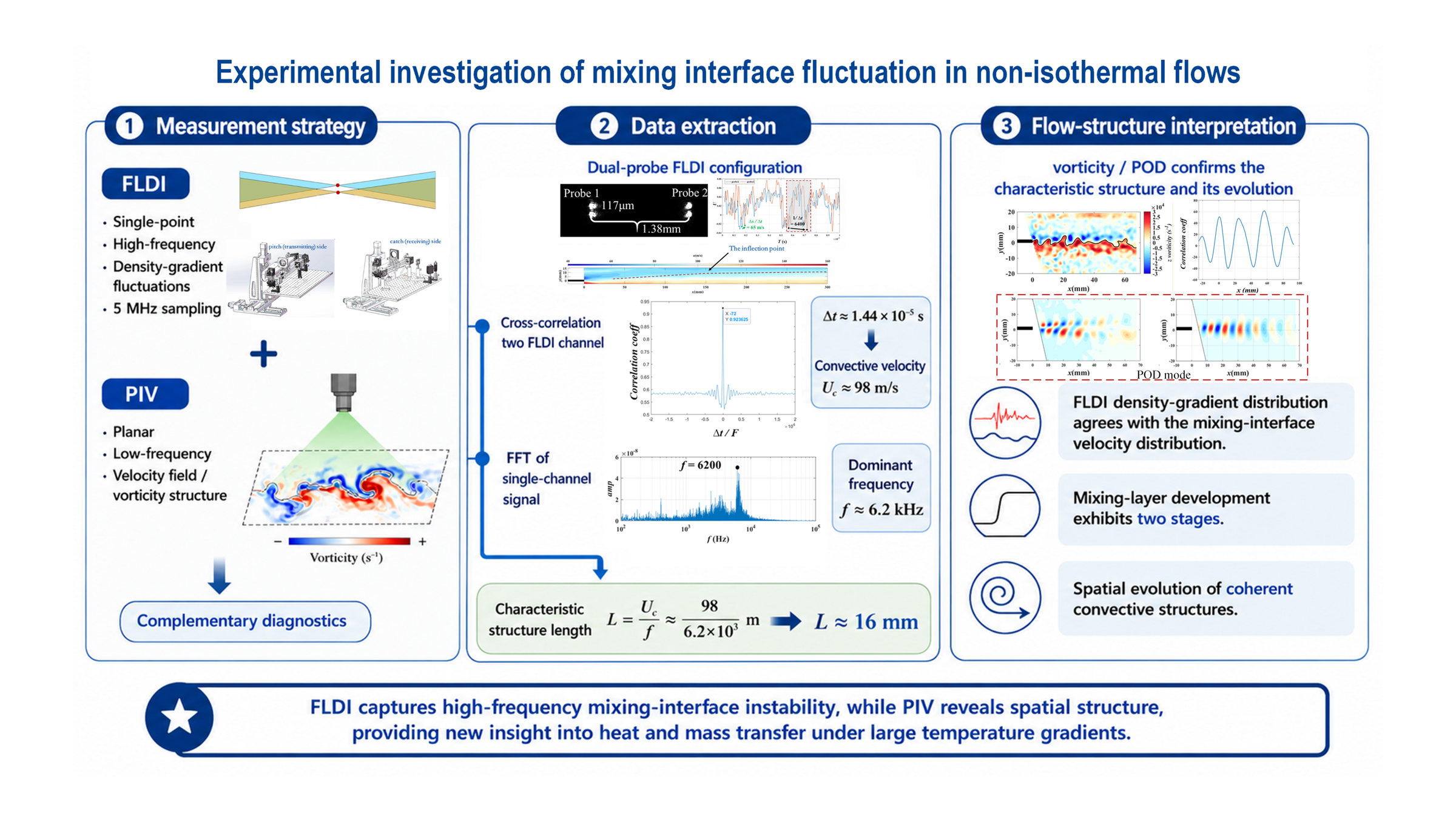
This study investigates the mixing flow of two streams with a large temperature difference using an integrated focused laser differential interferometry (FLDI) system and particle image velocimetry (PIV). The FLDI system was established to capture high-frequency density-gradient fluctuations, while PIV was employed to obtain the velocity-field distribution. The optical-path sensitivity length was evaluated using a small CO₂ jet and was found to be approximately 50 mm. High-frequency density-gradient fluctuations were measured at a sampling rate of 5 MHz using two closely spaced FLDI beam pairs with a streamwise separation of 1.38 mm and a spatial resolution of 117 μm. Cross-correlation of the two probe signals yielded a convective velocity of approximately 96 m/s, which showed good agreement with the PIV results. Spectral analysis based on fast Fourier transform identified a dominant frequency, corresponding to a characteristic convective structure length of about 16 mm. This characteristic length was further supported by instantaneous vorticity-based interface detection and proper orthogonal decomposition analysis. High-resolution measurements at 330 locations across the mixing section revealed a deflection in the expansion angle of the mixing-interface velocity distribution, suggesting that the development of heat and mass transfer can be divided into two distinct stages. The density-gradient distributions obtained by FLDI were consistent with the mixing-interface velocity distribution and with trends reported in related studies. These results demonstrate the capability of FLDI for resolving high-frequency mixing-interface instabilities under large temperature gradients and provide new insight into heat and mass transfer modeling in non-isothermal mixing flows.