Spontaneous Raman thermometry mapping of an overexpanded supersonic jet
R. Santagata(1), C. Pivard(1), P. Nicolas(1), N. Lupoglazoff(2), A. Langenais(2), R. Jalain(2), M. Scherman(1)
1: ONERA/DPHY, Université Paris Saclay, F-91123, Palaiseau, France
2: ONERA/DMPE, Université Paris Saclay, F-91123, Palaiseau, France
DOI:
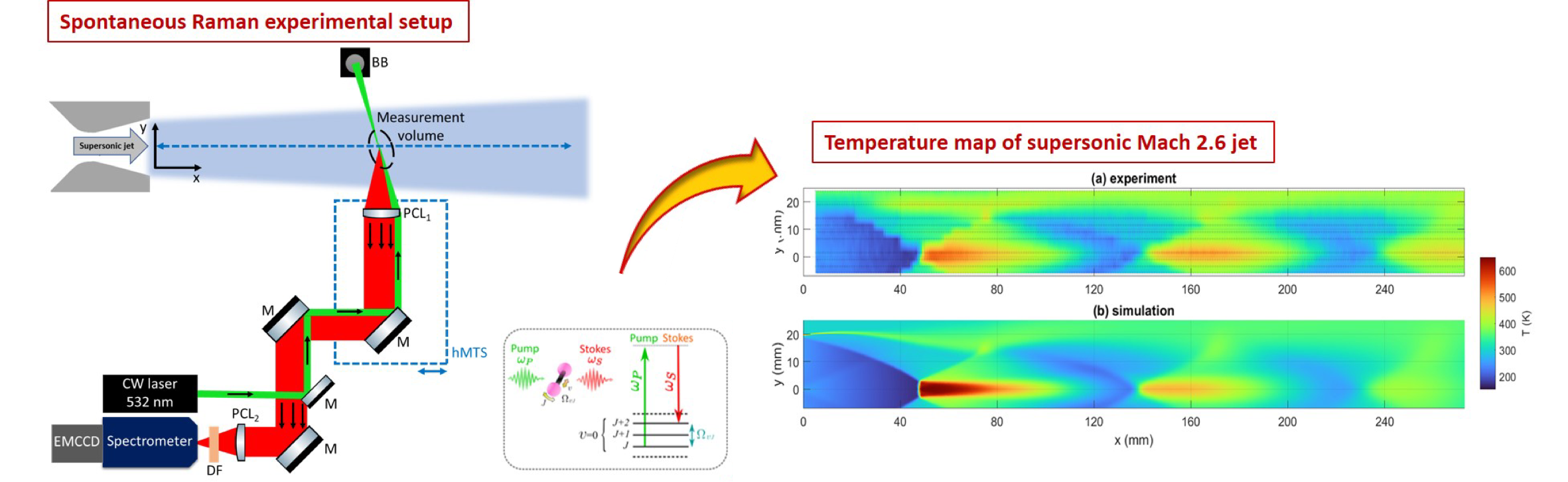
This work reports in-situ non-invasive temperature measurements performed by spontaneous Raman scattering thermometry in a large-scale round free-stream supersonic heated air jet produced by the ADIJE facility at ONERA, equipped with a convergent-divergent de Laval nozzle and producing a flow reaching Mach 2.6 in order to simulate gas exiting the nozzle of a supersonic vehicle. Spontaneous Raman scattering thermometry is employed to investigate the temperature distribution within the jet, which exhibits a cellular shock structure. The medium is excited using a continuous monochromatic laser radiation at 532 nm emitted from a high-power fiber laser (10 W) focused using a 150 mm focal length lens. The backward spontaneous Raman scattering is collected and analyzed in a 300-mm focal spectrometer. The well-resolved rotational structure of N2 and O2 follows a Boltzmann distribution that is fitted to estimate the internal temperature at the measurement volume. Hyperspectral data are acquired by scanning the measurement volume across the flow in several planes of interest. A state-of-the-art precision of ~0.3% in ambient air was obtained using signal accumulation over 1 s, and allowing to build temperature maps in the range 150–600 K with a 1 mm × 2.5 mm spatial sampling over a large area (~100 cm²). The experimental 2D maps showed overall good agreement with LES simulation revealing the precise structure of the flow in different planes of interest. To the best of the authors' knowledge, the temperature mapping presented in this work is unprecedented in terms of both spatial resolution and measurement coverage, enabling the detailed reconstruction of multiple shock cells topology. The achieved results outline the performance of spontaneous Raman scattering thermometry to provide in-situ quantitative diagnostics in realistic supersonic jets with the aim of build highly valuable experimental databases as a support for model validation.