Laser-Induced Phosphor Thermography on Surfaces in Humid Crossflow using Zinc Oxide
T. Fuhrmann(1), S. Sewalski(2), M. Käß(2), R. Poser(1), G. Lamanna(1)
1: Institute of Aerospace Thermodynamics, University of Stuttgart, Germany
2: Materials Testing Institute, University of Stuttgart, Germany
DOI:
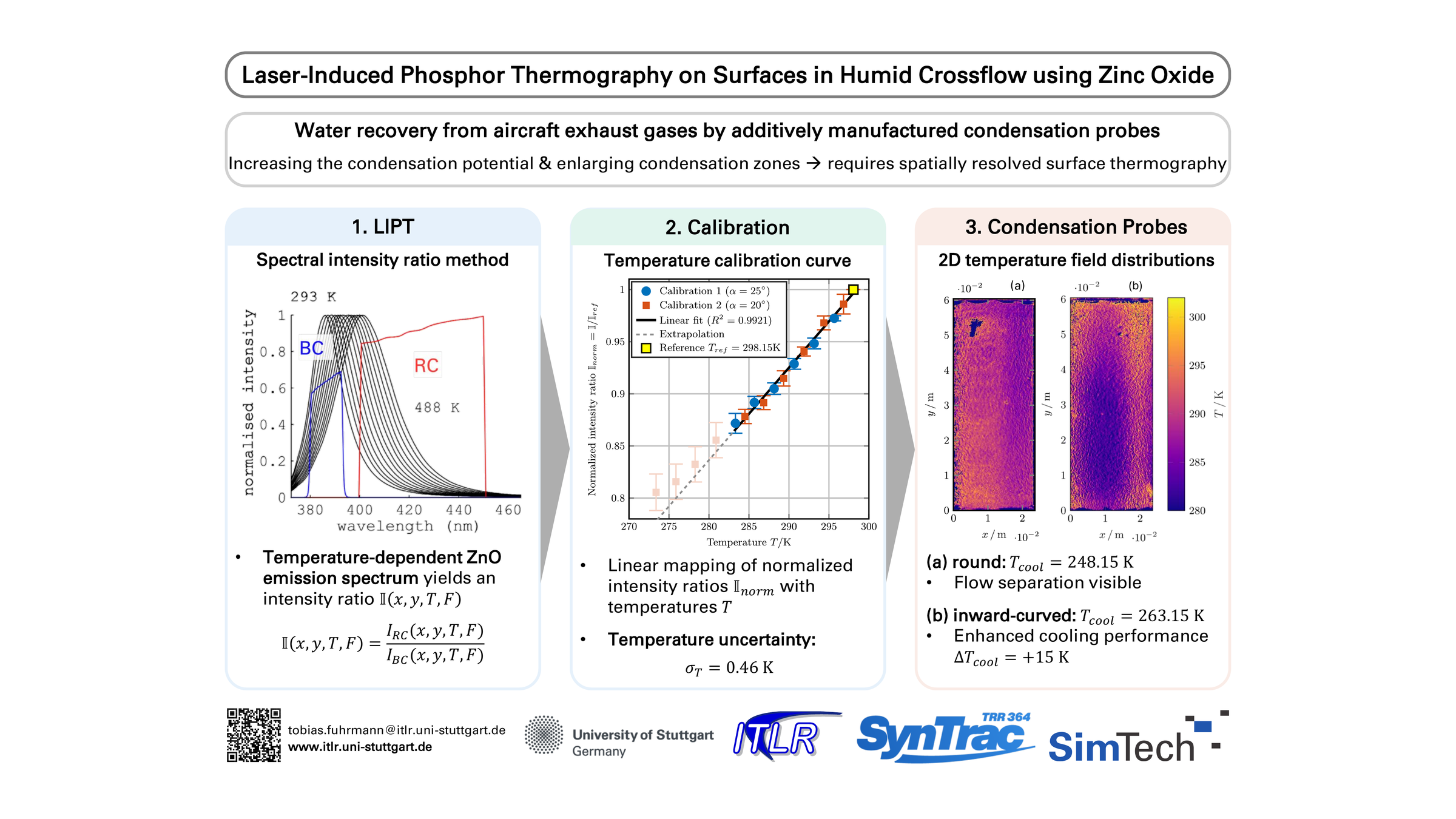
The increase of water content of the exhaust gas due to direct injection of water into the combustion chamber or the addition of urea to the exhaust gas promotes contrail formation and makes the water recovery in turbomachinery a potential benefit. In this work, Laser-Induced Phosphor Thermography (LIPT) based on the spectral intensity ratio method is employed to obtain two-dimensional surface temperature distributions on additively manufactured condensation probes exposed to a humid turbulent crossflow. A calibration facility for zinc oxide coatings on surfaces with temperatures between Tmin = 283.15 K and Tmax = 298.15 K was established and successfully put into operation with a temperature uncertainty of σT = 0.46 K. Using this calibration, LIPT measurements were performed on two additively manufactured condensation probe geometries, a basic round geometry and an inward-curving square tube geometry. The resulting two-dimensional surface temperature fields qualitatively reveal consistent features on both probes, in particular a horizontal temperature gradient marking the location of turbulent boundary-layer separation on the basic round geometry. Beyond this qualitative agreement, the comparison between the two geometries demonstrates the enhanced cooling performance of the inward-curving square tube probe: despite a coolant temperature elevated by 15 K, its surface temperature in the inward-curved area remains below that of the basic round sample. This finding is consistent with the design intent of the modified geometry, which was optimized to create zones with increased condensation potential and to enlarge the existing condensation zones of the basic geometry. The presented results highlight the capability of LIPT to resolve subtle differences in the local temperature distribution of complex, additively manufactured surfaces and provide a basis for further optimization of condensation probe geometries and heat transfer analysis.