Evaluation of the thermal performance of an Organ-on-a-Chip device: a numerical study
M. Ferreira(1), G. Nobrega(1,2), L. Neves(1), C. Faria(1), A. Moita(3,4), D. Pinho(5,6), R.A. Lima(1,7,8)
1: Mechanical Engineering and Resource Sustainability Center (MEtRICs), Mechanical Engineering Department, University of Minho, Campus de Azurém, 4800-058 Guimarães, Portugal.
2: Centro de Investigação de Montanha (CIMO), Campus de Santa Apolónia, Instituto Politécnico de Bragança, 5300-253 Bragança, Portugal.
3: IN+, Center for Innovation, Technology and Policy Research, Instituto Superior Técnico, Universidade de Lisboa, Av. Rovisco Pais, 1049- 001 Lisboa, Portugal.
4: CINAMIL—Centro de Investigação Desenvolvimento e Inovação da Academia Militar, Academia Militar, Instituto Universitário Militar, Rua Gomes Freire, 1169-203 Lisboa, Portugal.
5: Center for MicroElectroMechanics Systems (CMEMS), University of Minho, Campus de Azurém, 4800-058, Guimarães, Portugal.
6: Associate Laboratory in Biotechnology and Bioengineering and Microelectromechanical Systems (LABBELS) – University of Minho, Braga/Guimarães, Portugal.
7: Transport Phenomena Research Center (CEFT), Faculdade de Engenharia da Universidade do Porto (FEUP), Rua Roberto Frias, 4200- 465 Porto, Portugal.
8: Associate Laboratory in Chemical Engineering (ALiCE), Faculty of Engineering, University of Porto, 4200-465 Porto, Portugal.
DOI:
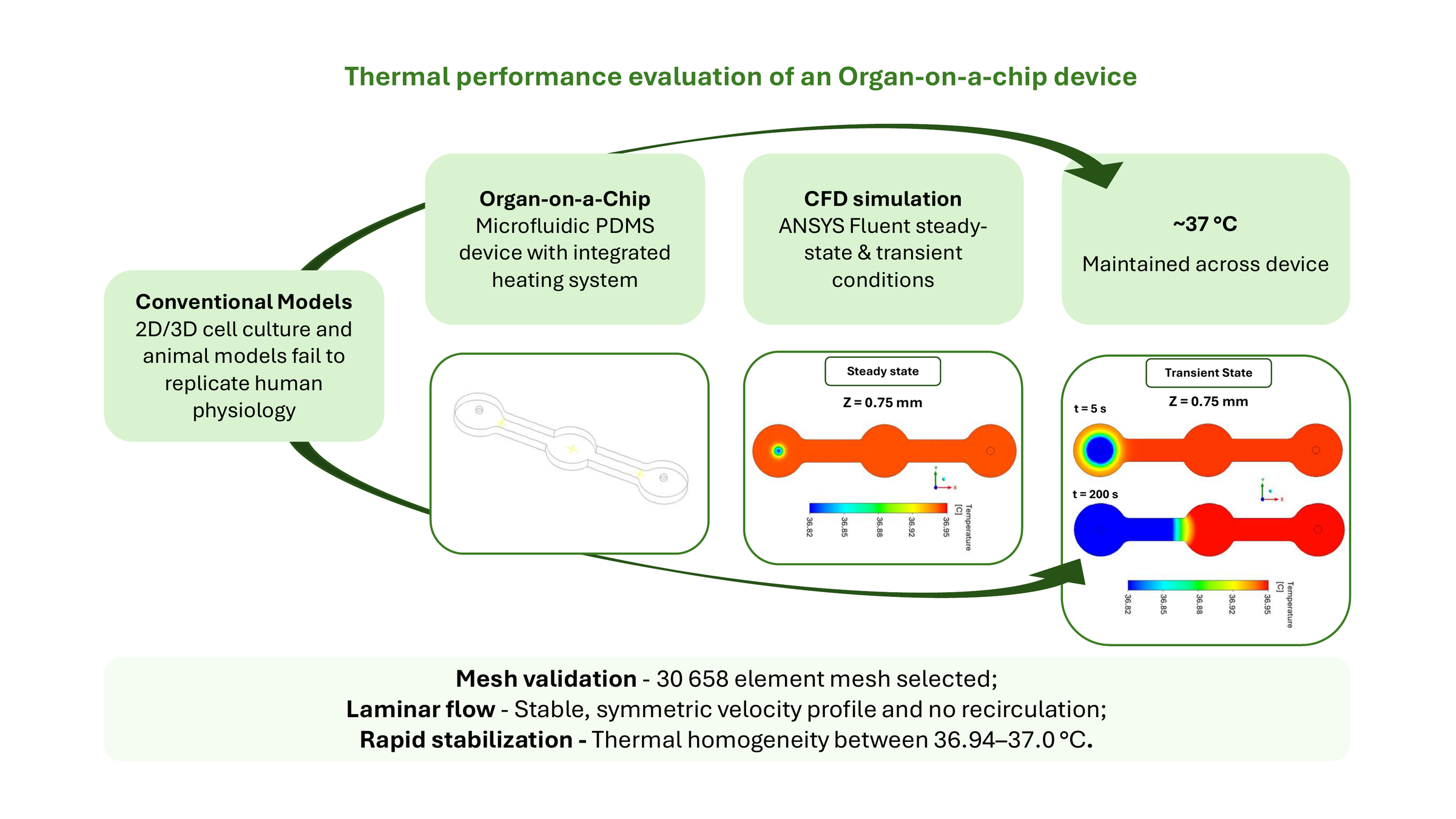
Conventional 2D and 3D culture models and animal testing fail to accurately reproduce human physiological complexity, limiting the predictive capability of preclinical studies. Organ-on-a-Chip (OoC) platforms have emerged as a promising alternative by enabling precise control of the cellular microenvironment. In this work, a microfluidic system incorporating an integrated heating strategy for OoC applications was developed and analyzed, aiming to maintain physiological temperature conditions (~37 °C). Computational fluid dynamics (CFD) simulations were performed using ANSYS Fluent to investigate fluid flow and heat transfer within the device. The microfluidic device was designed to contain an inlet, a main circular reservoir, and an outlet, connected by narrow channels. A heating boundary condition of 37 °C was imposed on the external bottom wall of the device, while the fluid entered at room temperature (25 °C) at a flow rate of 500 μL/h. A mesh sensitivity study was conducted using three hexahedral meshes comprising 9 599, 30 658, and 99 440 elements. The medium mesh (30 658 elements) was selected as it provided the best balance between computational cost and accuracy, with an average orthogonal quality of 0.975 and an average skewness of 0.112, both classified as excellent. Steady-state simulations demonstrated stable and symmetric laminar velocity profiles throughout the geometry, with no recirculation zones observed. The flow field exhibited a parabolic cross-sectional profile in the channels and a radial deceleration pattern within the reservoir, consistent with low Reynolds number microfluidic behavior. Regarding thermal performance, temperature monitoring at five points along the device confirmed that regions downstream of the inlet (P2–P5) reached values between 36.943 °C and 36.945 °C under steady-state conditions, closely approaching the physiological target. Only the inlet point (P1) recorded a lower temperature (28.753 °C) due to the continuous entry of cooler fluid. Transient simulations at t = 5 s and t = 200 s confirmed rapid thermal stabilization: by t = 200 s, temperatures at P2–P5 reached 36.971–36.993 °C, demonstrating progressive convergence toward a highly uniform thermal regime. These results validate the proposed heating strategy as an effective and computationally efficient approach to maintaining physiological temperature in OoC platforms, supporting the development of more reliable in vitro models for biomedical research and drug screening applications.