Evaluation of the thermal performance of PDMS composite serpentines combined with a synthesized green nanofluid
G. Nobrega(1,2), I.S. Afonso(1,2,3), B. Cardoso(1), R. Souza(4), D. Perdigão(1), F. Marques(1), C. Vilarinho(1), A. Moita(4,6), R.A. Lima(1,7,8)
1: Mechanical Engineering and Resource Sustainability Center (MEtRICs), Mechanical Engineering Department, University of Minho, Campus de Azurém, 4800-058 Guimarães, Portugal
2: Centro de Investigação de Montanha (CIMO), Campus de Santa Apolónia, Instituto Politécnico de Bragança, 5300-253 Braganca, Portugal;
3: International Iberian Nanotechnology Laboratory, 4715-330 Braga, Portugal
4: IN+, Center for Innovation, Technology and Policy Research, Instituto Superior Técnico, Universidade de Lisboa, Av. Rovisco Pais, 1049- 001 Lisboa, Portugal;
5: Centro de Investigação de Montanha (CIMO), Campus de Santa Apolónia, Instituto Politécnico de Bragança, 5300-253 Braganca, Portugal;
6: CINAMIL—Centro de Investigação Desenvolvimento e Inovação da Academia Militar, Academia Militar, Instituto Universitário Militar, Rua Gomes Freire, 1169-203 Lisboa, Portugal
7: Transport Phenomena Research Center (CEFT), Faculdade de Engenharia da Universidade do Porto (FEUP), Rua Roberto Frias, 4200- 465 Porto, Portugal;
8: Associate Laboratory in Chemical Engineering (ALiCE), Faculty of Engineering, University of Porto, 4200-465 Porto, Portugal.
DOI:
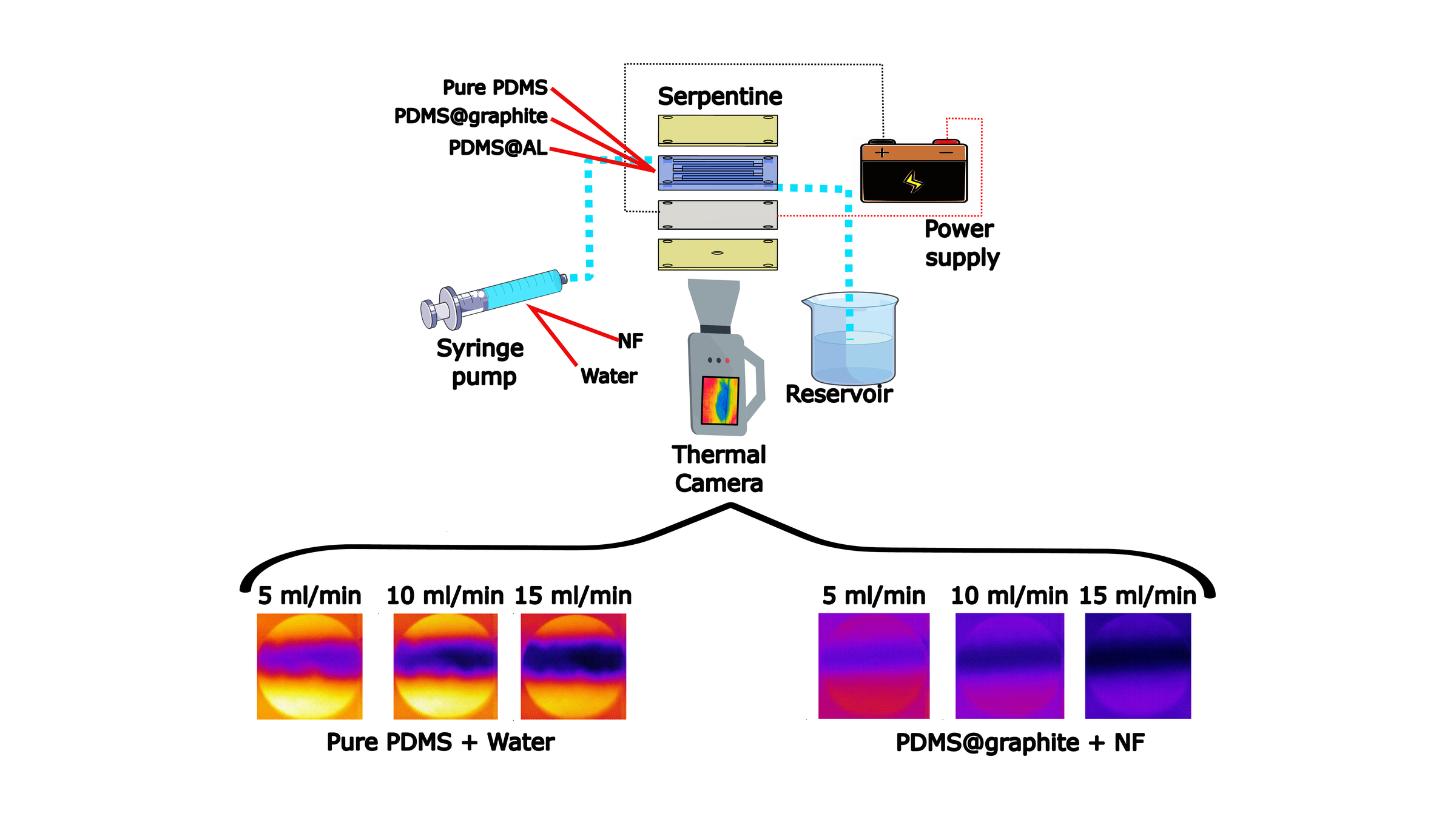
As electronic components advance, managing areas of high heat density creates significant thermal management challenges. Polydimethylsiloxane (PDMS) has emerged as an attractive material for cooling systems due to its adaptability, low cost and ease of molding into complex channel geometries. However, its intrinsically low thermal conductivity remains a primary limitation. Concurrently, nanofluids (NFs) have shown promise in multiplying a fluid's heat transfer capacity, yet their commercial application is frequently hindered by high production costs and stability issues such as particle agglomeration. This study investigates a novel, sustainable approach to surface cooling by evaluating composite PDMS heat exchangers paired with a highly stable, green-synthesized nanofluid. A water-based iron oxide NF (0.05 wt%) was successfully synthesized utilizing an aqueous extract of the alga Chlorella vulgaris as a biological reducing agent. To overcome the thermal insulating properties of the base polymer, composite serpentines featuring 5 mm square channels were fabricated by integrating 30 wt% recycled graphite microparticles (PDMS@Graphite) and 30 wt% commercial aluminum nanoparticles (PDMS@Al) into the pure PDMS matrix. The thermal performance of these millimeter-scale cooling systems was experimentally evaluated against pure PDMS serpentines using both the green NF and distilled water. The fluids were pumped at flow rates of 5, 10, and 15 ml/min over a 65 mm by 65 mm stainless-steel sheet heated by a 6W direct-current power supply, with the real-time surface heat distribution continuously monitored via an infrared thermal camera. Experimental data revealed that increasing the fluid flow rate systematically reduced both the average and maximum surface temperatures across all configurations due to enhanced convective heat transfer. Among the heat exchanger materials tested, the PDMS@Graphite composite exhibited the highest overall thermal efficiency. When operating with pure water at 15 ml/min, this composite achieved an average surface temperature reduction of up to 12% and maintained maximum temperatures at least 7.5 °C below those recorded for pure PDMS, providing the most homogeneous heat distribution. The green iron oxide NF successfully minimized temperature gradients and promoted exceptional thermal uniformity, particularly within the pure PDMS serpentine. However, within the highly conductive composite serpentines, the NF did not has better colling performance when compared to pure water , likely due to the inherently lower specific heat of the iron oxide nanoparticles. Ultimately, integrating recycled graphite into PDMS presents an effective, scalable solution for advanced thermal management.