Assessment Of PIV Load-Estimation Techniques For 2D And 3D Bluff Bodies
S.M. Dastjerdi, W. Terra, A. Sciacchitano
Delft University of Technology, Delft, the Netherlands
DOI:
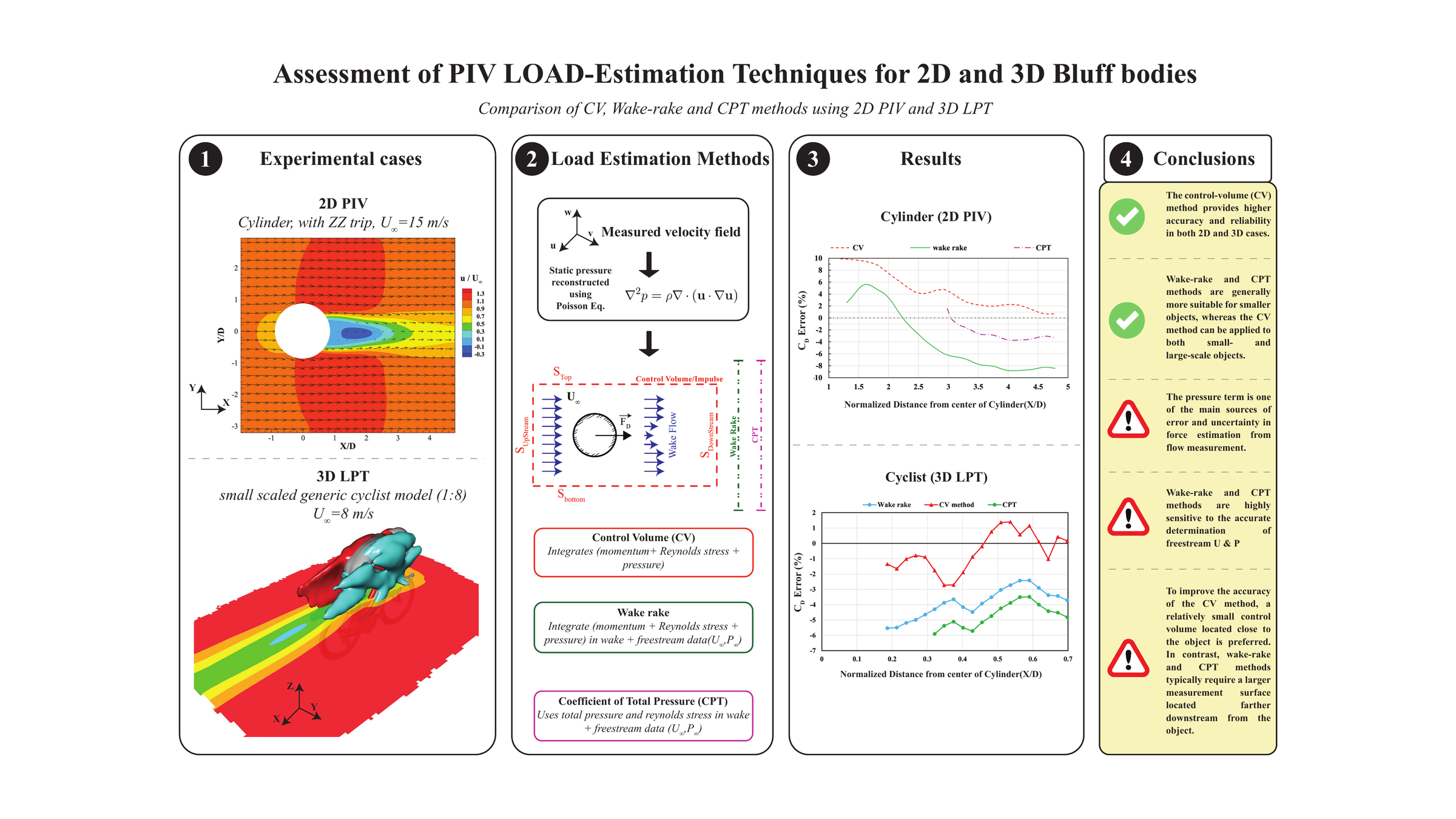
In this study, the accuracy and practical limitations of three PIV-based load-estimation methods are assessed for 2D and 3D bluff-bodies using two-dimensional PIV and three-dimensional Lagrangian particle tracking (LPT) data. The investigated methods are the control-volume (CV) approach, the wake-rake approach, and the total pressure coefficient (CPT) approach. The CV method computes the aerodynamic load by integrating the momentum, Reynolds stress, and pressure contributions over a control surface enclosing the object, whereas the wake-rake and CPT methods estimate drag from downstream wake-plane measurements using the freestream pressure and velocity. Static pressure fields required by the formulations are reconstructed from the measured velocity fields through the pressure Poisson equation. The methods are evaluated using two experimental datasets: planar PIV measurements around a circular cylinder with zig-zag trips at a freestream velocity of 15 m/s, and 3D LPT measurements around a smallscaled time-trial cyclist model. In both cases, the drag coefficients obtained from the methods are compared against reference load balance measurements. The influence of the downstream boundary location is also investigated. For the cylinder case, the CV method shows the highest accuracy, with the drag-coefficient error decreasing below 1% when the downstream boundary is placed sufficiently far from the cylinder. In contrast, the wake-rake and CPT methods exhibit larger errors and tend to underestimate the drag within the available downstream domain. Their accuracy is also strongly affected by the prescribed freestream quantities, particularly freestream velocity, for which even small bias errors can significantly alter the computed drag. The 3D LPT results around the cyclist model show a similar trend: the CV method stabilizes faster and fluctuates around zero error, whereas the wake-rake and CPT methods continue to decrease toward zero without reaching a fully converged value within the measurement domain. These findings demonstrate that, although the wake-rake and CPT methods require fewer measurement surfaces, they demand accurate freestream conditions and larger downstream measurement regions. Overall, the CV method provides the most reliable load estimation among the methods for bluff bodies when a control volume enclosing the object can be measured.